Thank you for visiting SNEWPapers!
Sign up free
Editorial
January 3, 1939
Mcallen Daily Press
Mcallen, Hidalgo County, Texas
What is this article about?
The 1938 editorial reflects on a year of global crises averted but ongoing wars, US economic recovery from depression with business improvements and conservative electoral shift, yet warns of unresolved issues in railroads, utilities, retail distribution, debt, taxation, and unemployment hindering stability.
Clipping
OCR Quality
98%
Excellent
Full Text
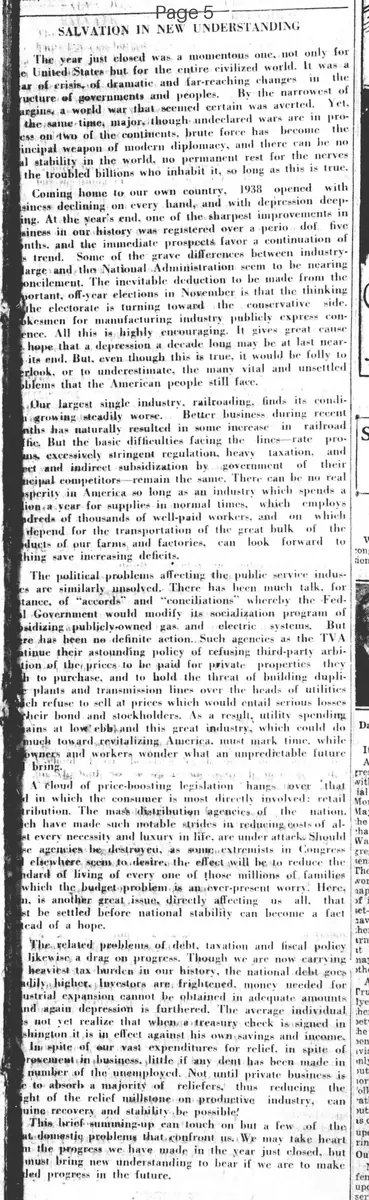
SALVATION IN NEW UNDERSTANDING
The year just closed was a momentous one, not only for the United States—but for the entire civilized world. It was a year of crisis, of dramatic and far-reaching changes in the structure of governments and peoples. By the narrowest of margins a world war that seemed certain was averted. Yet, at the same time, major though undeclared wars are in progress on two of the continents, brute force has become the principal weapon of modern diplomacy, and there can be no real stability in the world, no permanent rest for the nerves of the troubled billions who inhabit it, so long as this is true.
Coming home to our own country, 1938 opened with business declining on every hand, and with depression deepening. At the year's end, one of the sharpest improvements in business in our history was registered over a period of five months, and the immediate prospects favor a continuation of this trend. Some of the grave differences between big business and the National Administration seem to be nearing reconciliation. The inevitable deduction to be made from the important, off-year elections in November is that the thinking of the electorate is turning toward the conservative side. Spokesmen for manufacturing industry publicly express confidence. All this is highly encouraging. It gives great cause for hope that a depression a decade long may be at last nearing its end. But, even though this is true, it would be folly to overlook, or to underestimate, the many vital and unsettled problems that the American people still face.
Our largest single industry, railroading, finds its condition growing steadily worse. Better business during recent months has naturally resulted in some increase in railroad traffic. But the basic difficulties facing the lines—excessively stringent regulation, heavy taxation, and direct and indirect subsidization by government of their principal competitors—remain the same. There can be no real prosperity in America so long as an industry which spends a billion a year for supplies in normal times, which employs hundreds of thousands of well-paid workers, and on which the farmers, merchants, and factories depend for the transportation of the great bulk of the products of our farms and factories, can look forward to nothing save increasing deficits.
The political problems affecting the public service industries are similarly unsolved. There has been much talk, for instance, of "accords" and "conciliations" whereby the Federal Government would modify its socialization program of subsidizing publicly-owned gas and electric systems. But there has been no definite action. Such agencies as the TVA continue their astounding policy of refusing third-party arbitration of the prices to be paid for private properties they wish to purchase, and to hold the threat of building duplicate plants and transmission lines over the heads of utilities which refuse to sell at prices which would entail serious losses to their bond and stockholders. As a result, utility spending remains at low ebb and this great industry, which could do much toward revitalizing America, must mark time, while owners and workers wonder what an unpredictable future may bring.
A cloud of price-boosting legislation hangs over that field in which the consumer is most directly involved: retail distribution. The mass distribution agencies of the nation, which have made such notable strides in reducing costs of almost every necessity and luxury in life, are under attack. Should these agencies be destroyed, as some extremists in Congress and elsewhere seem to desire, the effect will be to reduce the standard of living of every one of those millions of families for which the budget problem is an ever-present worry. Here, then, is another great issue, directly affecting us all, that must be settled before national stability can become a fact instead of a hope.
The related problems of debt, taxation and fiscal policy likewise are a drag on progress. Though we are now carrying the heaviest tax-burden in our history, the national debt goes steadily higher. Investors are frightened, money needed for industrial expansion cannot be obtained in adequate amounts, and again depression is furthered. The average individual does not yet realize that whenever a treasury check is signed in Washington it is in effect against his own savings and income. In spite of our vast expenditures for relief, in spite of improvement in business, little if any dent has been made in the number of the unemployed. Not until private business is able to absorb a majority of reliefers, thus reducing the weight of the relief millstone on productive industry, can genuine recovery and stability be possible!
This brief summing-up can touch on but a few of the important domestic problems that confront us. We may take heart from the progress we have made in the year just closed, but we must bring new understanding to bear if we are to make needed progress in the future.
The year just closed was a momentous one, not only for the United States—but for the entire civilized world. It was a year of crisis, of dramatic and far-reaching changes in the structure of governments and peoples. By the narrowest of margins a world war that seemed certain was averted. Yet, at the same time, major though undeclared wars are in progress on two of the continents, brute force has become the principal weapon of modern diplomacy, and there can be no real stability in the world, no permanent rest for the nerves of the troubled billions who inhabit it, so long as this is true.
Coming home to our own country, 1938 opened with business declining on every hand, and with depression deepening. At the year's end, one of the sharpest improvements in business in our history was registered over a period of five months, and the immediate prospects favor a continuation of this trend. Some of the grave differences between big business and the National Administration seem to be nearing reconciliation. The inevitable deduction to be made from the important, off-year elections in November is that the thinking of the electorate is turning toward the conservative side. Spokesmen for manufacturing industry publicly express confidence. All this is highly encouraging. It gives great cause for hope that a depression a decade long may be at last nearing its end. But, even though this is true, it would be folly to overlook, or to underestimate, the many vital and unsettled problems that the American people still face.
Our largest single industry, railroading, finds its condition growing steadily worse. Better business during recent months has naturally resulted in some increase in railroad traffic. But the basic difficulties facing the lines—excessively stringent regulation, heavy taxation, and direct and indirect subsidization by government of their principal competitors—remain the same. There can be no real prosperity in America so long as an industry which spends a billion a year for supplies in normal times, which employs hundreds of thousands of well-paid workers, and on which the farmers, merchants, and factories depend for the transportation of the great bulk of the products of our farms and factories, can look forward to nothing save increasing deficits.
The political problems affecting the public service industries are similarly unsolved. There has been much talk, for instance, of "accords" and "conciliations" whereby the Federal Government would modify its socialization program of subsidizing publicly-owned gas and electric systems. But there has been no definite action. Such agencies as the TVA continue their astounding policy of refusing third-party arbitration of the prices to be paid for private properties they wish to purchase, and to hold the threat of building duplicate plants and transmission lines over the heads of utilities which refuse to sell at prices which would entail serious losses to their bond and stockholders. As a result, utility spending remains at low ebb and this great industry, which could do much toward revitalizing America, must mark time, while owners and workers wonder what an unpredictable future may bring.
A cloud of price-boosting legislation hangs over that field in which the consumer is most directly involved: retail distribution. The mass distribution agencies of the nation, which have made such notable strides in reducing costs of almost every necessity and luxury in life, are under attack. Should these agencies be destroyed, as some extremists in Congress and elsewhere seem to desire, the effect will be to reduce the standard of living of every one of those millions of families for which the budget problem is an ever-present worry. Here, then, is another great issue, directly affecting us all, that must be settled before national stability can become a fact instead of a hope.
The related problems of debt, taxation and fiscal policy likewise are a drag on progress. Though we are now carrying the heaviest tax-burden in our history, the national debt goes steadily higher. Investors are frightened, money needed for industrial expansion cannot be obtained in adequate amounts, and again depression is furthered. The average individual does not yet realize that whenever a treasury check is signed in Washington it is in effect against his own savings and income. In spite of our vast expenditures for relief, in spite of improvement in business, little if any dent has been made in the number of the unemployed. Not until private business is able to absorb a majority of reliefers, thus reducing the weight of the relief millstone on productive industry, can genuine recovery and stability be possible!
This brief summing-up can touch on but a few of the important domestic problems that confront us. We may take heart from the progress we have made in the year just closed, but we must bring new understanding to bear if we are to make needed progress in the future.
What sub-type of article is it?
Economic Policy
Taxation
Infrastructure
What keywords are associated?
1938 Review
Economic Recovery
Railroad Crisis
Utility Regulation
Taxation Burden
Fiscal Policy
Business Depression
What entities or persons were involved?
National Administration
Tva
Congress
Big Business
Editorial Details
Primary Topic
1938 Review Of Us Economic Recovery And Unresolved Domestic Challenges
Stance / Tone
Hopeful Yet Cautious About Progress
Key Figures
National Administration
Tva
Congress
Big Business
Key Arguments
World War Averted But Undeclared Wars Continue, Brute Force In Diplomacy Threatens Stability
Us Business Improved Sharply In Late 1938, Conservative Shift In Elections
Railroads Face Worsening Conditions Due To Regulation, Taxation, And Competition Subsidies
Public Utilities Hindered By Government Socialization Threats And Lack Of Arbitration
Retail Distribution Under Attack By Price Boosting Legislation, Risking Lower Living Standards
Heavy Taxes And Rising Debt Frighten Investors, Prolong Depression And Unemployment