Thank you for visiting SNEWPapers!
Sign up free
Letter to Editor
February 10, 1795
Gazette Of The United States And Daily Evening Advertiser
Philadelphia, Philadelphia County, Pennsylvania
What is this article about?
In Letter VIII, Germanicus argues against relying on political societies for societal improvement, asserting that freedoms of speech, publication, and assembly suffice for collaboration. He critiques societies for suppressing diverse opinions and quotes John Locke on the inevitability of popular resistance to oppressive government.
Clipping
OCR Quality
95%
Excellent
Full Text
From the American Daily Advertiser.
GERMANICUS,
LETTER VIII:
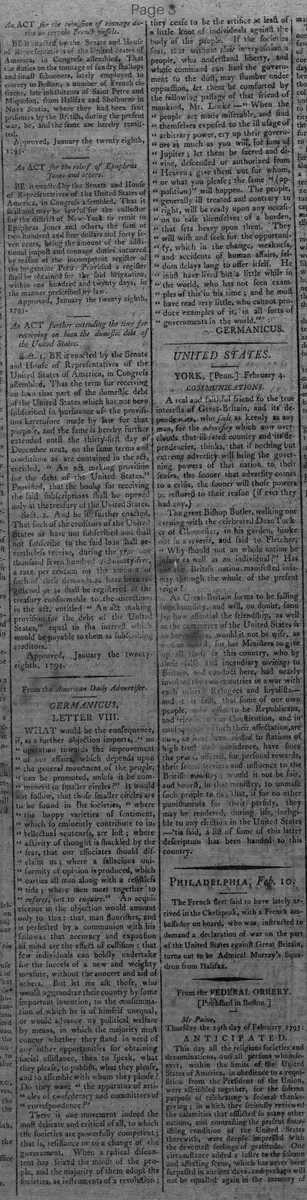
What would be the consequence, if, as a further objection imports, "no operation towards the improvement of our affairs, which depends upon the general movement of the people, can be promoted, unless it be commenced in smaller circles?" It would not follow, that those smaller circles are to be found in the societies, "where the happy varieties of sentiment, which so eminently contribute to intellectual acuteness, are lost; where activity of thought is shackled by the fear, that our associates should disclaim us; where a fallacious uniformity of opinion is produced, which carries all men along with a resistless tide; where men meet together to enforce, not to enquire." An acquiescence in the objection would amount only to this: that man flourishes, and is perfected by a communion with his fellows: that accuracy and expansion of mind are the effect of collision: that few individuals can boldly undertake for the success of a new and weighty measure, without the concert and aid of others. But let me ask those, who would aggrandize their country by some important invention, to the consummation of which he is of himself unequal, or would advance its political welfare by means, in which the majority must concur whether they stand in need of any other opportunities for obtaining social assistance, than to speak, what they please, to publish, what they please, and to assemble with whom they please?
Do they want "the apparatus of articles of confederacy and committees of correspondence?"
There is one movement indeed the most delicate and critical of all, to which the societies are powerfully competent; that is, resistance to a change of the government. When a radical discontent has seized the minds of the people, and the majority of them adopt the societies, as instruments of a revolution;
they cease to be the artificers at least of a little knot of individuals against the body of the people. If the societies fear, that without their interposition a people, who understand liberty, and whose command can hurl the government to the dust, may slumber under oppression, let them be comforted by the following passage of that friend of mankind, Mr. Locke. "When the people are made miserable, and find themselves exposed to the ill usage of arbitrary power, cry up their governors as much as you will, for sons of Jupiter; let them be sacred and divine, descended or authorized from Heaven; give them out for whom, or what you please; the same opposition will happen. The people, generally ill treated and contrary to right, will be ready upon any occasion to ease themselves of a burden, that sits heavy upon them. They will wish and seek for the opportunity, which in the change, weakness, and accidents of human affairs, seldom delays long to offer itself." He must have lived but a little while in the world, who has not seen examples of this in his time; and he must have read very little, who cannot produce examples of it, in all sorts of governments in the world.
GERMANICUS.
GERMANICUS,
LETTER VIII:
What would be the consequence, if, as a further objection imports, "no operation towards the improvement of our affairs, which depends upon the general movement of the people, can be promoted, unless it be commenced in smaller circles?" It would not follow, that those smaller circles are to be found in the societies, "where the happy varieties of sentiment, which so eminently contribute to intellectual acuteness, are lost; where activity of thought is shackled by the fear, that our associates should disclaim us; where a fallacious uniformity of opinion is produced, which carries all men along with a resistless tide; where men meet together to enforce, not to enquire." An acquiescence in the objection would amount only to this: that man flourishes, and is perfected by a communion with his fellows: that accuracy and expansion of mind are the effect of collision: that few individuals can boldly undertake for the success of a new and weighty measure, without the concert and aid of others. But let me ask those, who would aggrandize their country by some important invention, to the consummation of which he is of himself unequal, or would advance its political welfare by means, in which the majority must concur whether they stand in need of any other opportunities for obtaining social assistance, than to speak, what they please, to publish, what they please, and to assemble with whom they please?
Do they want "the apparatus of articles of confederacy and committees of correspondence?"
There is one movement indeed the most delicate and critical of all, to which the societies are powerfully competent; that is, resistance to a change of the government. When a radical discontent has seized the minds of the people, and the majority of them adopt the societies, as instruments of a revolution;
they cease to be the artificers at least of a little knot of individuals against the body of the people. If the societies fear, that without their interposition a people, who understand liberty, and whose command can hurl the government to the dust, may slumber under oppression, let them be comforted by the following passage of that friend of mankind, Mr. Locke. "When the people are made miserable, and find themselves exposed to the ill usage of arbitrary power, cry up their governors as much as you will, for sons of Jupiter; let them be sacred and divine, descended or authorized from Heaven; give them out for whom, or what you please; the same opposition will happen. The people, generally ill treated and contrary to right, will be ready upon any occasion to ease themselves of a burden, that sits heavy upon them. They will wish and seek for the opportunity, which in the change, weakness, and accidents of human affairs, seldom delays long to offer itself." He must have lived but a little while in the world, who has not seen examples of this in his time; and he must have read very little, who cannot produce examples of it, in all sorts of governments in the world.
GERMANICUS.
What sub-type of article is it?
Philosophical
Persuasive
Political
What themes does it cover?
Politics
Constitutional Rights
Press Freedom
What keywords are associated?
Political Societies
Free Speech
Assembly Rights
John Locke
Government Resistance
Liberty
Revolution
What entities or persons were involved?
Germanicus
Letter to Editor Details
Author
Germanicus
Main Argument
political and intellectual improvement does not require organized societies, which stifle diverse opinions; instead, freedoms of speech, publication, and assembly enable collaboration, and people will naturally resist oppression as per locke's observations.
Notable Details
Quotes John Locke On Popular Resistance To Arbitrary Power
Critiques Societies For Enforcing Uniformity Over Inquiry