Thank you for visiting SNEWPapers!
Sign up free
Letter to Editor
June 29, 1782
The New Hampshire Gazette And General Advertiser
Portsmouth, Exeter, Rockingham County, New Hampshire
What is this article about?
A citizen questions a General Court act confiscating estates of British absentees, which grants widows one-third but provides nothing for fatherless children, deeming it unjust and contrary to moral laws protecting the innocent from parental crimes.
Clipping
OCR Quality
98%
Excellent
Full Text
Messieurs Printers,
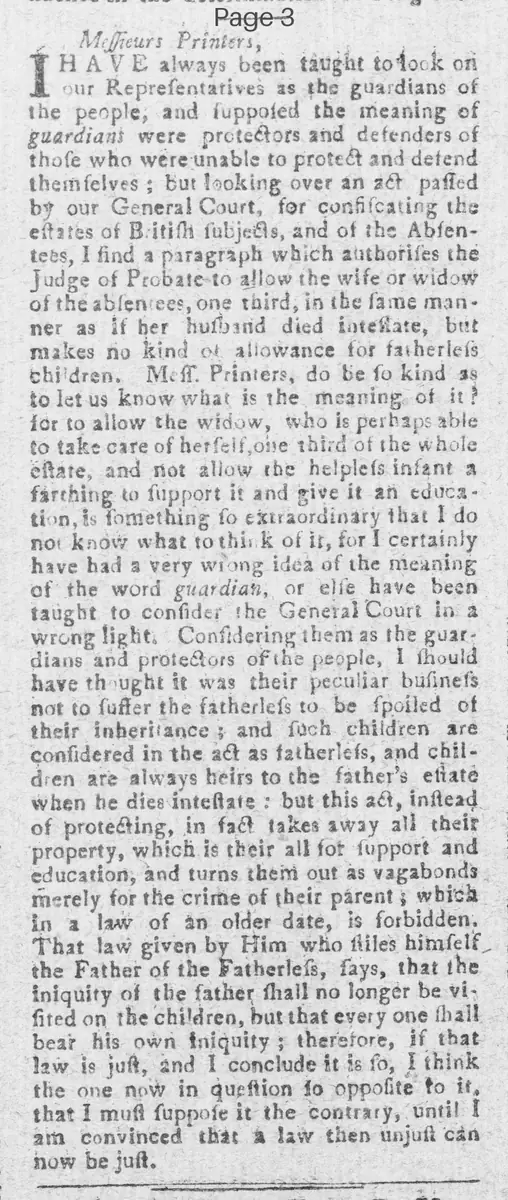
I HAVE always been taught to look on our Representatives as the guardians of the people, and supposed the meaning of guardians were protectors and defenders of those who were unable to protect and defend themselves: but looking over an act passed by our General Court, for confiscating the estates of British subjects, and of the Absentees, I find a paragraph which authorises the Judge of Probate to allow the wife or widow of the absentees, one third, in the same manner as if her husband died intestate, but makes no kind of allowance for fatherless children. Mess. Printers, do be so kind as to let us know what is the meaning of it? for to allow the widow, who is perhaps able to take care of herself, one third of the whole estate, and not allow the helpless infant a farthing to support it and give it an education, is something so extraordinary that I do not know what to think of it, for I certainly have had a very wrong idea of the meaning of the word guardian, or else have been taught to consider the General Court in a wrong light. Considering them as the guardians and protectors of the people, I should have thought it was their peculiar business not to suffer the fatherless to be spoiled of their inheritance: and such children are considered in the act as fatherless, and children are always heirs to the father's estate when he dies intestate: but this act, instead of protecting, in fact takes away all their property, which is their all for support and education, and turns them out as vagabonds merely for the crime of their parent; which in a law of an older date, is forbidden. That law given by Him who styles himself the Father of the Fatherless, says, that the iniquity of the father shall no longer be visited on the children, but that every one shall bear his own iniquity: therefore, if that law is just, and I conclude it is so, I think the one now in question so opposite to it, that I must suppose it the contrary, until I am convinced that a law then unjust can now be just.
I HAVE always been taught to look on our Representatives as the guardians of the people, and supposed the meaning of guardians were protectors and defenders of those who were unable to protect and defend themselves: but looking over an act passed by our General Court, for confiscating the estates of British subjects, and of the Absentees, I find a paragraph which authorises the Judge of Probate to allow the wife or widow of the absentees, one third, in the same manner as if her husband died intestate, but makes no kind of allowance for fatherless children. Mess. Printers, do be so kind as to let us know what is the meaning of it? for to allow the widow, who is perhaps able to take care of herself, one third of the whole estate, and not allow the helpless infant a farthing to support it and give it an education, is something so extraordinary that I do not know what to think of it, for I certainly have had a very wrong idea of the meaning of the word guardian, or else have been taught to consider the General Court in a wrong light. Considering them as the guardians and protectors of the people, I should have thought it was their peculiar business not to suffer the fatherless to be spoiled of their inheritance: and such children are considered in the act as fatherless, and children are always heirs to the father's estate when he dies intestate: but this act, instead of protecting, in fact takes away all their property, which is their all for support and education, and turns them out as vagabonds merely for the crime of their parent; which in a law of an older date, is forbidden. That law given by Him who styles himself the Father of the Fatherless, says, that the iniquity of the father shall no longer be visited on the children, but that every one shall bear his own iniquity: therefore, if that law is just, and I conclude it is so, I think the one now in question so opposite to it, that I must suppose it the contrary, until I am convinced that a law then unjust can now be just.
What sub-type of article is it?
Persuasive
Ethical Moral
Political
What themes does it cover?
Politics
Morality
Constitutional Rights
What keywords are associated?
Confiscation Act
Absentee Estates
Fatherless Children
Inheritance Rights
General Court
Guardians Of People
What entities or persons were involved?
Messieurs Printers
Letter to Editor Details
Recipient
Messieurs Printers
Main Argument
the general court act confiscating absentee estates unjustly allows widows one-third while denying fatherless children any inheritance, violating principles of guardianship and moral laws against punishing children for parents' crimes.
Notable Details
References Biblical Law: 'The Iniquity Of The Father Shall No Longer Be Visited On The Children'
Critiques Representatives As Failing Guardians Of The People, Especially The Fatherless