Thank you for visiting SNEWPapers!
Sign up free
Story
February 4, 1887
The Lusk Herald
Lusk, Niobrara County, Wyoming
What is this article about?
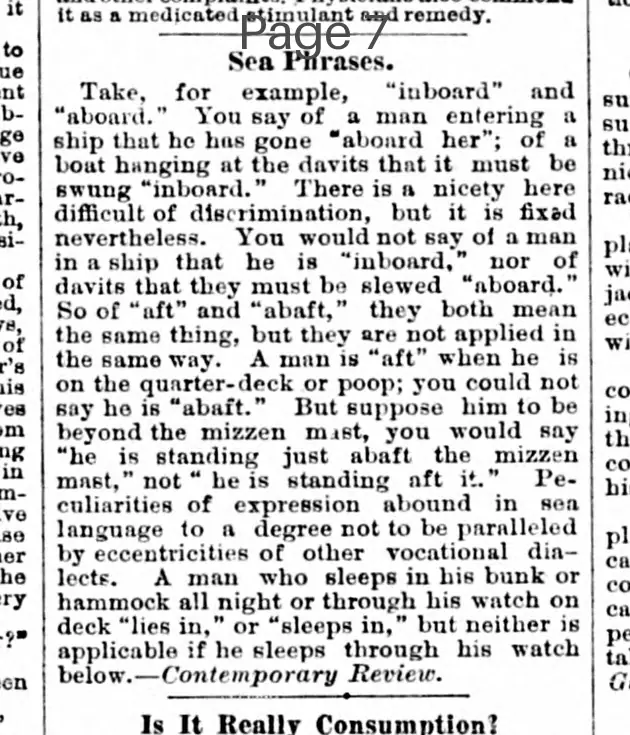
An article explaining nautical terminology distinctions, such as 'inboard' vs. 'aboard', 'aft' vs. 'abaft', and 'lies in' for sleeping through a watch, highlighting peculiarities of sea language from the Contemporary Review.
Clipping
OCR Quality
98%
Excellent
Full Text
Sea Phrases.
Take, for example, "inboard" and "aboard." You say of a man entering a ship that he has gone "aboard her": of a boat hanging at the davits that it must be swung "inboard." There is a nicety here difficult of discrimination, but it is fixed nevertheless. You would not say of a man in a ship that he is "inboard," nor of davits that they must be slewed "aboard."
So of "aft" and "abaft," they both mean the same thing, but they are not applied in the same way. A man is "aft" when he is on the quarter-deck or poop; you could not say he is "abaft." But suppose him to be beyond the mizzen mast, you would say "he is standing just abaft the mizzen mast," not "he is standing aft it." Peculiarities of expression abound in sea language to a degree not to be paralleled by eccentricities of other vocational dialects.
A man who sleeps in his bunk or hammock all night or through his watch on deck "lies in," or "sleeps in," but neither is applicable if he sleeps through his watch below.—Contemporary Review.
Take, for example, "inboard" and "aboard." You say of a man entering a ship that he has gone "aboard her": of a boat hanging at the davits that it must be swung "inboard." There is a nicety here difficult of discrimination, but it is fixed nevertheless. You would not say of a man in a ship that he is "inboard," nor of davits that they must be slewed "aboard."
So of "aft" and "abaft," they both mean the same thing, but they are not applied in the same way. A man is "aft" when he is on the quarter-deck or poop; you could not say he is "abaft." But suppose him to be beyond the mizzen mast, you would say "he is standing just abaft the mizzen mast," not "he is standing aft it." Peculiarities of expression abound in sea language to a degree not to be paralleled by eccentricities of other vocational dialects.
A man who sleeps in his bunk or hammock all night or through his watch on deck "lies in," or "sleeps in," but neither is applicable if he sleeps through his watch below.—Contemporary Review.
What sub-type of article is it?
Curiosity
What keywords are associated?
Sea Phrases
Nautical Terms
Inboard Aboard
Aft Abaft
Sleeps In
Where did it happen?
On Ships
Story Details
Location
On Ships
Story Details
Explanations of precise usages in sea phrases: 'aboard' for entering a ship, 'inboard' for swinging a boat; 'aft' for quarter-deck position, 'abaft' for behind the mizzen mast; 'lies in' or 'sleeps in' for sleeping through watch on deck.