Thank you for visiting SNEWPapers!
Sign up free
The Virginia Gazette
Richmond, Williamsburg, Richmond County, Virginia
What is this article about?
William Chandler, a clerk, fakes a robbery of 900l in bank notes near Hare Hatch in 1748 to sue the hundred, wins a verdict but loses on appeal. His scheme unravels, leading to conviction for perjury at Reading Assizes in 1751 and sentence to 7 years transportation.
Merged-components note: This is a continuation of the same story about William Chandler's perjury conviction, flowing directly from page 1 to page 2.
Clippings
1 of 2
OCR Quality
Full Text
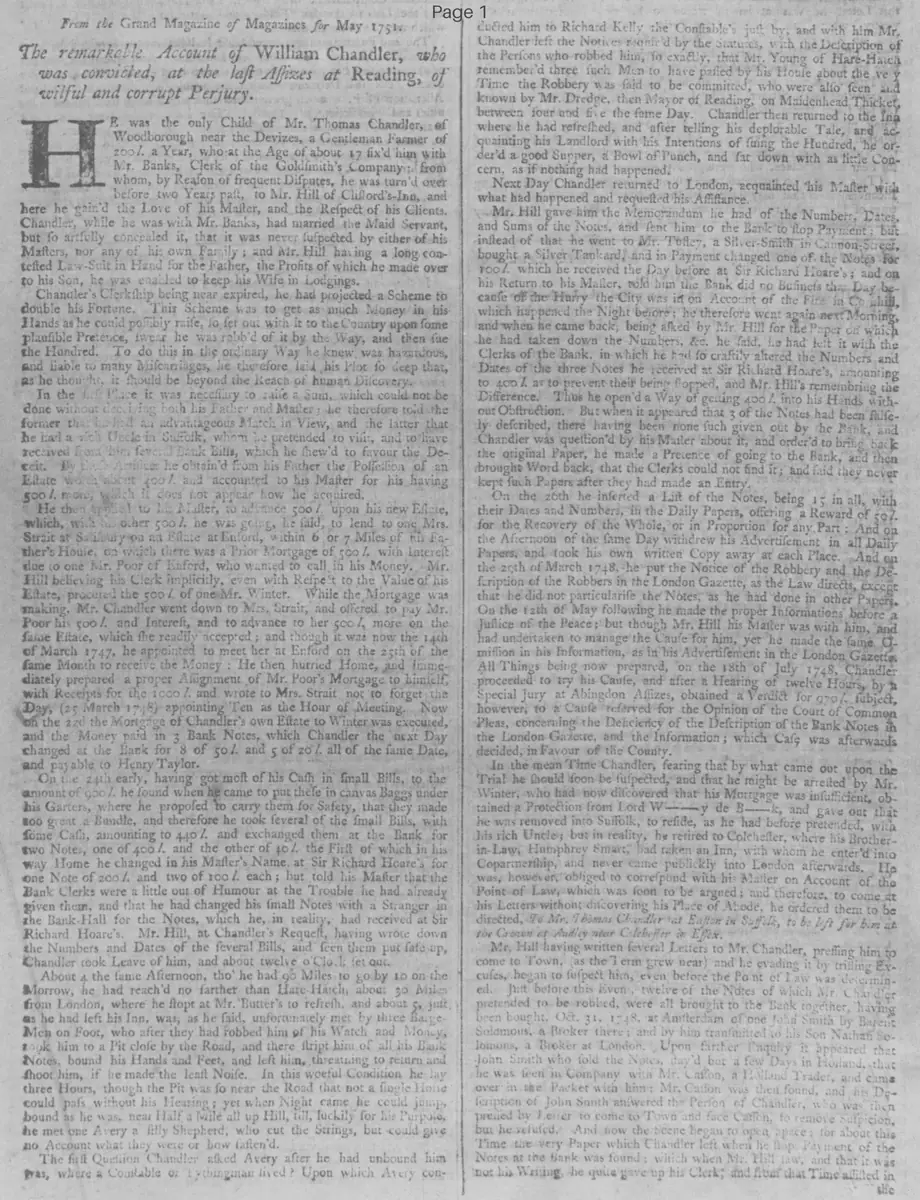
The remarkable Account of William Chandler, who was convicted, at the last Assizes at Reading, of wilful and corrupt Perjury.
He was the only Child of Mr. Thomas Chandler, of Woodborough near the Devizes, a Gentleman Farmer of 200l. a Year, who at the Age of about 17 fix'd him with Mr. Banks, Clerk of the Goldsmith's Company; from whom, by Reason of frequent Disputes, he was turn'd over before two Years past, to Mr. Hill of Clifford's-Inn, and here he gain'd the Love of his Master, and the Respect of his Clients.
Chandler, while he was with Mr. Banks, had married the Maid Servant, but so artfully concealed it, that it was never suspected by either of his Masters, nor any of his own Family; and Mr. Hill having a long contested Law-Suit in Hand for the Father, the Profits of which he made over to his Son, he was enabled to keep his Wife in Lodgings.
Chandler's Clerkship being near expired, he had projected a Scheme to double his Fortune. This Scheme was to get as much Money in his Hands as he could possibly raise, to set out with it to the Country upon some plausible Pretence, swear he was robb'd of it by the Way, and then sue the Hundred. To do this in the ordinary Way he knew was hazardous, and liable to many Miscarriages, he therefore laid his Plot so deep that, as he thought, it should be beyond the Reach of human Discovery.
In the first Place it was necessary to raise a Sum, which could not be done without deceiving both his Father and Master; he therefore told the former that he had an advantageous Match in View, and the latter that he had a rich Uncle in Suffolk, whom he pretended to visit, and to have received from him several Bank Bills, which he shew'd to favour the Deceit. In a little while he obtain'd from his Father the Possession of an Estate worth 200l. and accounted to his Master for his having 500l. more, which it does not appear how he acquired.
He then applied to his Master, to advance 200l. upon his new Estate, which, with the other 500l. he was going, he said, to lend to one Mrs. Strait at Salisbury on an Estate at Enford, within 6 or 7 Miles of his Father's House, on which there was a prior Mortgage of 200l. with Interest due to one Mr. Poor of Enford, who wanted to call in his Money. Mr. Hill believing his Clerk implicitly, even with Respect to the Value of his Estate, procured the 200l. of one Mr. Winter. While the Mortgage was making, Mr. Chandler went down to Mrs. Strait, and offered to pay Mr. Poor his 200l. and Interest, and to advance to her 500l. more on the same Estate, which he readily accepted; and though it was now the 14th of March 1747, he appointed to meet her at Enford on the 25th of the same Month to receive the Money: He then hurried Home, and immediately prepared a proper Assignment of Mr. Poor's Mortgage to himself, with Receipts for the 200l. and wrote to Mrs. Strait not to forget the Day, (25 March 1747-8) appointing Ten as the Hour of Meeting. Now on the 22d the Mortgage of Chandler's own Estate to Winter was executed, and the Money paid in 3 Bank Notes, which Chandler the next Day changed at the Bank for 8 of 50l. and 5 of 20l. all of the same Date, and payable to Henry Taylor.
On the 24th early, having got most of his Cash in small Bills, to the amount of 900l. he found when he came to put these in canvas Bags under his Garter, where he proposed to carry them for Safety, that they made too great a Bundle, and therefore he took several of the small Bills, with some Cash, amounting to 440l. and exchanged them at the Bank for two Notes, one of 400l. and the other of 40l. the First of which in his way Home he changed in his Master's Name, at Sir Richard Hoare's for one Note of 200l. and two of 100l. each; but told his Master that the Bank Clerks were a little out of Humour at the Trouble he had already given them, and that he had changed his small Notes with a Stranger in the Bank-Hall for the Notes, which he, in reality, had received at Sir Richard Hoare's. Mr. Hill, at Chandler's Request, having wrote down the Numbers and Dates of the several Bills, and seen them put safe up, Chandler took Leave of him, and about twelve o'Clock set out.
About 4 the same Afternoon, tho' he had 60 Miles to go by 10 on the Morrow, he had reach'd no farther than Hare Hatch, about 30 Miles from London, where he stopt at Mr. Butter's to refresh, and about 5, just as he had left his Inn, was, as he said, unfortunately met by three Stage Men on Foot, who after they had robbed him of his Watch and Money, took him to a Pit close by the Road, and there stript him of all his Bank Notes, bound his Hands and Feet, and left him, threatning to return and shoot him, if he made the least Noise. In this woeful Condition he lay three Hours, though the Pit was so near the Road that not a single Line could pass without his Hearing; yet when Night came he could jump bound as he was, near half a Mile all up Hill, till, luckily for his Purpose, he met one Avery a silly Shepherd, who cut the Strings, but could give no Account what they were or how fasten'd.
The first Question Chandler ask'd Avery after he had unbound him was, where a Constable or Headborough lived? Upon which Avery conducted him to Richard Kelly the Constable's just by, and with him Mr. Chandler left the Notices required by the Statutes, with the Description of the Persons who robbed him, so exactly, that Mr. Young of Hare-Hatch remember'd three such Men to have passed by his House about the very Time the Robbery was said to be committed, who were also seen and known by Mr. Dredge, then Mayor of Reading, on Maidenhead Thicket, between four and five the same Day. Chandler then returned to the Inn where he had refreshed, and after telling his deplorable Tale, and acquainting his Landlord with his Intentions of suing the Hundred, he order'd a good Supper, a Bowl of Punch, and sat down with as little Concern, as if nothing had happened.
Next Day Chandler returned to London, acquainted his Master with what had happened and requested his Assistance. Mr. Hill gave him the Memorandum he had of the Numbers, Dates, and Sums of the Notes, and sent him to the Bank to stop Payment; but instead of that he went to Mr. Tosler, a Silver-Smith in Cannon-Street, bought a Silver Tankard, and in Payment changed one of the Notes for 100l. which he received the Day before at Sir Richard Hoare's; and on his Return to his Master, told him the Bank did no Business that Day because of the Hurry the City was in on Account of the Fire in Cornhill, which happened the Night before; he therefore went again next Morning, and when he came back, being asked by Mr. Hill for the Paper on which he had taken down the Numbers, &c. he said, he had left it with the Clerks of the Bank, in which he had so craftily altered the Numbers and Dates of the three Notes he received at Sir Richard Hoare's, amounting to 400l. as to prevent their being stopt, and Mr. Hill's remembering the Difference. Thus he open'd a Way of getting 400l. into his Hands without Obstruction. But when it appeared that 3 of the Notes had been slightly described, there having been none such given out by the Bank, and Chandler was question'd by his Master about it, and order'd to bring back the original Paper, he made a Pretence of going to the Bank, and then brought Word back, that the Clerks could not find it; and said they never kept such Papers after they had made an Entry.
On the 25th he inserted a List of the Notes, being 13 in all, with their Dates and Numbers, in the Daily Papers, offering a Reward of 20l. for the Recovery of the Whole, or in Proportion for any Part: And on the Afternoon of the same Day withdrew his Advertisement in all Daily Papers, and took his own written Copy away at each Place. And on the 28th of March 1748, he put the Notice of the Robbery and the Description of the Robbers in the London Gazette, as the Law directs, except that he did not particularize the Notes, as he had done in other Papers.
On the 12th of May following he made the proper Informations before a Justice of the Peace; but though Mr. Hill his Master was with him, and had undertaken to manage the Cause for him, yet he made the same Omission in his Information, as in his Advertisement in the London Gazette. All Things being now prepared, on the 18th of July 1748, Chandler proceeded to try his Cause, and after a Hearing of twelve Hours, by a Special Jury at Abingdon Assizes, obtained a Verdict for 970l. subject, however, to a Cause reserved for the Opinion of the Court of Common Pleas, concerning the Deficiency of the Description of the Bank Notes in the London Gazette, and the Information; which Case was afterwards decided, in Favour of the County.
In the mean Time Chandler, fearing that by what came out upon the Trial he should soon be suspected, and that he might be arrested by Mr. Winter, who had now discovered that his Mortgage was insufficient, obtained a Protection from Lord W--y de B--k, and gave out that he was removed into Suffolk, to reside, as he had before pretended, with his rich Uncle; but in reality, he retired to Colchester, where his Brother-in-Law, Humphrey Smart, had taken an Inn, with whom he enter'd into Copartnership, and never came publickly into London afterwards. He was, however, obliged to correspond with his Master on Account of the Point of Law, which was soon to be argued; and therefore, to come at his Letters without discovering his Place of Abode, he ordered them to be directed, To Mr. Thomas Chandler at Eufton in Suffolk, to be left for him at the Crown at Audley near Colchester in Essex.
Mr. Hill having written Several Letters to Mr. Chandler, pressing him to come to Town, as the Term grew near, and he evading it by trifling Excuses, began to suspect him, even before the Point of Law was determined. Just before this Event, twelve of the Notes of which Mr. Chandler pretended to be robbed, were all brought to the Bank together, having been bought Oct. 31. 1748. at Amsterdam of one John Smith by Bagent Solomons, a Broker there; and by him transmitted to his Son Nathan Solomons, a Broker at London. Upon farther Inquiry it appeared that John Smith who sold the Notes, stay'd but a few Days in Holland, that he was seen in Company with Mr. Carson, a Holland Trader, and came over in the Packet with him: Mr. Carson was then found, and his Description of John Smith answered the Person of Chandler, who was then pressed by Letter to come to Town and face John, to remove Suspicion, but he refused. And now the Scene began to open apace; for about this Time the very Paper which Chandler left when he stopt Payment of the Notes at the Bank was found: which when Mr. Hill saw, and that it was not his Writing, he quite gave up his Clerk; and from that Time assisted in bringing him to Justice.
the Prosecution. By Means of the Bank Books, they traced every Circumstance that has been related of his taking out the 400 l. Note, afterwards changing it at Sir Richard Hoare's for three lesser Notes, his passing those Notes, and by whom received; and even his buying the Tankard of Tussey; which Tankard was afterwards produced in Evidence against him.
All that now remained was to come at his Person; and with this View Mr. Wise, Mr. Hill, and Mr. Caton, about Mid-Summer 1749, set out for Colchester, from thence went to the Crown at Audley, and there enquiring for Easton were directed first to one Place and then to another of that Name; and after a fruitless Journey of 120 Miles, they returned to the very Inn then kept by Chandler at Colchester, and departed for London without gaining any Intelligence.
Chandler, who himself saw them at his House, immediately sold his Goods and took a small Inn at Coventry, where, though 120 Miles from Colchester and near 90 Miles from London, he was still apprehensive of being arrested by Mr. Winter; and therefore, he sent a Draught to Mr. Gauntlet, a Linen-Draper of his Acquaintance for 150 l. to be paid to Mr. Hill, and by him to Mr. Winter. This Draught he procured at Northampton, and there put it into the Post. By the Post-Mark of this Letter he was at length traced to his new Habitation at Coventry, where, an Indictment for Perjury having been found against him, he was apprehended by a Judge's Warrant, and detained in Gaol there. till by a Habeas Corpus he was removed to Reading, in order to take his Trial at Abingdon Assizes on the 22d of July 1750. But though the Prosecutors were ready with all their Witnesses, at a vast Expence, yet he traversed the Indictment, as by Law he might, and put off his Trial to the last Lent Assizes held at Reading; where the Facts already related being proved, he was sentenced to stand on the Pillory the then next Market Day, and to be transported for 7 Years. But the former Part of this Sentence was changed by the Judge into three Months Imprisonment, for Fear the Populace, who were greatly enraged, should kill him.
[This Prosecution produced two Acts of Parliament, one for remedying Inconveniences that may happen by Proceedings in Actions on the Statutes of Hue and Cry, and the other to render Prosecutions for Perjury and Subornation of Perjury more easy and effectual.]
What sub-type of article is it?
What themes does it cover?
What keywords are associated?
What entities or persons were involved?
Where did it happen?
Story Details
Key Persons
Location
London, Hare Hatch, Enford, Colchester, Coventry, England
Event Date
1747 1751
Story Details
William Chandler devises an elaborate scheme to fake a robbery of 900l in bank notes to sue the hundred, deceives his master and father to raise funds, wins a 970l verdict at Abingdon Assizes in 1748 but loses on appeal; his fraud is exposed through traced notes, leading to perjury conviction at Reading Assizes in 1751 and sentence to 7 years transportation.