Thank you for visiting SNEWPapers!
Sign up free
Virginia Argus
Richmond, Virginia
What is this article about?
In New York, Islunael Fraser and George Vanderpool were tried for arson after setting fire to a building at Washington and Liberty streets on August 26. Accomplices Kingston Pease and Richard Perselles testified for the prosecution. The jury found them guilty after a trial presided by Justices Platt and Mayor Radcliff.
Clipping
OCR Quality
Full Text
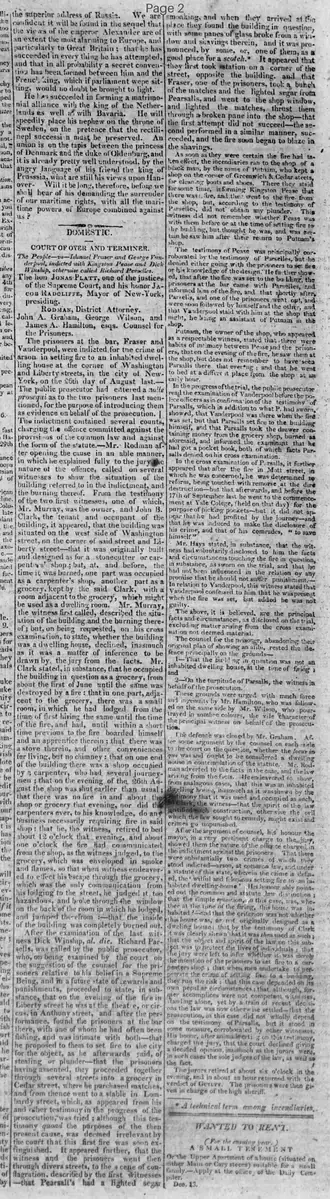
COURT OF OYER AND TERMINER.
The People—vs—Islunael Fraser and George Vanderpool, indicted with Kingston Pease and Dick Winship, otherwise called Richard Perselles.
The hon. Jonas Platt, one of the justices of the Supreme Court, and his honor Jacob Radcliff, Mayor of New-York, presiding.
Rodman, District Attorney.
John A. Graham, George Wilson, and James A. Hamilton, esqs. Counsel for the Prisoners.
The prisoners at the bar, Fraser and Vanderpool, were indicted for the crime of arson, in setting fire to an inhabited dwelling house at the corner of Washington and Liberty streets, in the city of New-York, on the 26th day of August last.
The public prosecutor had entered a nolle prosequi as to the two prisoners last mentioned, for the purpose of introducing them as evidence on behalf of the prosecution.
The indictment contained several counts, charging the offence committed against the provisions of the common law and against the form of the statute.—Mr. Rodman after opening the cause in an able manner, in which he explained fully to the jury the nature of the offence, called on several witnesses to show the situation of the building referred to in the indictment, and the burning thereof. From the testimony of the two first witnesses, one of which, Mr. Murray, was the owner, and John B. Clark, the tenant and occupant of the building, it appeared, that the building was situated on the west side of Washington street, on the corner of said street and Liberty street—that it was originally built and designed as for a stonecutter or carpenters' shop.; but, at, and before, the time it was burned, one part was occupied as a carpenter's shop, another part as a grocery, kept by the said Clark, with a room adjacent to the grocery, which might be used as a dwelling room. Mr. Murray, the witness first called, described the situation of the building and the burning thereof; but, on being requested, on his cross examination, to state, whether the building was a dwelling house, declined, inasmuch as it was a matter of inference to be drawn by the jury from the facts. Mr. Clark stated, in substance, that he occupied the building in question as a grocery, from about the first of June until the same was destroyed by a fire: that in one part, adjacent to the grocery, there was a small room, in which he had lodged from the time of first hiring the same until the time of the fire, and had, until within a short time previous to the fire boarded himself and an apprentice therein; that there was a stove therein, and other conveniences for living, but no chimney: that on one end of the building there was a shop occupied by a carpenter, who had several journeymen; that on the evening of the 26th August the shop was shut earlier than usual: that there was no fire in and about the shop or grocery that evening, nor did the carpenters ever, to his knowledge, do any business necessarily requiring fire in said shop: that he, the witness, retired to bed about 12 o'clock that evening, and about one o'clock the fire had communicated from the shop, as the witness judged, to the grocery, which was enveloped in smoke and flames, so that when witness endeavored to effect his escape through the grocery, which was the only communication from his lodging to the street, he judged it too hazardous, and broke through the window on the back of the room in which he lodged, and jumped therefrom: that the inside of the building was completely burned out.
After the examination of the last witness Dick Winship, al. die. Richard Parselles, was called by the public prosecutor, who, on being examined by the court on the suggestion of the counsel for the prisoners relative to his belief in a Supreme Being, and in a future state of rewards and punishments, proceeded to state, in substance, that on the evening of the fire in Liberty street he was at the theatre, or circus, in Anthony street, and after the performance, found the prisoners at the bar there, with one of whom he had often been fishing, and was intimate with both—that he proposed to them to set fire to the city for the object, as he afterwards said, of stealing or plunder—that the prisoners having assented, they proceeded together through several streets into a grocery in Cedar street, where he purchased matches, and from thence went to a stable in Lombardy street, which, as appeared from his and her testimony in the progress of the prosecution, was tried; although this testimony quoad the purposes of the then present cause, was deemed irrelevant by the court that this first fire was soon extinguished. it appeared further, that the witness and the prisoners went then through divers streets, to the scene of conflagration, described by the first witnesses—that Parselles had a lighted segar smoking, and when they arrived at the place they found the building in question, with some panes of glass broke from a window and shavings therein, and it was pronounced, by some, or, one of them, as a good place for a scotch.* It appeared that they first took station on a corner of the street, opposite the building. and that Fraser, one of the prisoners, took a bunch of the matches and the lighted segar from Parselles. and went to the shop window, and lighted the matches, thrust them through a broken pane into the shop—that the first attempt did not succeed the second performed in a similar manner, succeeded, and the fire soon began to blaze in the shavings.
As soon as they were certain the fire had taken effect, the incendiaries ran to the shop of a black man, by the name of Putnam, who kept a shop on the corner of Greenwich & Cedar streets, for cleaning boots and shoes. There they staid for some time, informing Kingston Pease that there was a fire, and then went to the fire. from the shop, but, according to the testimony of Parselles, did not obtain any plunder. This witness did not remember whether Pease was with them before or at the time of setting fire to the building, but thought he was, and was certain he saw him after their return to Putnam's shop.
The testimony of Pease was principally corroborated by the testimony of Parselles, but he denied either going with the prisoners to set fire or his knowledge of the design. He further showed, that after the fire was set to the building, the prisoners at the bar came with Parselles, and informed him of the fire, and that shortly after. Parselles, and one of the prisoners went out, and were soon followed by himself and the other, and that Vanderpool staid with him at the shop that night, he being an assistant of Putnam in the shop.
Putnam, the owner of the shop, who appeared as a respectable witness, stated that there were habits of intimacy between Pease and the prisoners, that on the evening of the fire, he saw them at the shop, but does not remember to have seen Parselles there that evening; and that he went to bed at a different place from the shop at an early hour.
In the progress of the trial, the public prosecutor read the examination of Vanderpool before the police officers as in confirmation of the testimony of Parselles, which in addition to what P. had sworn, showed, that Vanderpool was there when the fire was set, but that Parselles set fire to the building himself, and that Parselles took the drawer containing money from the grocery shop, burned as aforesaid, and informed the examinant that he had got a pocket book, both of which acts Parselles denied on his cross examination.
In the cross examination of Parselles, it further appeared that after the fire in Mott street, in which he was concerned, he was determined to reform, being touched with remorse at the dire destruction—but that afterwards, and before the 17th of September last he went to the commencement at Yale College, (held on that day) for the purpose of picking pockets—but it did not appear that he had profited by the journey—and that he was induced to make the disclosure of his crime, and that of his comrades, "to save himself."
Mr. Hays stated, in substance, that the witness had voluntarily disclosed to him the facts and circumstances touching the fire in question, in substance, as sworn on the trial, and that he had not been influenced in the relation by any promise that he should not suffer punishment.—In relation to Vanderpool, this witness stated that Vanderpool confessed to him that he was present when the fire was set, but added he was not guilty.
The above, it is believed, are the principal facts and circumstances, as disclosed on the trial, excluding matter arising from the cross examination not deemed material.
The counsel for the prisoner, abandoning their original plan of showing an alibi, rested the defence principally on the grounds—
1—That the building in question was not an inhabited dwelling house, at the time of firing; and
2—On the turpitude of Parselles, the witness in behalf of the prosecution.
These grounds were urged with much force and ingenuity by Mr. Hamilton, who was followed on the same side by Mr. Wilson, who portrayed in sombre colours, the vile character of the principal witness on behalf of the prosecution.
The defence was closed by Mr. Graham. After some argument by the counsel on each side to the court on the question, whether the locus in quo was and ought to be considered a dwelling house in contemplation of the statute. Mr. Rodman adverted to the facts in the case, and the law arising from the facts. He endeavored to show, from analogous cases, that this was an inhabited dwelling house, inasmuch as it was shewn by the testimony that it was used and occupied as such, Clark. the witness—that the spirit of the law justified such construction, otherwise the evil which the law sought to remedy, might exist and crimes go unpunished.
After the argument of counsel, his honour the mayor, in a very pertinent charge to the jury, showed them the nature of the offence charged in the indictment against the prisoners That there were substantially two crimes of which they stood indicted—arson, at common law, and under a statute of this state, wherein the crime is defined, the 'wilful and felonious setting fire to an inhabited dwelling-house' His honour ably pointed out the common and statute law distinction: that the simple question, in this case, was, whether at the time of the firing, this house was inhabited? and that the criterion was not whether this house was, or not originally designed as a dwelling house; that by the testimony of Clark it was clearly shewn' that it was then used as such; that the object and spirit of the law on this subject was to protect the lives of individuals; that the jury were left to infer whether it, was merely the intention of the prisoner, to set fire to a carpenters shop; that when men undertake to perpetrate the crime of setting fire to a building, they run the risk; that this case depended on its own peculiar circumstances; that although, former accomplices were not competent witnesses, standing alone, yet by a train of recent decisions the law was now otherwise settled—that the prosecution, in this case did not wholly depend on the testimony of Parselles, but it stood in some measure, corroborated by other witnesses.
His honor, after animadverting on this testimony, charged the jury, that the court declined giving a decided opinion, inasmuch as the jurors were, in such cases the sole judges of the law, as well as the fact.
The jurors retired at about six o'clock in the evening, and in about an hour returned with the verdict of Guilty. The prisoners were then given in charge of the high sheriff.
*A technical term among incendiaries.
What sub-type of article is it?
What keywords are associated?
What entities or persons were involved?
Where did it happen?
Domestic News Details
Primary Location
New York
Event Date
26th Day Of August Last
Key Persons
Outcome
building completely burned out; no deaths or injuries mentioned; prisoners found guilty and given to the high sheriff.
Event Details
Fraser and Vanderpool indicted for arson on a building used as a carpenter's shop and grocery with a dwelling room at Washington and Liberty streets. Witnesses testified to the fire's origin and the defendants' involvement, aided by accomplices Pease and Perselles who turned state's evidence. Defense argued the building was not a dwelling house and questioned witness credibility. Jury returned guilty verdict after arguments and charge.