Thank you for visiting SNEWPapers!
Sign up free
Ellsworth American
Ellsworth, Hancock County, Maine
What is this article about?
U.S. Senate debated amendments to a road bill: Polk's route proposal rejected (17-29); Foster's mandate for American iron passed (25-23) after arguments on costs and protectionism. Rice introduced bill for Dakota Territory, referred to committee; session adjourned.
Clipping
OCR Quality
Full Text
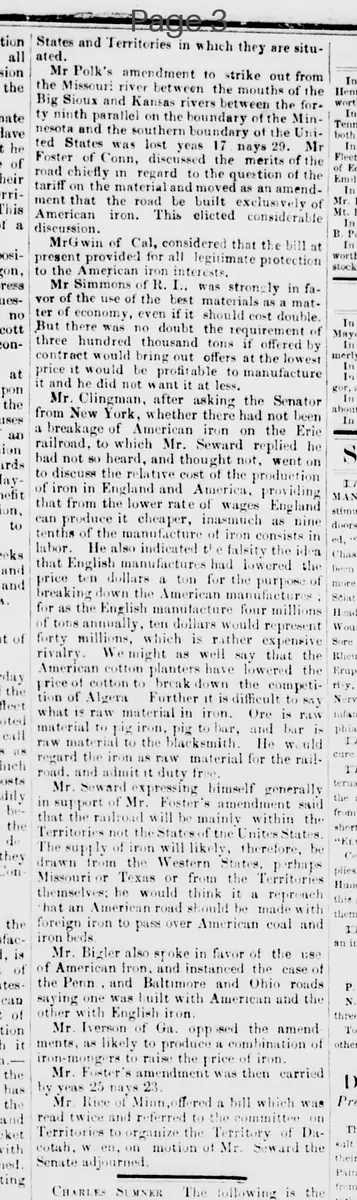
Mr. Gwin of Cal, considered that the bill at present provided for all legitimate protection to the American iron interests.
Mr. Simmons of R. I., was strongly in favor of the use of the best materials as a matter of economy, even if it should cost double. But there was no doubt the requirement of three hundred thousand tons if offered by contract would bring out offers at the lowest price it would be profitable to manufacture it and he did not want it at less.
Mr. Clingman, after asking the Senator from New York, whether there had not been a breakage of American iron on the Erie railroad, to which Mr. Seward replied he had not so heard, and thought not, went on to discuss the relative cost of the production of iron in England and America, providing that from the lower rate of wages England can produce it cheaper, inasmuch as nine tenths of the manufacture of iron consists in labor. He also indicated the falsity the idea that English manufactures had lowered the price ten dollars a ton for the purpose of breaking down the American manufactures. for as the English manufacture four millions of tons annually, ten dollars would represent forty millions, which is rather expensive rivalry. We might as well say that the American cotton planters have lowered the price of cotton to 'break down the competition of Algeria Further it is difficult to say what is raw material in iron. Ore is raw material to pig iron, pig to bar, and bar is raw material to the blacksmith. He would regard the iron as raw material for the railroad. and admit it duty free.
Mr. Seward expressing himself generally in support of Mr. Foster's amendment said that the railroad will be mainly within the Territories not the States of the United States. The supply of iron will likely, therefore, be drawn from the Western States. perhaps Missouri or Texas or from the Territories themselves; he would think it a reproach that an American road should be made with foreign iron to pass over American coal and iron beds
Mr. Bigler also spoke in favor of the use of American iron, and instanced the case of the Penn., and Baltimore and Ohio roads saving one was built with American and the other with English iron.
Mr. Iverson of Ga. opposed the amendment, as likely to produce a combination of iron-mongers to raise the price of iron.
Mr. Foster's amendment was then carried by yeas 25 nays 23
Mr. Rice of Minn, offered a bill which was read twice and referred to the committee on Territories to organize the Territory of Dakota. when, on motion of Mr. Seward the Senate adjourned.
What sub-type of article is it?
What keywords are associated?
What entities or persons were involved?
Domestic News Details
Key Persons
Outcome
mr. polk's amendment lost yeas 17 nays 29. mr. foster's amendment carried yeas 25 nays 23. mr. rice's bill read twice and referred to the committee on territories. senate adjourned on motion of mr. seward.
Event Details
Senate discussion on a road bill including Mr. Polk's amendment to strike out a section on the Missouri river route which was lost. Mr. Foster of Conn moved an amendment for the road to be built exclusively of American iron, eliciting discussion on tariff, material costs, and production. Various senators including Gwin of Cal, Simmons of R.I., Clingman, Seward, Bigler, and Iverson of Ga. spoke for or against. The amendment passed. Mr. Rice of Minn offered a bill to organize the Territory of Dakota.