Thank you for visiting SNEWPapers!
Sign up free
Editorial
June 27, 1809
Virginia Argus
Richmond, Virginia
What is this article about?
This editorial discusses U.S. hopes for peace with Britain, influenced by European wars involving France, Russia, and Austria. It argues Britain may seek accommodation if weakened, critiques British violations of neutral rights, advocates military preparedness, and contrasts republican virtues with monarchical warmongering.
Merged-components note: Continuation of the editorial 'Prospect of Peace with Britain' across columns.
Clipping
OCR Quality
95%
Excellent
Full Text
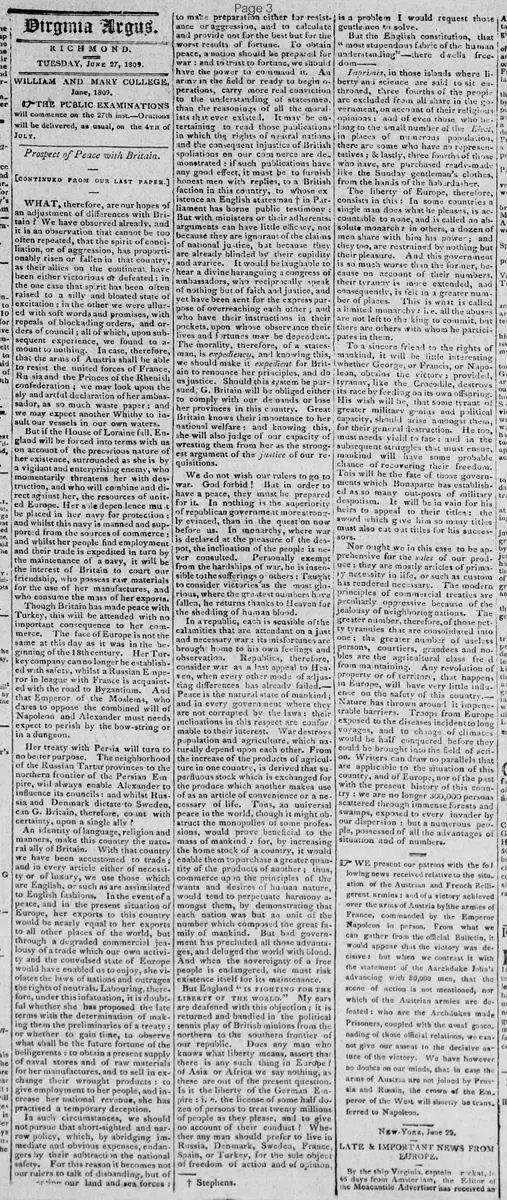
Prospect of Peace with Britain.
[Continued from our last paper.]
What therefore, are our hopes of an adjustment of differences with Britain? We have observed already, and it is an observation that cannot be too often repeated, that the spirit of conciliation, or of aggression, has proportionally risen or fallen in that country, as their allies on the continent have been either victorious or defeated: in the one case that spirit has been often raised to a silly and bloated state of excitation; in the other we were allured with soft words and promises, with repeals of blockading orders, and orders of council: all of which, upon subsequent experience, we found to amount to nothing. In case, therefore, that the arms of Austria shall be able to resist the united forces of France, Russia and the Princes of the Rhenish confederation; we may look upon the sly and artful declaration of her ambassador, as so much waste paper: and we may expect another Whitby to insult our vessels in our own waters. But if the House of Lorraine fall, England will be forced into terms with us on account of the precarious nature of her existence, surrounded as she is by a vigilant and enterprising enemy, who momentarily threatens her with destruction, and who will combine and direct against her, the resources of united Europe. Her sole dependence must be placed in her navy for protection: and whilst this navy is manned and supported from the sources of commerce: and whilst her people find employment and their trade is expedited in turn by the maintenance of a navy, it will be the interest of Britain to court our friendship, who possess raw materials for the use of her manufactures, and who consume the mass of her exports. Though Britain has made peace with Turkey, this will be attended with no important consequence to her commerce. The face of Europe is not the same at this day as it was in the beginning of the 18th century. Her Turkey company cannot longer be established with safety, whilst a Russian Emperor in league with France is acquainted with the road to Byzantium. And that Emperor of the Moslems, who dares to oppose the combined will of Napoleon and Alexander must needs expect to perish by the bow-string or in a dungeon. Her treaty with Persia will turn to no better purpose. The neighborhood of the Russian Tartar provinces to the northern frontier of the Persian Empire, will always enable Alexander to influence its councils: and whilst Russia and Denmark dictate to Sweden, can G. Britain, therefore, count with certainty, upon a single ally? An identity of language, religion and manners, make this country the natural ally of Britain. With that country we have been accustomed to trade; and in every article either of necessity or of luxury, we use those which are English, or such as are assimilated to English fashions. In the event of a peace, and in the present situation of Europe, her exports to this country would be nearly equal to her exports to all other places of the world, but through a degraded commercial jealousy of a trade which our own activity and the convulsed state of Europe would have enabled us to enjoy, she violates the laws of nations and outrages the rights of neutrals. Labouring, therefore, under this infatuation, it is doubtful whether she has proposed the late terms with the determination of making them the preliminaries of a treaty: or whether to gain time, to observe what shall be the future fortune of the belligerents: to obtain a present supply of naval stores and of raw materials for her manufactures, and to sell in exchange their wrought products: to give employment to her people, and increase her national revenue, she has practised a temporary deception. In such circumstances, we should not pursue that short-sighted and narrow policy, which, by abridging immediate and obvious expenses, endangers by their subtraction the national safety. For this reason it becomes not our rulers to talk of disbanding, but of increasing our land and sea forces: to make preparation either for resistance or aggression, and to calculate and provide not for the best but for the worst results of fortune. To obtain peace, a nation should be prepared for war: and to trust to fortune, we should have the power to command it. An army in the field or ready to begin operations, carry more real conviction to the understanding of statesmen, than the reasonings of all the moralists that ever existed. It may be entertaining to read those publications in which the rights of neutral nations and the consequent injustice of British spoliations on our commerce are demonstrated: if such publications have any good effect, it must be to furnish honest men with replies, to a British faction in this country, to whose existence an English statesman in Parliament has borne public testimony: But with ministers or their adherents, arguments can have little efficacy, not because they are ignorant of the claims of national justice, but because they are already blinded by their cupidity and avarice. It would be laughable to hear a divine haranguing a congress of ambassadors, who reciprocally speak of nothing but of faith and justice, and yet have been sent for the express purpose of overreaching each other; and who have their instructions in their pockets, upon whose observance their lives and fortunes may be dependent. The morality, therefore, of a statesman, is expediency, and knowing this, we should make it expedient for Britain to renounce her principles, and do us justice. Should this system be pursued, G. Britain will be obliged either to comply with our demands or lose her provinces in this country. Great Britain knows their importance to her national welfare: and knowing this, she will also judge of our capacity of wresting them from her as the strongest argument of the justice of our requisitions. We do not wish our rulers to go to war. God forbid! But in order to have a peace, they must be prepared for it. In nothing is the superiority of republican government more strongly evinced, than in the question now before us. In monarchy, where war is declared at the pleasure of the despot, the inclination of the people is never consulted. Personally exempt from the hardships of war, he is insensible to the sufferings of others: Taught to consider victories as the most glorious, where the greatest numbers have fallen, he returns thanks to Heaven for the shedding of human blood. In a republic, each is sensible of the calamities that are attendant on a just and necessary war: its misfortunes are brought home to his own feelings and observation. Republics, therefore, consider war as a last appeal to Heaven, when every other mode of adjusting differences has already failed.-- Peace is the natural state of mankind: and in every government where they are not corrupted by the laws: their inclinations in this respect are conformable to their interest. War destroys population and agriculture, which naturally depend upon each other. From the increase of the products of agriculture in one country, is derived that superfluous stock which is exchanged for the produce which another makes use of as an article of convenience or a necessary of life. Thus, an universal peace in the world, though it might obstruct the monopolies of some professions, would prove beneficial to the mass of mankind: for, by increasing the home stock of a country, it would enable them to purchase a greater quantity of the products of another; thus, commerce upon the principles of the wants and desires of human nature, would tend to perpetuate harmony amongst them, by demonstrating that each nation was but an unit of the number which composed the great family of mankind. But bad government has precluded all those advantages, and deluged the world with blood. And when the sovereignty of a free people is endangered, she must risk existence itself for its maintenance. But England "IS FIGHTING FOR THE LIBERTY OF THE WORLD." My ears are deafened with this objection: it is returned and bandied in the political tennis play of British minions from the northern to the southern frontier of our republic. Does any man who knows what liberty means, assert that there is any such thing in Europe? of Asia or Africa we say nothing, as these are out of the present question. Is it the liberty of the German Empire: i.e. the license of some half dozen of persons to treat twenty millions of people as they please, and to give no account of their conduct? Whether any man should prefer to live in Russia, Denmark, Sweden, France, Spain, or Turkey, for the sole object of freedom of action and of opinion,
†Stephens,
is a problem I would request those gentlemen to solve. But the English constitution, that "most stupendous fabric of the human understanding" there dwells freedom--
In brimis, in those islands where liberty and science are said to sit enthroned, three fourths of the people are excluded from all share in the government, on account of their religious opinions: and of even those who belong to the small number of the Elect, in places of numerous population, there are some who have no representatives: & lastly, three fourths of those who have, are purchased ready-made like the Sunday gentleman's clothes, from the hands of the haberdasher. The liberty of Europe, therefore, consists in this: In some countries a single man does what he pleases, is accountable to none, and is called an absolute monarch: in others, a dozen of men share with him his power: and they too, are restrained by nothing but their pleasure. And this government is so much worse than the former, because on account of their numbers, their tyranny is more extended, and consequently, is felt in a greater number of places. This is what is called a limited monarchy: i.e. all the abuses are not left to the king to commit. but there are others with whom he participates in them. To a sincere friend to the rights of mankind, it will be little interesting whether George, or Francis, or Napoleon, obtains the victory: provided, tyranny, like the Crocodile, destroys its race by feeding on its own offspring. His wish will be, that some tyrant of greater military genius and political capacity, should arise amongst them, for their general destruction. He too, must needs yield to fate: and in the subsequent struggles that must ensue, mankind will have some probable chance of recovering their freedom. This will be the fate of those governments which Bonaparte has established as so many out-posts of military despotism. It will be in vain for his heirs to appeal to their titles: the sword which gave him so many titles must also cut out titles for his successors. Nor ought we in this case to be apprehensive for the sales of our produce: they are mostly articles of primary necessity in life, or such as custom has rendered necessary. The modern principles of commercial treaties are peculiarly oppressive because of the jealousy of neighboring nations. The greater number, therefore, of those petty tyrannies that are consolidated into one: the greater number of useless persons, courtiers, grandees and nobles are the agricultural class freed from maintaining. Any revolution of property or of territory, that happens in Europe, will have very little influence on the safety of this country.-- Nature has thrown around it impenetrable barriers. Troops from Europe exposed to the diseases incident to long voyages, and to change of climates would be half conquered before they could be brought into the field of action. Writers can draw no parallels that are applicable to the situation of this country, and of Europe, nor of the past with the present history of this country: we are no longer 300,000 persons scattered through immense forests and swamps, exposed to every invader by our dispersion: but a numerous people, possessed of all the advantages of situation and of numbers.
[Continued from our last paper.]
What therefore, are our hopes of an adjustment of differences with Britain? We have observed already, and it is an observation that cannot be too often repeated, that the spirit of conciliation, or of aggression, has proportionally risen or fallen in that country, as their allies on the continent have been either victorious or defeated: in the one case that spirit has been often raised to a silly and bloated state of excitation; in the other we were allured with soft words and promises, with repeals of blockading orders, and orders of council: all of which, upon subsequent experience, we found to amount to nothing. In case, therefore, that the arms of Austria shall be able to resist the united forces of France, Russia and the Princes of the Rhenish confederation; we may look upon the sly and artful declaration of her ambassador, as so much waste paper: and we may expect another Whitby to insult our vessels in our own waters. But if the House of Lorraine fall, England will be forced into terms with us on account of the precarious nature of her existence, surrounded as she is by a vigilant and enterprising enemy, who momentarily threatens her with destruction, and who will combine and direct against her, the resources of united Europe. Her sole dependence must be placed in her navy for protection: and whilst this navy is manned and supported from the sources of commerce: and whilst her people find employment and their trade is expedited in turn by the maintenance of a navy, it will be the interest of Britain to court our friendship, who possess raw materials for the use of her manufactures, and who consume the mass of her exports. Though Britain has made peace with Turkey, this will be attended with no important consequence to her commerce. The face of Europe is not the same at this day as it was in the beginning of the 18th century. Her Turkey company cannot longer be established with safety, whilst a Russian Emperor in league with France is acquainted with the road to Byzantium. And that Emperor of the Moslems, who dares to oppose the combined will of Napoleon and Alexander must needs expect to perish by the bow-string or in a dungeon. Her treaty with Persia will turn to no better purpose. The neighborhood of the Russian Tartar provinces to the northern frontier of the Persian Empire, will always enable Alexander to influence its councils: and whilst Russia and Denmark dictate to Sweden, can G. Britain, therefore, count with certainty, upon a single ally? An identity of language, religion and manners, make this country the natural ally of Britain. With that country we have been accustomed to trade; and in every article either of necessity or of luxury, we use those which are English, or such as are assimilated to English fashions. In the event of a peace, and in the present situation of Europe, her exports to this country would be nearly equal to her exports to all other places of the world, but through a degraded commercial jealousy of a trade which our own activity and the convulsed state of Europe would have enabled us to enjoy, she violates the laws of nations and outrages the rights of neutrals. Labouring, therefore, under this infatuation, it is doubtful whether she has proposed the late terms with the determination of making them the preliminaries of a treaty: or whether to gain time, to observe what shall be the future fortune of the belligerents: to obtain a present supply of naval stores and of raw materials for her manufactures, and to sell in exchange their wrought products: to give employment to her people, and increase her national revenue, she has practised a temporary deception. In such circumstances, we should not pursue that short-sighted and narrow policy, which, by abridging immediate and obvious expenses, endangers by their subtraction the national safety. For this reason it becomes not our rulers to talk of disbanding, but of increasing our land and sea forces: to make preparation either for resistance or aggression, and to calculate and provide not for the best but for the worst results of fortune. To obtain peace, a nation should be prepared for war: and to trust to fortune, we should have the power to command it. An army in the field or ready to begin operations, carry more real conviction to the understanding of statesmen, than the reasonings of all the moralists that ever existed. It may be entertaining to read those publications in which the rights of neutral nations and the consequent injustice of British spoliations on our commerce are demonstrated: if such publications have any good effect, it must be to furnish honest men with replies, to a British faction in this country, to whose existence an English statesman in Parliament has borne public testimony: But with ministers or their adherents, arguments can have little efficacy, not because they are ignorant of the claims of national justice, but because they are already blinded by their cupidity and avarice. It would be laughable to hear a divine haranguing a congress of ambassadors, who reciprocally speak of nothing but of faith and justice, and yet have been sent for the express purpose of overreaching each other; and who have their instructions in their pockets, upon whose observance their lives and fortunes may be dependent. The morality, therefore, of a statesman, is expediency, and knowing this, we should make it expedient for Britain to renounce her principles, and do us justice. Should this system be pursued, G. Britain will be obliged either to comply with our demands or lose her provinces in this country. Great Britain knows their importance to her national welfare: and knowing this, she will also judge of our capacity of wresting them from her as the strongest argument of the justice of our requisitions. We do not wish our rulers to go to war. God forbid! But in order to have a peace, they must be prepared for it. In nothing is the superiority of republican government more strongly evinced, than in the question now before us. In monarchy, where war is declared at the pleasure of the despot, the inclination of the people is never consulted. Personally exempt from the hardships of war, he is insensible to the sufferings of others: Taught to consider victories as the most glorious, where the greatest numbers have fallen, he returns thanks to Heaven for the shedding of human blood. In a republic, each is sensible of the calamities that are attendant on a just and necessary war: its misfortunes are brought home to his own feelings and observation. Republics, therefore, consider war as a last appeal to Heaven, when every other mode of adjusting differences has already failed.-- Peace is the natural state of mankind: and in every government where they are not corrupted by the laws: their inclinations in this respect are conformable to their interest. War destroys population and agriculture, which naturally depend upon each other. From the increase of the products of agriculture in one country, is derived that superfluous stock which is exchanged for the produce which another makes use of as an article of convenience or a necessary of life. Thus, an universal peace in the world, though it might obstruct the monopolies of some professions, would prove beneficial to the mass of mankind: for, by increasing the home stock of a country, it would enable them to purchase a greater quantity of the products of another; thus, commerce upon the principles of the wants and desires of human nature, would tend to perpetuate harmony amongst them, by demonstrating that each nation was but an unit of the number which composed the great family of mankind. But bad government has precluded all those advantages, and deluged the world with blood. And when the sovereignty of a free people is endangered, she must risk existence itself for its maintenance. But England "IS FIGHTING FOR THE LIBERTY OF THE WORLD." My ears are deafened with this objection: it is returned and bandied in the political tennis play of British minions from the northern to the southern frontier of our republic. Does any man who knows what liberty means, assert that there is any such thing in Europe? of Asia or Africa we say nothing, as these are out of the present question. Is it the liberty of the German Empire: i.e. the license of some half dozen of persons to treat twenty millions of people as they please, and to give no account of their conduct? Whether any man should prefer to live in Russia, Denmark, Sweden, France, Spain, or Turkey, for the sole object of freedom of action and of opinion,
†Stephens,
is a problem I would request those gentlemen to solve. But the English constitution, that "most stupendous fabric of the human understanding" there dwells freedom--
In brimis, in those islands where liberty and science are said to sit enthroned, three fourths of the people are excluded from all share in the government, on account of their religious opinions: and of even those who belong to the small number of the Elect, in places of numerous population, there are some who have no representatives: & lastly, three fourths of those who have, are purchased ready-made like the Sunday gentleman's clothes, from the hands of the haberdasher. The liberty of Europe, therefore, consists in this: In some countries a single man does what he pleases, is accountable to none, and is called an absolute monarch: in others, a dozen of men share with him his power: and they too, are restrained by nothing but their pleasure. And this government is so much worse than the former, because on account of their numbers, their tyranny is more extended, and consequently, is felt in a greater number of places. This is what is called a limited monarchy: i.e. all the abuses are not left to the king to commit. but there are others with whom he participates in them. To a sincere friend to the rights of mankind, it will be little interesting whether George, or Francis, or Napoleon, obtains the victory: provided, tyranny, like the Crocodile, destroys its race by feeding on its own offspring. His wish will be, that some tyrant of greater military genius and political capacity, should arise amongst them, for their general destruction. He too, must needs yield to fate: and in the subsequent struggles that must ensue, mankind will have some probable chance of recovering their freedom. This will be the fate of those governments which Bonaparte has established as so many out-posts of military despotism. It will be in vain for his heirs to appeal to their titles: the sword which gave him so many titles must also cut out titles for his successors. Nor ought we in this case to be apprehensive for the sales of our produce: they are mostly articles of primary necessity in life, or such as custom has rendered necessary. The modern principles of commercial treaties are peculiarly oppressive because of the jealousy of neighboring nations. The greater number, therefore, of those petty tyrannies that are consolidated into one: the greater number of useless persons, courtiers, grandees and nobles are the agricultural class freed from maintaining. Any revolution of property or of territory, that happens in Europe, will have very little influence on the safety of this country.-- Nature has thrown around it impenetrable barriers. Troops from Europe exposed to the diseases incident to long voyages, and to change of climates would be half conquered before they could be brought into the field of action. Writers can draw no parallels that are applicable to the situation of this country, and of Europe, nor of the past with the present history of this country: we are no longer 300,000 persons scattered through immense forests and swamps, exposed to every invader by our dispersion: but a numerous people, possessed of all the advantages of situation and of numbers.
What sub-type of article is it?
War Or Peace
Foreign Affairs
Trade Or Commerce
What keywords are associated?
Peace With Britain
European Wars
Neutral Rights
Military Preparedness
Republican Government
British Commerce
Napoleonic Europe
What entities or persons were involved?
Britain
Austria
France
Russia
Napoleon
Alexander
House Of Lorraine
Turkey
Persia
Sweden
Denmark
George
Francis
Editorial Details
Primary Topic
Prospects For Peace With Britain Amid European Conflicts
Stance / Tone
Skeptical Of British Sincerity, Advocating Military Preparedness For Peace, Pro Republican Critique Of Monarchy
Key Figures
Britain
Austria
France
Russia
Napoleon
Alexander
House Of Lorraine
Turkey
Persia
Sweden
Denmark
George
Francis
Key Arguments
Britain's Conciliatory Spirit Fluctuates With European Allies' Fortunes
U.S. Should Prepare For War To Secure Peace
British Violations Of Neutral Rights Stem From Commercial Jealousy
Republics Value Peace More Than Monarchies
European Liberty Is Illusory Under Monarchies
U.S. Natural Barriers And Growth Ensure Security