Thank you for visiting SNEWPapers!
Sign up free
Jackson Advocate
Jackson, Hinds County, Mississippi
What is this article about?
In Kenya, the Kenya National Party demands self-government by 1968, while Tom Mboya rejects the New Kenya Parliamentary Group and pushes for early African-led rule via his Kenya Independent Movement. Divergent African opinions complicate independence talks with Britain, amid white settler concerns and a new right-wing United Party.
Merged-components note: Merged continuation of Kenya nationalist party self-government demand story across pages.
Clippings
1 of 2
OCR Quality
Full Text
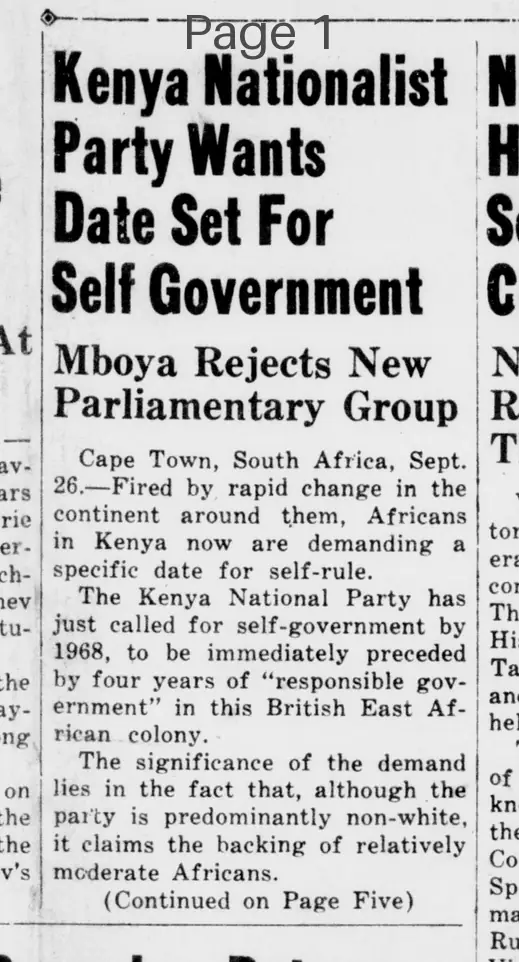
Mboya Rejects New Parliamentary Group
Cape Town, South Africa, Sept. 26.-Fired by rapid change in the continent around them, Africans in Kenya now are demanding a specific date for self-rule.
The Kenya National Party has just called for self-government by 1968, to be immediately preceded by four years of "responsible government" in this British East African colony.
The significance of the demand lies in the fact that, although the party is predominantly non-white, it claims the backing of relatively moderate Africans.
(Continued on Page Five)
Kenya
(Continued from Page One)
Meanwhile, at the more fiery end of the African political scale, the African nationalist leader Tom Mboya is continuing, in the tradition of nationalist leaders elsewhere, his campaign of constant political harassment against white authority. Although it has set no target date, his new Kenya Independent Movement is demanding early self-rule under African authority.
Opinions Diverge
The presence of these two groups, which have come into being recently, indicates a divergence of opinion between leading African politicians in Kenya, who thus are now in two camps. Nevertheless they both are vitally concerned with independence, which is a dominant theme among African voters, and both will presumably press for their own specific timetables for independence when key constitutional talks begin with the British Government in London next year. For the moment, it appears as though British reaction will be cool to such demands. Britain is not pushing Kenya along the road to self-rule as speedily as was the case with Ghana, or as is the case with Nigeria, for example.
Apprehensions Aired
For whereas the two latter are primarily African lands with no settled white populations to speak of, the position of Kenya is complicated by the presence of some 65,000 white settlers, mainly of British descent. Many of these are apprehensive lest an African government would discriminate against them, and British Colonial Secretary Alan Lennox-Boyd made it clear earlier this year that Britain did not intend relinquishing its authority in Kenya in the foreseeable future. British firmness on this point seems to be borne out by plans for a $10,000,000 British military base outside the Kenya capital of Nairobi on which work will soon start. It seems doubtful if the British Government would go ahead with the scheme if it intended to hand over political power in Kenya in the near future to Africans who have shown themselves hostile toward the projected base. Meanwhile, in the sphere of white politics in Kenya the welcome recent emergence of the New Kenya Parliamentary Group under the guidance of the settler leader Michael Blundell has been balanced by the birth of a new, right-wing settler faction, the United Party. The New Kenya Parliamentary Group adopted a progressive policy, relatively liberal against a background of white conservatism in Kenya. The United Party is campaigning on a platform of what one Kenya political weekly calls "a way of segregation or 'separatism' which, in essence, falls not so short of a policy of apartheid' (South Africa's race-segregation policy)." The New Kenya Parliamentary Group apparently has been prepared to open up Kenya's white highlands to Africans. This is a controversial issue and the group's standpoint must be regarded as courageous, even if only realistic. African entry to the white highlands has been one of the main planks in Mr. Mboya's platform, and with the removal of this thorny point of controversy it had seemed to some observers as though the way to some compromise between the Blundell and Mboya groups might be open. These hopes have been dashed, however, by Mr. Mboya's emphatic rejection of the New Kenya Parliamentary Group. Mr. Mboya apparently is determined to stick to the tough line which, as he sees it, has brought power and office to such nationalists as Kwame Nkrumah, whom he much admires. In this event, the New Kenya Parliamentary Group may perhaps be able to reach some understanding with the Kenya National Party which, though it now has called for self-government in 1968, nevertheless represents the nearest moderate African counterpart to the moderate predominantly white, New Kenya Parliamentary Group. The extremists field, meanwhile, appears left to the white United Party of the settlers on the one hand, and the fiery Mr. Mboya's African Kenya Independent Movement on the other. If some accord is reached between white and African moderates, however, this leaves Mr. Mboya's position untouched and it remains to be seen how much African support he can rally. If the split with more moderate African leaders has left his reputation unharmed, and perhaps even consolidated, among the masses, then he will remain one of the key figures in Kenya's future.
What sub-type of article is it?
What keywords are associated?
What entities or persons were involved?
Where did it happen?
Foreign News Details
Primary Location
Kenya
Event Date
Sept. 26
Key Persons
Outcome
demands for self-government by 1968 from kenya national party; mboya's rejection of new kenya parliamentary group; british plans for military base in nairobi; emergence of united party advocating segregation; ongoing constitutional talks with britain next year.
Event Details
The Kenya National Party, backed by moderate Africans, calls for self-government by 1968 after four years of responsible government. Tom Mboya's Kenya Independent Movement demands early African-led self-rule without a specific date. Divergent African opinions split politicians into moderate and fiery camps. White settlers' apprehensions complicate matters, with Britain showing firmness via a planned military base. New moderate white group under Michael Blundell contrasts with right-wing United Party. Mboya rejects compromise, admiring Nkrumah's approach.