Thank you for visiting SNEWPapers!
Sign up free
Literary
July 8, 1819
Daily National Intelligencer
Washington, District Of Columbia
What is this article about?
Excerpt from the poem 'Mount Hope' by W. E. Richmond describes the ancient inscribed rock on the Taunton River, speculating it records the fate of shipwrecked sailors from a lost civilization who perished there, evoking enduring human sympathy.
Clipping
OCR Quality
95%
Excellent
Full Text
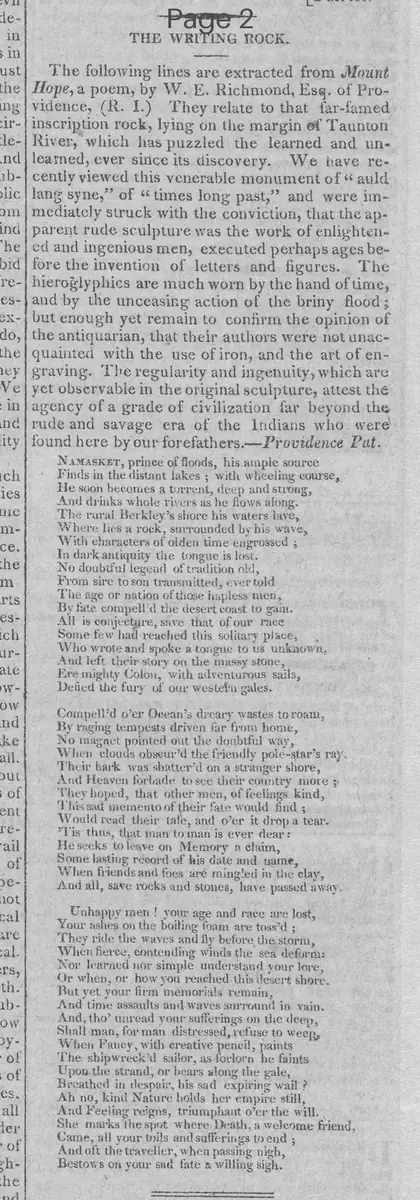
THE WRITING ROCK.
The following lines are extracted from Mount Hope, a poem, by W. E. Richmond, Esq. of Providence, (R. I.) They relate to that far-famed inscription rock, lying on the margin of Taunton River, which has puzzled the learned and unlearned, ever since its discovery. We have recently viewed this venerable monument of "auld lang syne," of "times long past," and were immediately struck with the conviction, that the apparent rude sculpture was the work of enlightened and ingenious men, executed perhaps ages before the invention of letters and figures. The hieroglyphics are much worn by the hand of time, and by the unceasing action of the briny flood; but enough yet remain to confirm the opinion of the antiquarian, that their authors were not unacquainted with the use of iron, and the art of engraving. The regularity and ingenuity, which are yet observable in the original sculpture, attest the agency of a grade of civilization far beyond the rude and savage era of the Indians who were found here by our forefathers.—Providence Pat.
Namauskett, prince of floods, his ample source
Finds in the distant lakes; with wheeling course,
He soon becomes a torrent, deep and strong,
And drinks whole rivers as he flows along.
The rural Berkley's shore his waters lave,
Where lies a rock, surrounded by his wave.
With characters of olden time engrossed;
In dark antiquity the tongue is lost.
No doubtful legend of tradition old,
From sire to son transmitted, ever told
The age or nation of those hapless men,
By fate compell'd the desert coast to gain.
All is conjecture, save that of our race
Some few had reached this solitary place,
Who wrote and spoke a tongue to us unknown,
And left their story on the massy stone,
Ere mighty Colon, with adventurous sails,
Defied the fury of our western gales.
Compell'd o'er Ocean's dreary wastes to roam
By raging tempests driven far from home,
No magnet pointed out the doubtful way,
When clouds obscured the friendly pole-star's ray
Their bark was shatter'd on a stranger shore,
And Heaven forbade to see their country more;
They hoped, that other men, of feelings kind,
This sad memento of their fate would find;
Would read their tale, and o'er it drop a tear.
Tis thus, that man to man is ever dear:
He seeks to leave on Memory a claim,
Some lasting record of his date and name,
When friends and foes are mingled in the clay,
And all, save rocks and stones, have passed away
Unhappy men! your age and race are lost,
Your ashes on the boiling foam are toss'd;
They ride the waves and fly before the storm,
When fierce, contending winds the sea deform:
Nor learned nor simple understand your lore,
Or when, or how you reached this desert shore.
But yet your firm memorials remain,
And time assaults and waves surround in vain.
And, tho' unread your sufferings on the deep,
Shall man, for man distressed, refuse to weep
When Fancy, with creative pencil, paints
The shipwreck'd sailor, as forlorn he faints
Upon the strand, or bears along the gale,
Breathed in despair, his sad expiring wail?
Ah no, kind Nature holds her empire still,
And Feeling reigns, triumphant o'er the will.
She marks the spot where Death, a welcome friend.
Came, all your toils and sufferings to end;
And oft the traveller, when passing nigh,
Bestows on your sad fate a willing sigh.
The following lines are extracted from Mount Hope, a poem, by W. E. Richmond, Esq. of Providence, (R. I.) They relate to that far-famed inscription rock, lying on the margin of Taunton River, which has puzzled the learned and unlearned, ever since its discovery. We have recently viewed this venerable monument of "auld lang syne," of "times long past," and were immediately struck with the conviction, that the apparent rude sculpture was the work of enlightened and ingenious men, executed perhaps ages before the invention of letters and figures. The hieroglyphics are much worn by the hand of time, and by the unceasing action of the briny flood; but enough yet remain to confirm the opinion of the antiquarian, that their authors were not unacquainted with the use of iron, and the art of engraving. The regularity and ingenuity, which are yet observable in the original sculpture, attest the agency of a grade of civilization far beyond the rude and savage era of the Indians who were found here by our forefathers.—Providence Pat.
Namauskett, prince of floods, his ample source
Finds in the distant lakes; with wheeling course,
He soon becomes a torrent, deep and strong,
And drinks whole rivers as he flows along.
The rural Berkley's shore his waters lave,
Where lies a rock, surrounded by his wave.
With characters of olden time engrossed;
In dark antiquity the tongue is lost.
No doubtful legend of tradition old,
From sire to son transmitted, ever told
The age or nation of those hapless men,
By fate compell'd the desert coast to gain.
All is conjecture, save that of our race
Some few had reached this solitary place,
Who wrote and spoke a tongue to us unknown,
And left their story on the massy stone,
Ere mighty Colon, with adventurous sails,
Defied the fury of our western gales.
Compell'd o'er Ocean's dreary wastes to roam
By raging tempests driven far from home,
No magnet pointed out the doubtful way,
When clouds obscured the friendly pole-star's ray
Their bark was shatter'd on a stranger shore,
And Heaven forbade to see their country more;
They hoped, that other men, of feelings kind,
This sad memento of their fate would find;
Would read their tale, and o'er it drop a tear.
Tis thus, that man to man is ever dear:
He seeks to leave on Memory a claim,
Some lasting record of his date and name,
When friends and foes are mingled in the clay,
And all, save rocks and stones, have passed away
Unhappy men! your age and race are lost,
Your ashes on the boiling foam are toss'd;
They ride the waves and fly before the storm,
When fierce, contending winds the sea deform:
Nor learned nor simple understand your lore,
Or when, or how you reached this desert shore.
But yet your firm memorials remain,
And time assaults and waves surround in vain.
And, tho' unread your sufferings on the deep,
Shall man, for man distressed, refuse to weep
When Fancy, with creative pencil, paints
The shipwreck'd sailor, as forlorn he faints
Upon the strand, or bears along the gale,
Breathed in despair, his sad expiring wail?
Ah no, kind Nature holds her empire still,
And Feeling reigns, triumphant o'er the will.
She marks the spot where Death, a welcome friend.
Came, all your toils and sufferings to end;
And oft the traveller, when passing nigh,
Bestows on your sad fate a willing sigh.
What sub-type of article is it?
Poem
What themes does it cover?
Death Mortality
Nature
Moral Virtue
What keywords are associated?
Writing Rock
Taunton River
Shipwreck
Ancient Inscription
Hieroglyphics
Shipwrecked Sailors
Human Sympathy
What entities or persons were involved?
W. E. Richmond, Esq. Of Providence, (R. I.)
Literary Details
Title
The Writing Rock
Author
W. E. Richmond, Esq. Of Providence, (R. I.)
Subject
Inscription Rock On The Margin Of Taunton River
Key Lines
Namauskett, Prince Of Floods, His Ample Source
Finds In The Distant Lakes; With Wheeling Course,
He Soon Becomes A Torrent, Deep And Strong,
And Drinks Whole Rivers As He Flows Along.
With Characters Of Olden Time Engrossed;
In Dark Antiquity The Tongue Is Lost.
Their Bark Was Shatter'd On A Stranger Shore,
And Heaven Forbade To See Their Country More;
Tis Thus, That Man To Man Is Ever Dear:
He Seeks To Leave On Memory A Claim,
Some Lasting Record Of His Date And Name,
Ah No, Kind Nature Holds Her Empire Still,
And Feeling Reigns, Triumphant O'er The Will.