Thank you for visiting SNEWPapers!
Sign up free
Editorial
May 2, 1808
The National Intelligencer And Washington Advertiser
Washington, District Of Columbia
What is this article about?
Editorial from May 2 justifies Congress's embargo over war with Britain or France amid European conflicts, details defensive preparations, and urges citizens to support policy and foster self-reliance through internal improvements.
Merged-components note: Continuation of the editorial on Congress and embargo across components based on sequential reading order and text flow.
Clipping
OCR Quality
95%
Excellent
Full Text
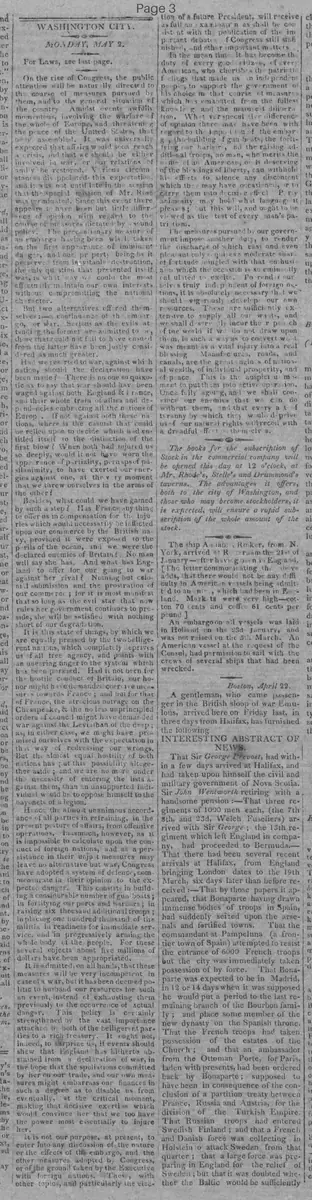
WASHINGTON CITY.
MONDAY, MAY 2.
For Laws, see last page.
On the rise of Congress, the public attention will be naturally directed to the course of measures pursued by them, and to the general situation of the country. Amidst events awful momentous, involving the warfare of the whole of Europe, and threatening the peace of the United States, that body assembled. It was universally expected that affairs would soon reach a crisis, and that we should be either involved in war, or our relations of amity be restored. Various circumstances disappointed this expectation. and it was not until late in the session that the special mission of Mr. Rose was terminated. Since this event there appears to have been but little difference of opinion with regard to the course of measures dictated by sound policy. The precautionary measure of an embargo having been wisely taken on the first appearance of imminent danger, and our property being by it preserved from inevitable destruction, the only question that presented itself was, in what way we could the most effectually maintain our own interests without compromising the national character.
But two alternatives offered themselves;—a continuance of the embargo, or war. Serious as the evils attending the former are admitted to be, those that could not fail to have ensued from the latter have been justly considered as much greater.
Had we resorted to war, against which nation, should the declaration have been made? There is no one so quixotic as to say that war should have been waged against both England & France, and their whole train of allies and dependencies embracing all the nations of Europe. If not against both these nations, where is the casuist that could be relied upon to decide which had entitled itself to the distinction of the first blow? When both had injured us so deeply, would it not have worn the appearance of partiality, perhaps of pusillanimity, to have exerted our energies against one, at the very moment that we threw ourselves in the arms of the other?
Besides, what could we have gained by such a step? Has France any thing to offer us in compensation for the injuries which would necessarily be inflicted upon our commerce by the British navy, provided it were exposed to the perils of the ocean, and we were the declared enemies of Britain? No man will say she has. And what has England to offer for our going to war against her rival? Nothing but colonial submission and the prostration of our commerce; for it is most manifest that so long as the evil star that now rules her government continues to preside, she will be satisfied with nothing short of our degradation.
It is this state of things. by which we are equally pressed by the two belligerent nations, which completely deprives us of all free agency, and points with an unerring finger to the system which has been pursued. Had it not been for the hostile Conduct of Britain, our honor might have demanded coercive measures towards France; and but for that of France, the atrocious outrage on the Chesapeake, & the no less unprincipled orders of council might have demanded war against the Leviathan of the deep; as, in either case, we might have promised ourselves with the expectation in that way of redressing our wrongs.
But the almost equal hostility of both nations has put this possibility altogether aside; and we are no more under the necessity of entering the lists against them, than an unsupported individual would be to oppose himself to the bayonets of a legion.
Hence the almost unanimous accordance of all parties in refraining, in the present posture of affairs, from offensive operations. Inasmuch, however, as it is impossible to calculate upon the conduct of foreign nations, and as a persistence in their unjust measures may leave no alternative but war, Congress have adopted a system of defence, commensurate in their opinion to the expected danger. This consists in building a considerable number of gun boats; in fortifying our ports and harbours; in raising six thousand additional troops; in placing one hundred thousand of the militia in readiness for immediate service, and in progressively arming the whole body of the people. For these several objects about five millions of dollars have been appropriated.
It is admitted, on all hands, that these measures will be very incompetent in case of a war, but it has been deemed politic to husband our resources for such an event, instead of exhausting them previously to the occurrence of actual danger. This policy is certainly strengthened by the vast importance attached by both of the belligerent parties to a rich treasury. It ought not, indeed, to surprize us. if events should shew that England has hitherto abstained from a declaration of war, in the hope that the spoliations committed by her on our trade, and our own measures might embarrass our finances in such a degree as to disable us from eventually, at the critical moment, making that decisive exertion which would convince her that we too have the power most essentially to injure her.
It is not our purpose, at present, to enter into any discussion of the nature or the effects of the embargo, and the other measures adopted by Congress, or of the ground taken by the Executive with foreign nations. These, with other topics, and particularly the election of a future President. will receive as full an examination as shall be consistent with the publication of the important debates of Congress still unfinished, and other important matters.
In the mean time it has become the duty of every good citizen, of every American, who cherishes the patriotic feelings that made us an independent people, to support the government of his choice in that course of measures which has emanated from the fullest knowledge and the maturest deliberation. What speculative difference of opinion there may have been with regard to the imposition of the embargo, the building of gun-boats, the fortifying our harbours, and the raising additional troops, no man, who merits the name of an American, or is deserving of the blessings of liberty, can withhold his efforts to silence any discontent which they may have occasioned, or to carry them into decisive effect. Party animosity may hold what language it pleases; but this will, and ought to be viewed as the test of every man's patriotism.
The measures pursued by our government impose another duty, to render the discharge of which easy and even pleasant only requires a moderate share of fortitude mingled with that enthusiasm which the occasion is so eminently calculated to excite. To render ourselves truly independent of foreign nations, it is absolutely necessary that we should vigorously develope our own resources. These are sufficiently extensive to supply all our wants, and we shall deservedly incur the reproach of the world if we do not draw upon them. in such a way as to convert what was meant as a vital injury into a real blessing. Manufactures, roads, and canals, are the great engines of national wealth, of individual prosperity, and of peace. This is the auspicious moment to put them into active operation. Once fully agoing, and we shall convince our enemies that we can do without them, and that every act of tyranny by which they would deprive us of our natural rights will recoil with a dreadful effect on themselves.
MONDAY, MAY 2.
For Laws, see last page.
On the rise of Congress, the public attention will be naturally directed to the course of measures pursued by them, and to the general situation of the country. Amidst events awful momentous, involving the warfare of the whole of Europe, and threatening the peace of the United States, that body assembled. It was universally expected that affairs would soon reach a crisis, and that we should be either involved in war, or our relations of amity be restored. Various circumstances disappointed this expectation. and it was not until late in the session that the special mission of Mr. Rose was terminated. Since this event there appears to have been but little difference of opinion with regard to the course of measures dictated by sound policy. The precautionary measure of an embargo having been wisely taken on the first appearance of imminent danger, and our property being by it preserved from inevitable destruction, the only question that presented itself was, in what way we could the most effectually maintain our own interests without compromising the national character.
But two alternatives offered themselves;—a continuance of the embargo, or war. Serious as the evils attending the former are admitted to be, those that could not fail to have ensued from the latter have been justly considered as much greater.
Had we resorted to war, against which nation, should the declaration have been made? There is no one so quixotic as to say that war should have been waged against both England & France, and their whole train of allies and dependencies embracing all the nations of Europe. If not against both these nations, where is the casuist that could be relied upon to decide which had entitled itself to the distinction of the first blow? When both had injured us so deeply, would it not have worn the appearance of partiality, perhaps of pusillanimity, to have exerted our energies against one, at the very moment that we threw ourselves in the arms of the other?
Besides, what could we have gained by such a step? Has France any thing to offer us in compensation for the injuries which would necessarily be inflicted upon our commerce by the British navy, provided it were exposed to the perils of the ocean, and we were the declared enemies of Britain? No man will say she has. And what has England to offer for our going to war against her rival? Nothing but colonial submission and the prostration of our commerce; for it is most manifest that so long as the evil star that now rules her government continues to preside, she will be satisfied with nothing short of our degradation.
It is this state of things. by which we are equally pressed by the two belligerent nations, which completely deprives us of all free agency, and points with an unerring finger to the system which has been pursued. Had it not been for the hostile Conduct of Britain, our honor might have demanded coercive measures towards France; and but for that of France, the atrocious outrage on the Chesapeake, & the no less unprincipled orders of council might have demanded war against the Leviathan of the deep; as, in either case, we might have promised ourselves with the expectation in that way of redressing our wrongs.
But the almost equal hostility of both nations has put this possibility altogether aside; and we are no more under the necessity of entering the lists against them, than an unsupported individual would be to oppose himself to the bayonets of a legion.
Hence the almost unanimous accordance of all parties in refraining, in the present posture of affairs, from offensive operations. Inasmuch, however, as it is impossible to calculate upon the conduct of foreign nations, and as a persistence in their unjust measures may leave no alternative but war, Congress have adopted a system of defence, commensurate in their opinion to the expected danger. This consists in building a considerable number of gun boats; in fortifying our ports and harbours; in raising six thousand additional troops; in placing one hundred thousand of the militia in readiness for immediate service, and in progressively arming the whole body of the people. For these several objects about five millions of dollars have been appropriated.
It is admitted, on all hands, that these measures will be very incompetent in case of a war, but it has been deemed politic to husband our resources for such an event, instead of exhausting them previously to the occurrence of actual danger. This policy is certainly strengthened by the vast importance attached by both of the belligerent parties to a rich treasury. It ought not, indeed, to surprize us. if events should shew that England has hitherto abstained from a declaration of war, in the hope that the spoliations committed by her on our trade, and our own measures might embarrass our finances in such a degree as to disable us from eventually, at the critical moment, making that decisive exertion which would convince her that we too have the power most essentially to injure her.
It is not our purpose, at present, to enter into any discussion of the nature or the effects of the embargo, and the other measures adopted by Congress, or of the ground taken by the Executive with foreign nations. These, with other topics, and particularly the election of a future President. will receive as full an examination as shall be consistent with the publication of the important debates of Congress still unfinished, and other important matters.
In the mean time it has become the duty of every good citizen, of every American, who cherishes the patriotic feelings that made us an independent people, to support the government of his choice in that course of measures which has emanated from the fullest knowledge and the maturest deliberation. What speculative difference of opinion there may have been with regard to the imposition of the embargo, the building of gun-boats, the fortifying our harbours, and the raising additional troops, no man, who merits the name of an American, or is deserving of the blessings of liberty, can withhold his efforts to silence any discontent which they may have occasioned, or to carry them into decisive effect. Party animosity may hold what language it pleases; but this will, and ought to be viewed as the test of every man's patriotism.
The measures pursued by our government impose another duty, to render the discharge of which easy and even pleasant only requires a moderate share of fortitude mingled with that enthusiasm which the occasion is so eminently calculated to excite. To render ourselves truly independent of foreign nations, it is absolutely necessary that we should vigorously develope our own resources. These are sufficiently extensive to supply all our wants, and we shall deservedly incur the reproach of the world if we do not draw upon them. in such a way as to convert what was meant as a vital injury into a real blessing. Manufactures, roads, and canals, are the great engines of national wealth, of individual prosperity, and of peace. This is the auspicious moment to put them into active operation. Once fully agoing, and we shall convince our enemies that we can do without them, and that every act of tyranny by which they would deprive us of our natural rights will recoil with a dreadful effect on themselves.
What sub-type of article is it?
Foreign Affairs
War Or Peace
Economic Policy
What keywords are associated?
Embargo
Britain France Tensions
Congress Defense
National Unity
Domestic Resources
What entities or persons were involved?
Congress
Britain
France
Mr. Rose
Chesapeake
Editorial Details
Primary Topic
Justification Of Embargo And Defensive Measures Against Britain And France
Stance / Tone
Supportive Of Non Aggressive Policy, National Unity, And Domestic Development
Key Figures
Congress
Britain
France
Mr. Rose
Chesapeake
Key Arguments
Embargo Preserves Property Better Than War
War Against Both Britain And France Impossible
Defensive Measures Like Gunboats And Militia Sufficient For Now
Develop Manufactures, Roads, And Canals For Independence
Support Government Measures As Test Of Patriotism