Thank you for visiting SNEWPapers!
Sign up free
The Evening Times
Washington, District Of Columbia
What is this article about?
R. C. Gill, Superintendent of the Patent Office Museum, lists significant U.S. and international patents and inventions from 1800 to 1896, illustrating a century of technological advancement in areas like printing, weaponry, communication, and lighting.
Clipping
OCR Quality
Full Text
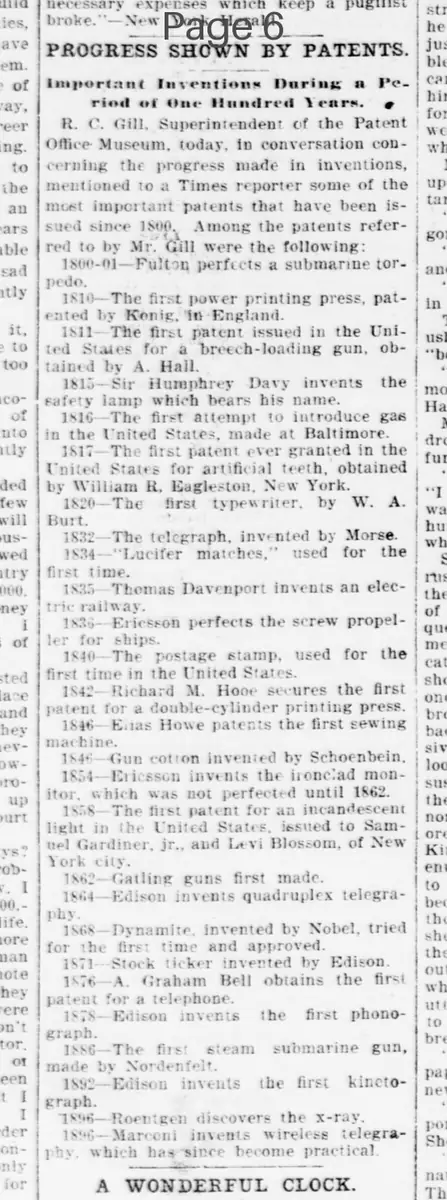
Important Inventions During a Period of One Hundred Years.
R. C. Gill, Superintendent of the Patent Office Museum, today, in conversation concerning the progress made in inventions mentioned to a Times reporter some of the most important patents that have been issued since 1800. Among the patents referred to by Mr. Gill were the following:
1800—Fulton perfects a submarine torpedo.
1810—The first power printing press, patented by Konig, in England.
1811—The first patent issued in the United States for a breech-loading gun, obtained by A. Hall.
1815—Sir Humphrey Davy invents the safety lamp which bears his name.
1816—The first attempt to introduce gas in the United States, made at Baltimore.
1817—The first patent ever granted in the United States for artificial teeth, obtained by William R. Eagleston, New York.
1820—The first typewriter, by W. A. Burt.
1832—The telegraph, invented by Morse.
1834—"Lucifer matches," used for the first time.
1835—Thomas Davenport invents an electric railway.
1840—Ericsson perfects the screw propeller for ships.
1840—The postage stamp, used for the first time in the United States.
1842—Richard M. Hooe secures the first patent for a double-cylinder printing press.
1846—Elias Howe patents the first sewing machine.
1846—Gun cotton invented by Schoenbein.
1854—Ericsson invents the ironclad monitor, which was not perfected until 1862.
1855—The first patent for an incandescent light in the United States, issued to Samuel Gardiner, jr., and Levi Blossom, of New York city.
1857—Gatling guns first made.
1864—Edison invents quadruplex telegraphy.
1865—Dynamite, invented by Nobel, tried for the first time and approved.
1871—Stock ticker invented by Edison.
1876—A. Graham Bell obtains the first patent for a telephone.
1877—Edison invents the first phonograph.
1885—The first steam submarine gun, made by Nordenfelt.
1892—Edison invents the first kinetograph.
1895—Roentgen discovers the x-ray.
1896—Marconi invents wireless telegraphy by which has since become practical.
What sub-type of article is it?
What themes does it cover?
What keywords are associated?
What entities or persons were involved?
Where did it happen?
Story Details
Key Persons
Location
United States
Event Date
1800 1896
Story Details
R. C. Gill highlights key patents and inventions from 1800 to 1896, including submarine torpedo, power printing press, breech-loading gun, safety lamp, gas introduction, artificial teeth, typewriter, telegraph, lucifer matches, electric railway, screw propeller, postage stamp, double-cylinder printing press, sewing machine, gun cotton, ironclad monitor, incandescent light, Gatling guns, quadruplex telegraphy, dynamite, stock ticker, telephone, phonograph, steam submarine gun, kinetograph, x-ray, and wireless telegraphy.