Thank you for visiting SNEWPapers!
Sign up free
Richmond Palladium
Richmond, Wayne County, Indiana
What is this article about?
Correspondence between Colonel John Johnson and Shawnee Chief John Wolf discusses their past companionship, current hardships among the Shawnee in Kansas, complaints about reduced annuities possibly due to government loans to states, deaths of chiefs, and warnings of Indian unrest amid the Mexican War. Johnson urges investigation into fund mismanagement.
Clipping
OCR Quality
Full Text
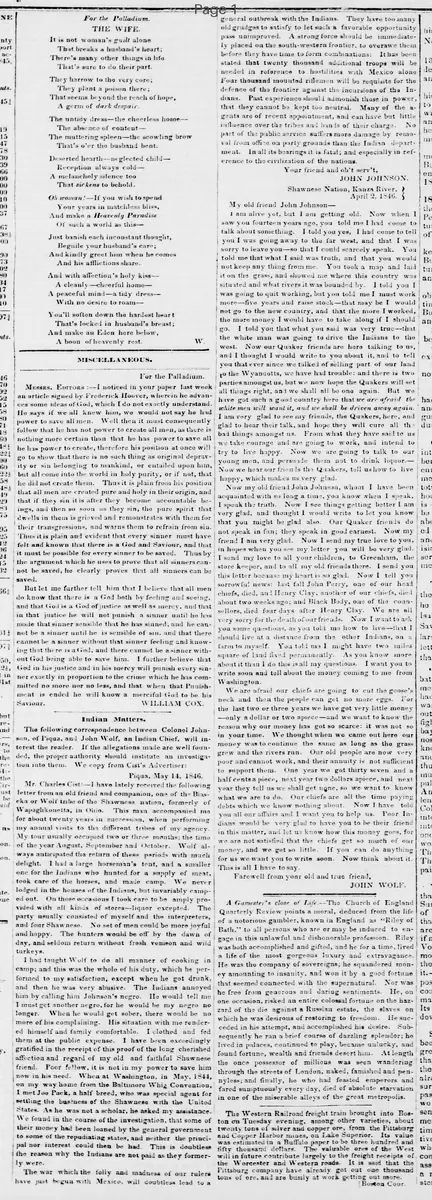
The following correspondence between Colonel Johnson, of Piqua, and John Wolf, an Indian Chief, will interest the reader. If the allegations made are well founded, the proper authority should institute an investigation into them. We copy from Cist's Advertiser:
Piqua, May 14, 1846.
Mr. Charles Cist:--I have lately received the following letter from an old friend and companion, one of the Shawnee or Wolf tribe of the Shawnee nation, formerly of Wapakonetta, in Ohio. This man accompanied me for about twenty years in succession, when performing my annual visits to the different tribes of my agency. My tour usually occupied two or three months; the time of the year August, September and October. Wolf always anticipated the return of these periods with much delight. I had a large horseman's tent, and a smaller one for the Indians who hunted for a supply of meat, took care of the horses, and made camp. We never lodged in the houses of the Indians, but invariably camped out. On those occasions I took care to be amply provided with all kinds of stores--liquor excepted. The party usually consisted of myself and the interpreters, and four Shawnee. No set of men could be more joyful and happy. The hunters would be off by the dawn of day, and seldom return without fresh venison and wild turkeys.
I had taught Wolf to do all manner of cooking in camp; and this was the whole of his duty, which he performed to my satisfaction, except when he got drunk, and then he was very abusive. The Indians annoyed him by calling him Johnson's negro. He would tell me I must get another negro, for he would be my negro no longer. When he would get sober, there would be no more of his complaining. His situation with me rendered himself and family comfortable. I clothed and fed them at the public expense. I have been exceedingly gratified in the receipt of this proof of the long cherished affection and regard of my old and faithful Shawnee friend. Poor fellow, it is not in my power to save him now in his need. When at Washington, in May, 1844, on my way home from the Baltimore Whig Convention, I met Joe Pack, a half breed, who was special agent for settling the business of the Shawnee with the United States. As he was not a scholar, he asked my assistance. We found in the course of the investigation, that some of their money had been loaned by the general government to some of the repudiating states, and neither the principal nor interest could then be had. This is doubtless the reason why the Indians are not paid as they formerly were.
The war which the folly and madness of our rulers have just begun with Mexico, will doubtless lead to a general outbreak with the Indians. They have too many old grudges to satisfy to let such a favorable opportunity pass unimproved. A strong force should be immediately placed on the south-western frontier, to overawe them before they have time to form combinations. It has been stated that twenty thousand additional troops will be needed in reference to hostilities with Mexico alone. Four thousand mounted riflemen will be requisite for the defence of the frontier against the incursions of the Indians. Past experience should admonish those in power, that they cannot be kept too neutral. Many of the agents are of recent appointment, and can have but little influence over the tribes and bands of their charge. No part of the public service suffers more damage by removal from office on party grounds than the Indian department. In all its bearings it is fatal; and especially in reference to the civilization of the nations.
Your friend and ob't serv't,
JOHN JOHNSON.
Shawnee Nation, Kansas River.
April 2, 1846.
My old friend John Johnson--
I am alive yet, but I am getting old. Now when I saw you fourteen years ago, you told me I had come to talk about something. I told you yes, I had come to tell you I was going away to the far west, and that I was sorry to leave you--so that I could scarcely speak. You told me that what I said was truth, and that you would not keep any thing from me. You took a map and laid it on the grass, and showed me where this country was situated and what rivers it was bounded by. I told you I was going to quit working, but you told me I must work more--five years and raise stock--that may be I would not go to the new country, and that the more I worked, the more money I would have to take along if I should go. I told you that what you said was very true--that the white man was going to drive the Indians to the west. Now our Quaker friends are here talking to us. and I thought I would write to you about it, and to tell you that ever since we talked of selling part of our land to the Wyandots, we have had trouble: and there is two parties amongst us, but we now hope the Quakers will set all things right, and we shall all be one again. But we have got such a good country here that we are afraid the white men will want it, and we shall be driven away again. I am very glad to see my friends, the Quakers, here, and glad to hear their talk, and hope they will cure all the bad things amongst us. From what they have said to us we take courage and are going to work, and intend to try to live happy. Now we are going to talk to our young men, and persuade them not to drink liquor. Now we hear our friends the Quakers, tell us how to live happy, which makes us very glad.
Now my old friend John Johnson, whom I have been acquainted with so long a time, you know when I speak, I speak the truth. Now I see things getting better I am very glad, and thought I would write to let you know that you might be glad also. Our Quaker friends do not speak in fun; they speak in good earnest. Now my friend I am very glad. Now I send my true love to you, in hopes when you see my letter you will be very glad. I send my love to all your children, to Greenham, the store keeper, and to all my old friends there. I send you this letter because my heart is so glad. Now I tell you sorrowful news: last fall John Perry, one of our head chiefs, died, and Henry Clay, another of our chiefs, died about two weeks ago; and Black Body, one of the counsellors, died four days after Henry Clay. We are all very sorry for the death of our friends. Now I want to ask you some questions, as you told me how to live that I should live at a distance from the other Indians, on a farm to myself. You told me I might have two miles square of land fixed permanently. As you know more about it than I do this is all my questions. I want you to write soon and tell about the money coming to me from Washington.
We are afraid our chiefs are going to cut the goose's neck and then the people can get no more eggs. For the last two or three years we have got very little money --only a dollar or two apiece--and we want to know the reason why our money has got so scarce: it was not so in your time. We thought when we came out here our money was to continue the same as long as the grass grew and the rivers run. Our old people are now very poor and cannot work, and their annuity is not sufficient to support them. One year we got thirty seven and a half cents a piece, next year two dollars apiece, and next year they tell us we shall get none, so we want to know what we are to do. Our chiefs are all the time paying debts which we know nothing about. Now I have told you all our affairs and I want you to help us. Poor Indians would be very glad to have you to be their friend in this matter, and let us know how this money goes, for we are not satisfied that the chiefs get so much of our money, and we get so little. If you can do anything for us we want you to write soon. Now think about it.
This is all I have to say.
Farewell from your old and true friend.
JOHN WOLF.
What sub-type of article is it?
What themes does it cover?
What keywords are associated?
What entities or persons were involved?
Where did it happen?
Story Details
Key Persons
Location
Piqua, Ohio; Wapakonetta, Ohio; Shawnee Nation, Kansas River; Washington
Event Date
1846 05 14; 1846 04 02
Story Details
Colonel Johnson shares a letter from his old Shawnee companion John Wolf, recounting their past travels and friendship. Wolf describes relocation to Kansas, Quaker influence for unity and sobriety, recent chief deaths, fears of further displacement, and complaints about diminished annuities due to chief mismanagement and government loans. Johnson explains fund issues, warns of Indian unrest from Mexican War, and calls for frontier defense and investigation.