Thank you for visiting SNEWPapers!
Sign up free
Editorial
September 25, 1850
The North Carolina Standard
Raleigh, Wake County, North Carolina
What is this article about?
This editorial sharply criticizes Senator George E. Badger's speech promoting strong federal allegiance and consolidation, arguing it erodes states' rights and sovereignty. It asserts allegiance is primarily to states, demands Badger obey state instructions or resign, and contrasts his pro-slavery defenses with his federalist stance amid 1850 compromises restricting slavery expansion.
Clipping
OCR Quality
98%
Excellent
Full Text
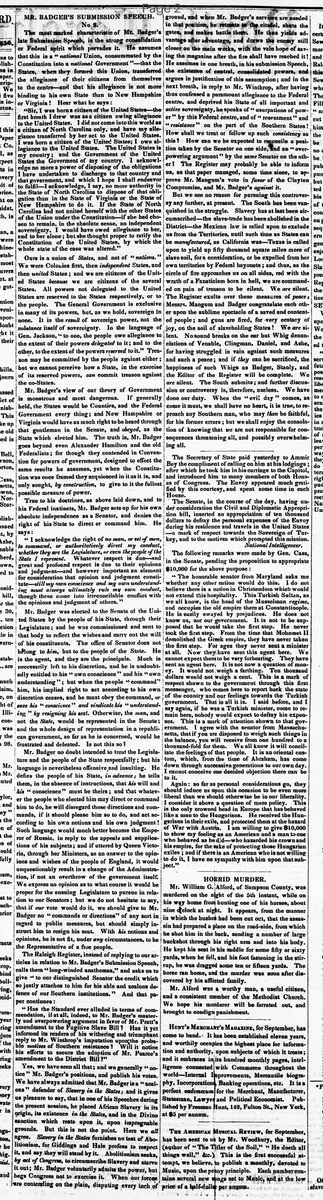
MR. BADGER'S SUBMISSION SPEECH.
No.
The most marked characteristic of Mr. Badger's late Submission Speech, is the strong consolidation or Federal spirit which pervades it. He assumes that this is a "national Union, consummated by the Constitution into a national Government"—that the States, when they formed this Union, transferred the allegiance of their citizens from themselves to the centre—and that his allegiance is not more binding to his own State than to New Hampshire or Virginia! Hear what he says:
"Sir, I was born a citizen of the United States—the first breath I drew was as a citizen owing allegiance to the United States. I did not come into this world as a citizen of North Carolina only, and have my allegiance transferred by her act to the United States. I was born a citizen of the United States; I owe allegiance to the United States. The United States is my country; and the Government of the United States the Government of my country. I acknowledge no more a power of disposing of the obligations I have undertaken to discharge to that country and that government, and which I hope I shall endeavor to fulfil—I acknowledge, I say, no more authority in the State of North Carolina to dispose of that obligation than in the State of Virginia or the State of New Hampshire to do it. If the State of North Carolina had not united herself with the other States of the Union under the Constitution—if she had chosen to remain, in the absolute sense, an independent sovereignty, I would have owed allegiance to her, and to her alone; but she thought proper to ratify the Constitution of the United States, by which the whole state of the case was altered."
Ours is a union of States, and not of "nations." We were Colonies first, then independent States, and then united States; and we are citizens of the United States because we are citizens of the several States. All powers not delegated to the United States are reserved to the States respectively, or to the people. The General Government is exclusive in many of its powers, but, as we hold, sovereign in none. It is the result of sovereign power, not the substance itself of sovereignty. In the language of Gen. Jackson, "to one, the people owe allegiance to the extent of their powers delegated to it; and to the other, to the extent of the powers reserved to it." Treason may be committed by the people against either; but we cannot perceive how a State, in the exercise of its reserved powers, can commit treason against the co-States.
Mr. Badger's view of our theory of Government is monstrous and most dangerous. If generally held, the States would be Counties, and the Federal Government every thing; and New Hampshire or Virginia would have as much right to be heard through that gentleman in the Senate, and obeyed, as the State which elected him. The truth is, Mr. Badger goes beyond even Alexander Hamilton and the old Federalists; for though they contended in Convention for powers of government, designed to effect the same results he assumes, yet when the Constitution was once framed they acquiesced in it as it is, and only sought, by construction, to give to it the fullest possible measure of power.
True to his doctrines, as above laid down, and to his Federal instincts, Mr. Badger sets up for his own absolute independence as a Senator, and denies the right of his State to direct or command him. He says:
"I acknowledge the right of no man, or set of men, to command, or authoritatively direct my conduct, whether they are the Legislature, or even the people of the State I represent. Whatever respect is due—and great and profound respect is due to their opinions and judgment—and however important an element for consideration that opinion and judgment constitute—still my own conscience and my own understanding must always ultimately rule my own conduct, though these come into irreconcilable conflict with the opinions and judgment of others."
Mr. Badger was elected to the Senate of the United States by the people of his State, through their Legislature; and he was commissioned and sent to that body to reflect the wishes and carry out the will of his constituents. The office of Senator does not belong to him, but to the people of the State. He is the agent, and they are the principals. Much is necessarily left to his discretion, and he is undoubtedly entitled to his "own conscience" and his "own understanding"; but when the people command him, his implied right to act according to his own discretion ceases, and he must obey the command, or save his "conscience" and vindicate his "understanding" by resigning his seat. Otherwise, the man, and not the State, would be represented in the Senate; and the whole design of representation in a republican government, so far as he is concerned, would be frustrated and defeated. Is not this so?
Mr. Badger no doubt intended to treat the Legislature and the people of the State respectfully; but his language is nevertheless offensive and insulting. He defies the people of his State, in advance; he tells them, in the absence of instructions, that his will and his "conscience" must be theirs; and that whatever the people who elected him may direct or command him to do, he will disregard those directions and commands, if it should please him so to do, and act according to his own notions and his own judgment!
Such language would much better become the Emperor of Russia, in reply to the appeals and supplications of his subjects; and if uttered by Queen Victoria, through her Ministers, as an answer to the opinions and wishes of the people of England, it would unquestionably result in a change of the Administration, if not an overthrow of the government itself.
We express no opinion as to what course it would be proper for the ensuing Legislature to pursue in relation to our Senators; but we do not hesitate to say, that if our vote would do it, we should give to Mr. Badger no "commands or directions" of any sort in regard to public measures, but should simply instruct him to resign his seat. With his notions and opinions, he is not fit, under any circumstances, to be the Representative of a free people.
The Raleigh Register, instead of replying to our articles in relation to Mr. Badger's Submission Speech, calls them "long-winded anathemas," and asks us to give "to our distinguished Senator the credit which so justly attaches to him for his able and zealous defence of our Southern institutions." And that paper continues:
"Has the Standard ever alluded in terms of commendation, if at all, indeed, to Mr. Badger's masterly and overpowering argument in favor of Mr. Pratt's amendment to the Fugitive Slave Bill? Has it yet informed its readers of his withering and triumphant reply to Mr. Winthrop's imputation upon the probable motives of Southern resistance? Will it notice his efforts to secure the adoption of Mr. Pearce's amendment to the District Bill?"
Yes, we have seen all that; and we generally "notice" Mr. Badger's positions, and publish his votes. We have always admitted that Mr. Badger is a "zealous" defender of Slavery in the States; and it gives us pleasure to say, that in one of his Speeches during the present session, he placed African Slavery in its origin, its existence in the States, and in the Divine sanction which rests upon it, upon impregnable grounds. But this is not the point. Here we all agree. Slavery in the States furnishes no test of Abolitionism, for Giddings and Hale profess to respect it, and say they will stand by it. Abolitionism seeks, by act of Congress, to circumscribe Slavery and starve it out; Mr. Badger voluntarily admits the power, but begs Congress not to exercise it. When our forces are contending on the plain, disputing every inch of ground, and when Mr. Badger's services are needed in that position, he retreats to the citadel, shuts the gates, and makes battle there. He thus yields advantage after advantage, and draws the enemy still closer on the main works, with the vain hope of saving the magazine after the fire shall have reached it!
He assumes in one breath, in his submission Speech, the existence of central, consolidated powers, and argues in justification of this assumption; and in the next breath, in reply to Mr. Winthrop, after having thus confessed a paramount allegiance to the Federal centre, and deprived his State of all important and active sovereignty, he speaks of "usurpations of power" by this Federal centre, and of "resentment" and "resistance" on the part of the Southern States!
How shall we treat or follow up such consistency as this! How can we be expected to reconcile a position taken by the Senator on one side, and an "overpowering argument" by the same Senator on the other? The Register may probably be able to inform us, as that paper managed, some time since, to approve Mr. Mangum's vote in favor of the Clayton Compromise, and Mr. Badger's against it.
But we see no reason for pursuing this controversy any further, at present. The South has been vanquished in the struggle. Slavery has at last been circumscribed—the slave-trade has been abolished in the District—the Mexican law is relied upon to exclude us from the Territories, until such time as States can be manufactured, as California was—Texas is called upon to yield up fifty thousand square miles more of slave soil, for a consideration, or be expelled from her own territories by Federal bayonets; and thus, as the circle of fire approaches us on all sides, red with the wrath of a Fanaticism born in hell, we are commanded on pain of treason to be silent. We are silent. The Register exults over these measures of peace; Messrs. Mangum and Badger congratulate each other upon the sublime spectacle of a saved and contented people; and guns are fired, for very ecstasy of joy, on the soil of slaveholding States! We are silent. No sound breaks on the ear but Whig denunciations of Venable, Clingman, Daniel, and Ashe, for having struggled in vain against such measures and such a peace; and if they can be sacrificed, the happiness of such Whigs as Badger, Stanly, and the Editor of the Register will be complete. We are silent. The South submits; and further discussion or controversy is, therefore, useless. We have done our duty. When the "evil day" comes, as come it must, we shall have no heart, it is true, to reproach any Southern man, who may then be faithful, for his former errors; but we shall enjoy the consolation of knowing that we are not responsible for consequences threatening all, and possibly overwhelming all.
No.
The most marked characteristic of Mr. Badger's late Submission Speech, is the strong consolidation or Federal spirit which pervades it. He assumes that this is a "national Union, consummated by the Constitution into a national Government"—that the States, when they formed this Union, transferred the allegiance of their citizens from themselves to the centre—and that his allegiance is not more binding to his own State than to New Hampshire or Virginia! Hear what he says:
"Sir, I was born a citizen of the United States—the first breath I drew was as a citizen owing allegiance to the United States. I did not come into this world as a citizen of North Carolina only, and have my allegiance transferred by her act to the United States. I was born a citizen of the United States; I owe allegiance to the United States. The United States is my country; and the Government of the United States the Government of my country. I acknowledge no more a power of disposing of the obligations I have undertaken to discharge to that country and that government, and which I hope I shall endeavor to fulfil—I acknowledge, I say, no more authority in the State of North Carolina to dispose of that obligation than in the State of Virginia or the State of New Hampshire to do it. If the State of North Carolina had not united herself with the other States of the Union under the Constitution—if she had chosen to remain, in the absolute sense, an independent sovereignty, I would have owed allegiance to her, and to her alone; but she thought proper to ratify the Constitution of the United States, by which the whole state of the case was altered."
Ours is a union of States, and not of "nations." We were Colonies first, then independent States, and then united States; and we are citizens of the United States because we are citizens of the several States. All powers not delegated to the United States are reserved to the States respectively, or to the people. The General Government is exclusive in many of its powers, but, as we hold, sovereign in none. It is the result of sovereign power, not the substance itself of sovereignty. In the language of Gen. Jackson, "to one, the people owe allegiance to the extent of their powers delegated to it; and to the other, to the extent of the powers reserved to it." Treason may be committed by the people against either; but we cannot perceive how a State, in the exercise of its reserved powers, can commit treason against the co-States.
Mr. Badger's view of our theory of Government is monstrous and most dangerous. If generally held, the States would be Counties, and the Federal Government every thing; and New Hampshire or Virginia would have as much right to be heard through that gentleman in the Senate, and obeyed, as the State which elected him. The truth is, Mr. Badger goes beyond even Alexander Hamilton and the old Federalists; for though they contended in Convention for powers of government, designed to effect the same results he assumes, yet when the Constitution was once framed they acquiesced in it as it is, and only sought, by construction, to give to it the fullest possible measure of power.
True to his doctrines, as above laid down, and to his Federal instincts, Mr. Badger sets up for his own absolute independence as a Senator, and denies the right of his State to direct or command him. He says:
"I acknowledge the right of no man, or set of men, to command, or authoritatively direct my conduct, whether they are the Legislature, or even the people of the State I represent. Whatever respect is due—and great and profound respect is due to their opinions and judgment—and however important an element for consideration that opinion and judgment constitute—still my own conscience and my own understanding must always ultimately rule my own conduct, though these come into irreconcilable conflict with the opinions and judgment of others."
Mr. Badger was elected to the Senate of the United States by the people of his State, through their Legislature; and he was commissioned and sent to that body to reflect the wishes and carry out the will of his constituents. The office of Senator does not belong to him, but to the people of the State. He is the agent, and they are the principals. Much is necessarily left to his discretion, and he is undoubtedly entitled to his "own conscience" and his "own understanding"; but when the people command him, his implied right to act according to his own discretion ceases, and he must obey the command, or save his "conscience" and vindicate his "understanding" by resigning his seat. Otherwise, the man, and not the State, would be represented in the Senate; and the whole design of representation in a republican government, so far as he is concerned, would be frustrated and defeated. Is not this so?
Mr. Badger no doubt intended to treat the Legislature and the people of the State respectfully; but his language is nevertheless offensive and insulting. He defies the people of his State, in advance; he tells them, in the absence of instructions, that his will and his "conscience" must be theirs; and that whatever the people who elected him may direct or command him to do, he will disregard those directions and commands, if it should please him so to do, and act according to his own notions and his own judgment!
Such language would much better become the Emperor of Russia, in reply to the appeals and supplications of his subjects; and if uttered by Queen Victoria, through her Ministers, as an answer to the opinions and wishes of the people of England, it would unquestionably result in a change of the Administration, if not an overthrow of the government itself.
We express no opinion as to what course it would be proper for the ensuing Legislature to pursue in relation to our Senators; but we do not hesitate to say, that if our vote would do it, we should give to Mr. Badger no "commands or directions" of any sort in regard to public measures, but should simply instruct him to resign his seat. With his notions and opinions, he is not fit, under any circumstances, to be the Representative of a free people.
The Raleigh Register, instead of replying to our articles in relation to Mr. Badger's Submission Speech, calls them "long-winded anathemas," and asks us to give "to our distinguished Senator the credit which so justly attaches to him for his able and zealous defence of our Southern institutions." And that paper continues:
"Has the Standard ever alluded in terms of commendation, if at all, indeed, to Mr. Badger's masterly and overpowering argument in favor of Mr. Pratt's amendment to the Fugitive Slave Bill? Has it yet informed its readers of his withering and triumphant reply to Mr. Winthrop's imputation upon the probable motives of Southern resistance? Will it notice his efforts to secure the adoption of Mr. Pearce's amendment to the District Bill?"
Yes, we have seen all that; and we generally "notice" Mr. Badger's positions, and publish his votes. We have always admitted that Mr. Badger is a "zealous" defender of Slavery in the States; and it gives us pleasure to say, that in one of his Speeches during the present session, he placed African Slavery in its origin, its existence in the States, and in the Divine sanction which rests upon it, upon impregnable grounds. But this is not the point. Here we all agree. Slavery in the States furnishes no test of Abolitionism, for Giddings and Hale profess to respect it, and say they will stand by it. Abolitionism seeks, by act of Congress, to circumscribe Slavery and starve it out; Mr. Badger voluntarily admits the power, but begs Congress not to exercise it. When our forces are contending on the plain, disputing every inch of ground, and when Mr. Badger's services are needed in that position, he retreats to the citadel, shuts the gates, and makes battle there. He thus yields advantage after advantage, and draws the enemy still closer on the main works, with the vain hope of saving the magazine after the fire shall have reached it!
He assumes in one breath, in his submission Speech, the existence of central, consolidated powers, and argues in justification of this assumption; and in the next breath, in reply to Mr. Winthrop, after having thus confessed a paramount allegiance to the Federal centre, and deprived his State of all important and active sovereignty, he speaks of "usurpations of power" by this Federal centre, and of "resentment" and "resistance" on the part of the Southern States!
How shall we treat or follow up such consistency as this! How can we be expected to reconcile a position taken by the Senator on one side, and an "overpowering argument" by the same Senator on the other? The Register may probably be able to inform us, as that paper managed, some time since, to approve Mr. Mangum's vote in favor of the Clayton Compromise, and Mr. Badger's against it.
But we see no reason for pursuing this controversy any further, at present. The South has been vanquished in the struggle. Slavery has at last been circumscribed—the slave-trade has been abolished in the District—the Mexican law is relied upon to exclude us from the Territories, until such time as States can be manufactured, as California was—Texas is called upon to yield up fifty thousand square miles more of slave soil, for a consideration, or be expelled from her own territories by Federal bayonets; and thus, as the circle of fire approaches us on all sides, red with the wrath of a Fanaticism born in hell, we are commanded on pain of treason to be silent. We are silent. The Register exults over these measures of peace; Messrs. Mangum and Badger congratulate each other upon the sublime spectacle of a saved and contented people; and guns are fired, for very ecstasy of joy, on the soil of slaveholding States! We are silent. No sound breaks on the ear but Whig denunciations of Venable, Clingman, Daniel, and Ashe, for having struggled in vain against such measures and such a peace; and if they can be sacrificed, the happiness of such Whigs as Badger, Stanly, and the Editor of the Register will be complete. We are silent. The South submits; and further discussion or controversy is, therefore, useless. We have done our duty. When the "evil day" comes, as come it must, we shall have no heart, it is true, to reproach any Southern man, who may then be faithful, for his former errors; but we shall enjoy the consolation of knowing that we are not responsible for consequences threatening all, and possibly overwhelming all.
What sub-type of article is it?
Constitutional
Partisan Politics
Slavery Abolition
What keywords are associated?
States Rights
Federal Allegiance
Mr Badger Speech
Southern Institutions
Slavery Defense
Compromise Of 1850
Senatorial Independence
Constitutional Union
What entities or persons were involved?
Mr. Badger
North Carolina
United States
Gen. Jackson
Alexander Hamilton
The Raleigh Register
Mr. Winthrop
Mr. Pratt
Mr. Pearce
Messrs. Mangum And Badger
Venable, Clingman, Daniel, Ashe
Editorial Details
Primary Topic
Critique Of Mr. Badger's Federalist Views On Allegiance And States' Rights
Stance / Tone
Strongly Pro States' Rights, Anti Federal Consolidation, Critical Of Mr. Badger
Key Figures
Mr. Badger
North Carolina
United States
Gen. Jackson
Alexander Hamilton
The Raleigh Register
Mr. Winthrop
Mr. Pratt
Mr. Pearce
Messrs. Mangum And Badger
Venable, Clingman, Daniel, Ashe
Key Arguments
Allegiance Is Primarily To States, Not The Federal Government
The Union Is Of States, Not Nations; States Retain Sovereignty
Mr. Badger's Views Reduce States To Counties Under Federal Dominance
Senators Must Obey State Instructions Or Resign To Uphold Representation
Badger's Speech Insults North Carolina's Legislature And People
Badger's Pro Slavery Defenses Concede Federal Power Over Slavery Expansion
Inconsistencies In Badger's Positions On Federal Authority And Southern Resistance
Southern Submission To 1850 Compromises Restricts Slavery Despite Defenses
Criticism Of Whig Politicians For Accepting Anti Southern Measures
Future Consequences Of Current Federal Overreach Will Vindicate States' Rights Advocates