Thank you for visiting SNEWPapers!
Sign up free
Domestic News
October 28, 1830
Litchfield Enquirer
Litchfield, Litchfield County, Connecticut
What is this article about?
Dodart observed that trees grow branches parallel to the earth's surface, even on steep hills. The author argues this leads to more fruitful orchards on declivities due to lateral branch growth, recommending such sites for planting fruit trees.
Clipping
OCR Quality
98%
Excellent
Full Text
Planting Fruit Trees on the side of Hills.
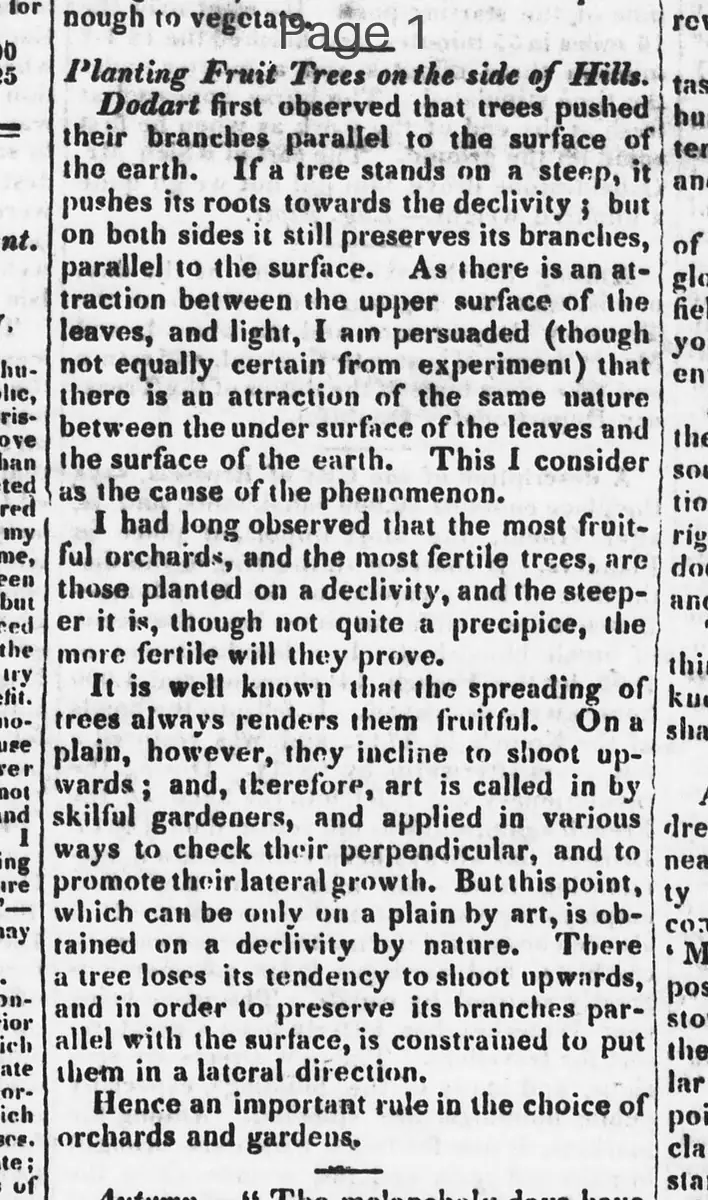
Dodart first observed that trees pushed their branches parallel to the surface of the earth. If a tree stands on a steep, it pushes its roots towards the declivity; but on both sides it still preserves its branches, parallel to the surface. As there is an attraction between the upper surface of the leaves, and light, I am persuaded (though not equally certain from experiment) that there is an attraction of the same nature between the under surface of the leaves and the surface of the earth. This I consider as the cause of the phenomenon.
I had long observed that the most fruitful orchards, and the most fertile trees, are those planted on a declivity, and the steeper it is, though not quite a precipice, the more fertile will they prove.
It is well known that the spreading of trees always renders them fruitful. On a plain, however, they incline to shoot upwards: and, therefore, art is called in by skilful gardeners, and applied in various ways to check their perpendicular, and to promote their lateral growth. But this point, which can be only on a plain by art, is obtained on a declivity by nature. There a tree loses its tendency to shoot upwards, and in order to preserve its branches parallel with the surface, is constrained to put them in a lateral direction.
Hence an important rule in the choice of orchards and gardens.
Dodart first observed that trees pushed their branches parallel to the surface of the earth. If a tree stands on a steep, it pushes its roots towards the declivity; but on both sides it still preserves its branches, parallel to the surface. As there is an attraction between the upper surface of the leaves, and light, I am persuaded (though not equally certain from experiment) that there is an attraction of the same nature between the under surface of the leaves and the surface of the earth. This I consider as the cause of the phenomenon.
I had long observed that the most fruitful orchards, and the most fertile trees, are those planted on a declivity, and the steeper it is, though not quite a precipice, the more fertile will they prove.
It is well known that the spreading of trees always renders them fruitful. On a plain, however, they incline to shoot upwards: and, therefore, art is called in by skilful gardeners, and applied in various ways to check their perpendicular, and to promote their lateral growth. But this point, which can be only on a plain by art, is obtained on a declivity by nature. There a tree loses its tendency to shoot upwards, and in order to preserve its branches parallel with the surface, is constrained to put them in a lateral direction.
Hence an important rule in the choice of orchards and gardens.
What sub-type of article is it?
Agriculture
What keywords are associated?
Fruit Trees
Planting On Hills
Orchards
Lateral Growth
Declivity
What entities or persons were involved?
Dodart
Domestic News Details
Key Persons
Dodart
Event Details
Trees push branches parallel to the earth's surface, even on steep hills, due to an attraction between leaf undersides and earth. This leads to lateral growth on declivities, making orchards more fruitful without artificial intervention, unlike on plains.