Thank you for visiting SNEWPapers!
Sign up free
Trainman News
Indianapolis, Marion County, Indiana
What is this article about?
John W. Perry testifies before the House Monopoly Investigating Committee about a conspiracy among Canadian newsprint producers, controlled by U.S. citizens, to fix prices, divide markets, and restrict production, evading U.S. antitrust laws. He reveals post-WWI agreements, WWII threats, and calls for investigation into tariff act violations.
Clipping
OCR Quality
Full Text
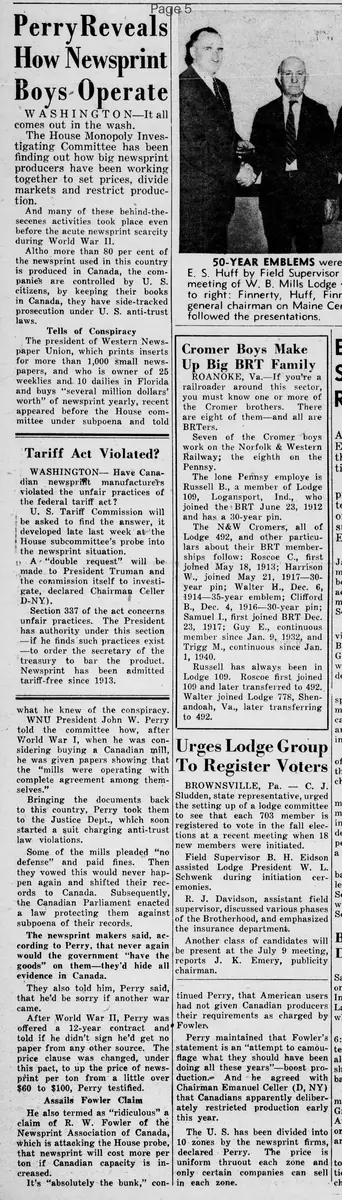
WASHINGTON—It all comes out in the wash.
The House Monopoly Investigating Committee has been finding out how big newsprint producers have been working together to set prices, divide markets and restrict production.
And many of these behind-the-scenes activities took place even before the acute newsprint scarcity during World War II.
Altho more than 80 per cent of the newsprint used in this country is produced in Canada, the companies are controlled by U. S. citizens, by keeping their books in Canada, they have side-tracked prosecution under U. S. anti-trust laws.
Tells of Conspiracy
The president of Western Newspaper Union, which prints inserts for more than 1,000 small newspapers, and who is owner of 25 weeklies and 10 dailies in Florida and buys "several million dollars' worth" of newsprint yearly, recently appeared before the House committee under subpoena and told what he knew of the conspiracy.
WNU President John W. Perry told the committee how, after World War I, when he was considering buying a Canadian mill, he was given papers showing that the "mills were operating with complete agreement among themselves."
Bringing the documents back to this country, Perry took them to the Justice Dept., which soon started a suit charging anti-trust law violations.
Some of the mills pleaded no defense and paid fines. Then they vowed this would never happen again and shifted their records to Canada. Subsequently, the Canadian Parliament enacted a law protecting them against subpoena of their records.
The newsprint makers said, according to Perry, that never again would the government "have the goods" on them—they'd hide all evidence in Canada.
They also told him, Perry said, that he'd be sorry if another war came.
After World War II, Perry was offered a 12-year contract and told if he didn't sign he'd get no paper from any other source. The price clause was changed, under this pact, to up the price of newsprint per ton from a little over $60 to $100, Perry testified.
Assails Fowler Claim
He also termed as "ridiculous" a claim of R. W. Fowler of the Newsprint Association of Canada, which is attacking the House probe, that newsprint will cost more per ton if Canadian capacity is increased.
It's "absolutely the bunk," continued Perry, that American users had not given Canadian producers their requirements as charged by Fowler.
Perry maintained that Fowler's statement is an "attempt to camouflage what they should have been doing all these years"—boost production. And he agreed with Chairman Emanuel Celler (D, NY) that Canadians apparently deliberately restricted production early this year.
The U. S. has been divided into 10 zones by the newsprint firms, declared Perry.
The price is uniform throughout each zone and only certain companies can sell in each zone.
Tariff Act Violated?
WASHINGTON—Have Canadian newsprint manufacturers violated the unfair practices of the federal tariff act?
U. S. Tariff Commission will be asked to find the answer. It developed late last week at the House subcommittee's probe into the newsprint situation.
A "double request" will be made to President Truman and the commission itself to investigate, declared Chairman Celler (D-NY).
Section 337 of the act concerns unfair practices. The President has authority under this section—if he finds such practices exist—to order the secretary of the treasury to bar the product.
Newsprint has been admitted tariff-free since 1913.
What sub-type of article is it?
What themes does it cover?
What keywords are associated?
What entities or persons were involved?
Where did it happen?
Story Details
Key Persons
Location
Washington
Event Date
Post World War Ii
Story Details
John W. Perry testifies about newsprint producers' conspiracy to fix prices, divide markets into zones, and restrict production, evading U.S. laws by basing in Canada; reveals post-WWI documents leading to fines, WWII contract pressures raising prices from $60 to $100 per ton, and calls for tariff act investigation.