Thank you for visiting SNEWPapers!
Sign up free
Yorkville Enquirer
York, York County, South Carolina
What is this article about?
President's message to Congress praises resumption of specie payments, details currency and coinage issues recommending suspension of silver dollars and removal of legal tenders; suggests tea/coffee taxes; urges action on Utah polygamy for statehood; supports election protections, civil service reforms; notes foreign amity, court remedies, Indian land division.
Clipping
OCR Quality
Full Text
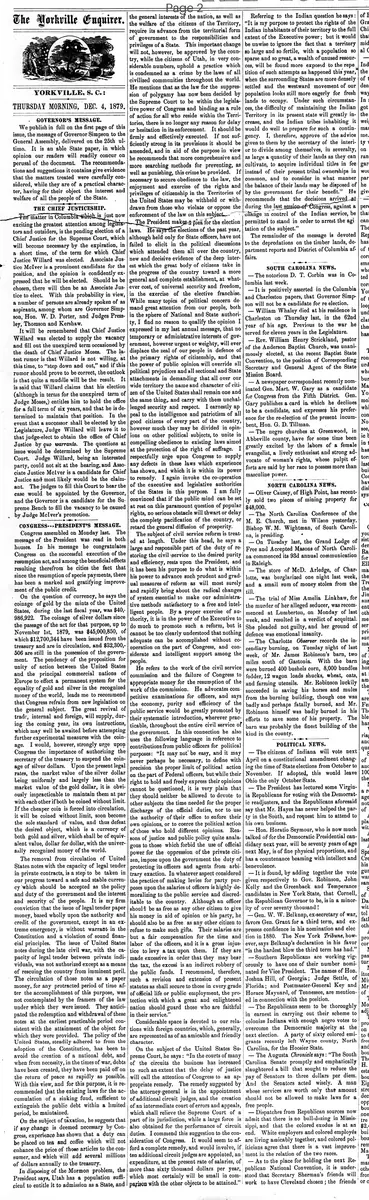
Congress assembled on Monday last. The message of the President was read in both houses. In his message he congratulates Congress on the successful execution of the resumption act, and among the beneficial effects resulting therefrom he cites the fact that since the resumption of specie payments, there has been a marked and gratifying improvement of the public credit.
On the question of currency, he says the coinage of gold by the mints of the United States, during the last fiscal year, was $40,986,922. The coinage of silver dollars since the passage of the act for that purpose, up to November 1st, 1879, was $45,000,850, of which $12,700,344 have been issued from the treasury and are in circulation, and $32,300,506 are still in the possession of the government. The pendency of the proposition for unity of action between the United States and the principal commercial nations of Europe to effect a permanent system for the equality of gold and silver in the recognized money of the world, leads me to recommend that Congress refrain from new legislation on the general subject. The great revival of trade, internal and foreign, will supply, during the coming year, its own instructions, which may well be awaited before attempting further experimental measures with the coinage. I would, however, strongly urge upon Congress the importance of authorizing the secretary of the treasury to suspend the coinage of silver dollars. Upon the present legal rates, the market value of the silver dollar being uniformly and largely less than the market value of the gold dollar, it is obviously impracticable to maintain them at par with each other if both be coined without limit. If the cheaper coin is forced into circulation, it will be coined without limit, soon become the sole standard of value, and thus defeat the desired object, which is a currency of both gold and silver, which shall be of equivalent value, dollar for dollar, with the universally recognized money of the world.
The removal from circulation of United States notes with the capacity of legal tender in private contracts, is a step to be taken in our progress toward a safe and stable currency which should be accepted as the policy and duty of the government and the interest and security of the people. It is my firm conviction that the issue of legal tender paper money, based wholly upon the authority and credit of the government, except in an extreme emergency, is without warrant in the Constitution and a violation of sound financial principles. The issue of United States notes during the late civil war, with the capacity of legal tender between private individuals, was not authorized except as a means of rescuing the country from imminent peril. The circulation of those notes as a paper money, for any protracted period of time after the accomplishment of this purpose, was not contemplated by the framers of the law under which they were issued. They anticipated the redemption and withdrawal of these notes at the earliest practicable period consistent with the attainment of the object for which they were provided. The policy of the United States, steadily adhered to from the adoption of the Constitution, has been to avoid the creation of a national debt, and when from necessity, in the times of war, debts have been created, they have been paid off on the return of peace as rapidly as possible. With this view, and for this purpose, it is recommended that the existing laws for the accumulation of a sinking fund, sufficient to extinguish the public debt within a limited period, be maintained.
On the subject of taxation, he suggests that if any change is deemed necessary by Congress, experience has shown that a duty can be placed on tea and coffee which will not enhance the price of those articles to the consumer, and which will add several millions of dollars annually to the treasury.
In disposing of the Mormon problem, the President says, Utah has a population sufficient to entitle it to admission as a State, and the general interests of the nation, as well as the welfare of the citizens of the Territory require its advance from the territorial form of government to the responsibilities and privileges of a State. This important change will not, however, be approved by the country, while the citizens of Utah, in very considerable numbers, uphold a practice which is condemned as a crime by the laws of all civilized communities throughout the world. He mentions that as the law for the suppression of polygamy has now been decided by the Supreme Court to be within the legislative power of Congress and binding as a rule of action for all who reside within the Territories, there is no longer any reason for delay or hesitation in its enforcement. It should be firmly and effectively executed. If not sufficiently strong in its provisions it should be amended, and in aid of the purpose in view he recommends that more comprehensive and more searching methods for preventing, as well as punishing, this crime be provided. If necessary to secure obedience to the law, the enjoyment and exercise of the rights and privileges of citizenship in the Territories of the United States may be withheld or withdrawn from those who violate or oppose the enforcement of the law on this subject.
The President makes a plea for the election laws. He says the elections of the past year, although held only for State officers, have not failed to elicit in the political discussions which attended them all over the country, new and decisive evidence of the deep interest which the great body of citizens take in the progress of the country toward a more general and complete establishment, at whatever cost, of universal security and freedom, in the exercise of the elective franchise. While many topics of political concern demand great attention from our people, both in the sphere of National and State authority, I find no reason to qualify the opinion I expressed in my last annual message, that no temporary or administrative interests of government, however urgent or weighty, will ever displace the zeal of our people in defence of the primary rights of citizenship, and that the power of public opinion will override all political prejudices and all sectional and State attachments in demanding that all over our wide territory the name and character of citizen of the United States shall remain one and the same thing, and carry with them unchallenged security and respect. I earnestly appeal to the intelligence and patriotism of all good citizens of every part of the country, however much they may be divided in opinions on other political subjects, to unite in compelling obedience to existing laws aimed at the protection of the right of suffrage. I respectfully urge upon Congress to supply any defects in these laws which experience has shown, and which it is within its power to remedy. I again invoke the co-operation of the executive and legislative authorities of the States in this purpose. I am fully convinced that if the public mind can be set at rest on this paramount question of popular rights, no serious obstacle will thwart or delay the complete pacification of the country, or retard the general diffusion of prosperity.
The subject of civil service reform is treated at length. Under this head, he says a large and responsible part of the duty of restoring the civil service to the desired purity and efficiency, rests upon the President, and it has been his purpose to do what is within his power to advance such prudent and gradual measures of reform as will most surely and rapidly bring about the radical changes of system essential to make our administrative methods satisfactory to a free and intelligent people. By a proper exercise of authority, it is in the power of the Executive to do much to promote such a reform, but it cannot be too clearly understood that nothing adequate can be accomplished without co-operation on the part of Congress, and considerate and intelligent support among the people. He refers to the work of the civil service commission and the failure of Congress to appropriate money for the resumption of the work of the commission. He advocates competitive examinations for officers, and says the economy, purity and efficiency of the public service would be greatly promoted by their systematic introduction, wherever practicable, throughout the entire civil service of the government. In this connection he also uses the following language in reference to contributions from public officers for political purposes: "It may not be easy, and it may never perhaps be necessary, to define with precision the proper limit of political action on the part of Federal officers, but while their right to hold and freely express their opinions cannot be questioned, it is very plain that they should neither be allowed to devote to other subjects the time needed for the proper discharge of the official duties, nor to use the authority of their office to enforce their own opinions, or to coerce the political action of those who hold different opinions. Reasons of justice and public policy quite analogous to those which forbid the use of official power for the oppression of the private citizen, impose upon the government the duty of protecting its officers and agents from arbitrary exaction. In whatever aspect considered the practice of making levies for party purposes upon the salaries of officers is highly demoralizing to the public service and discreditable to the country. Although an officer should be as free as any other citizen to give his money in aid of opinion or his party, he should also be as free as any other citizen to refuse to make such gifts. Their salaries are but a fair compensation for the time and labor of the officers, and it is a gross injustice to levy a tax upon them. If they are made excessive in order that they may bear the tax, the excess is an indirect robbery of the public funds. I recommend, therefore, such a revision and extension of present statutes as shall secure to those in every grade of official life or public employment, the protection with which a great and enlightened nation should guard those who are faithful in their service."
Considerable space is devoted to our relations with foreign countries, which, generally are represented as of an amicable and friendly character.
On the subject of the United States Supreme Court, he says: "In the courts of many of the circuits the business has increased to such an extent that the delay of justice will call the attention of Congress to an appropriate remedy. The remedy suggested by the attorney-general is in the appointment of additional circuit judges, and the creation of an intermediate court of errors and appeals which shall relieve the Supreme Court of a part of its jurisdiction, while a large force is also obtained for the performance of circuit duties. I commend this suggestion to the consideration of Congress. It would seem to afford a complete remedy, and would involve, if ten additional circuit judges are appointed, an expenditure, at the present rate of salaries, of more than sixty thousand dollars per year, which most certainly will be small in comparison with the other objects to be attained."
Referring to the Indian question he says: "It is my purpose to protect the rights of the Indian inhabitants of their territory to the full extent of the Executive power; but it would be unwise to ignore the fact that a territory so large and so fertile, with a population so sparse and so great, a wealth of unused resources, will be found more exposed to the repetition of such attempts as happened this year, when the surrounding States are more densely settled and the westward movement of our population looks still more eagerly for fresh lands to occupy. Under such circumstances, the difficulty of maintaining the Indian Territory in its present state will greatly increase, and the Indian tribes inhabiting it would do well to prepare for such a contingency. I, therefore, approve of the advice given to them by the secretary of the interior to divide among themselves, in severalty, as large a quantity of their lands as they can cultivate, to acquire individual titles in fee instead of their present tribal ownerships in common, and to consider in what manner the balance of their lands may be disposed of by the government for their benefit." He recommends that the decisions arrived at during the last session of Congress, against a change in control of the Indian service, be permitted to stand in order to arrest the agitation of the subject.
The remainder of the message is devoted to the depredations on the timber lands, department reports and District of Columbia affairs.
What sub-type of article is it?
What keywords are associated?
What entities or persons were involved?
Where did it happen?
Domestic News Details
Primary Location
Washington
Event Date
Monday Last
Key Persons
Event Details
Congress assembled on Monday last. The President's message was read in both houses, congratulating on the successful execution of the resumption act and improvement in public credit. It discusses currency, including gold and silver coinage figures, recommends refraining from new legislation on coinage unity with Europe, suspending silver dollar coinage, removing legal tender notes from circulation, maintaining sinking fund for public debt. On taxation, suggests duties on tea and coffee. Addresses Mormon problem in Utah, recommending admission as state conditional on suppressing polygamy, enforcing laws, possible amendments. Pleads for election laws to protect suffrage. Advocates civil service reform, competitive examinations, against political levies on officers. Notes amicable foreign relations. Suggests remedies for Supreme Court backlog, additional judges. On Indian question, advises dividing lands in severalty. Remainder covers timber depredations, department reports, District of Columbia.