Thank you for visiting SNEWPapers!
Sign up free
The National Intelligencer And Washington Advertiser
Washington, District Of Columbia
What is this article about?
Washington City newspaper editorial from July 13, 1801, reports presidential appointments, July 4th celebrations signaling declining party animosity, Mr. Peale's mammoth bone acquisition, and extensive commentary praising Albert Gallatin's 1796 financial sketch advocating debt reduction, import duties, and land taxes while opposing excises and funded debt.
Merged-components note: This is a single editorial piece including official appointments, commentary, and a continued multi-part extract from Gallatin's 1796 sketch on U.S. finances, indicated by '(Concluded.)' and continuous text across pages.
Clippings
1 of 3
OCR Quality
Full Text
This is Event 2 of 2. The full text below covers all events in this component.
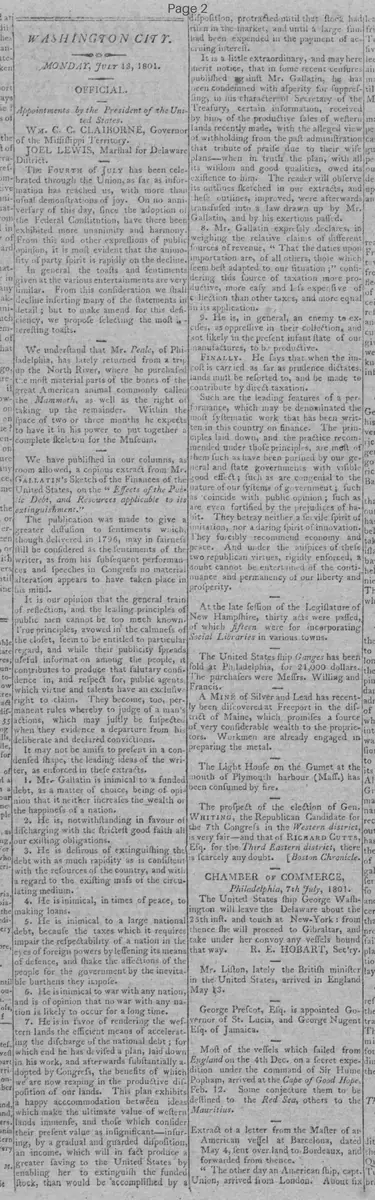
MONDAY, JULY 13, 1801.
:OFFICIAL
Appointments by the President of the United States.
WM. C. C. CLAIBORNE, Governor of the Mississippi Territory.
JOEL LEWIS, Marshal for Delaware District.
The Fourth of July has been celebrated throughout the Union, as far as information has reached us, with more than usual demonstrations of joy. On no anniversary of this day, since the adoption of the Federal Constitution, have there been exhibited more unanimity and harmony.
From this and other expressions of public opinion, it is most evident that the animosity of party spirit is rapidly on the decline.
In general the toasts and sentiments given at the various entertainments are very similar. From this consideration we shall decline inserting many of the statements in detail; but to make amend for this deficiency, we propose selecting the most interesting toasts.
We understand that Mr. Peale, of Philadelphia, has lately returned from a trip up the North River, where he purchased the most material parts of the bones of the great American animal commonly called the Mammoth, as well as the right of taking up the remainder. Within the space of two or three months he expects to have it in his power to put together a complete skeleton for the Museum.
We have published in our columns, as room allowed, a copious extract from Mr. Gallatin's Sketch of the Finances of the United States, on the "Effects of the Public Debt, and Resources applicable to its extinguishment."
The publication was made to give a greater diffusion to sentiments which, though delivered in 1796, may in fairness still be considered as the sentiments of the writer, as from his subsequent performances and speeches in Congress no material alteration appears to have taken place in his mind.
It is our opinion that the general train of reflection, and the leading principles of public men cannot be too much known.
True principles, avowed in the calmness of the closet, seem to be entitled to particular regard, and while their publicity spreads useful information among the people, it contributes to produce that salutary confidence in, and respect for, public agents which virtue and talents have an exclusive right to claim. They become, too, permanent rules whereby to judge of a man's actions, which may justly be suspected when they evidence a departure from his deliberate and declared convictions.
It may not be amiss to present in a condensed shape, the leading ideas of the writer, as enforced in these extracts.
1. Mr. Gallatin is inimical to a funded debt, as a matter of choice, being of opinion that it neither increases the wealth or the happiness of a nation.
2. He is, notwithstanding in favour of discharging with the strictest good faith all our existing obligations.
3. He is desirous of extinguishing the debt with as much rapidity as is consistent with the resources of the country, and with a regard to the existing mass of the circulating medium.
4. He is inimical, in times of peace, to making loans.
5. He is inimical to a large national debt, because the taxes which it requires impair the respectability of a nation in the eyes of foreign powers by lessening its means of defence, and shake the affections of the people for the government by the inevitable burdens they impose.
6. He is inimical to war with any nation, and is of opinion that no war with any nation is likely to occur for a long time.
7. He is in favor of rendering the western lands the efficient means of accelerating the discharge of the national debt; for which end he has devised a plan, laid down in his work, and afterwards substantially adopted by Congress, the benefits of which we are now reaping in the productive disposition of our lands. This plan exhibits a happy accommodation between ideas which make the ultimate value of western lands immense, and those which consider their present value as insignificant—insuring, by a gradual and guarded disposition, an income, which will in fact produce a greater saving to the United States by enabling her to extinguish the funded stock, than would be accomplished by a disposition, protracted until that stock had risen in the market, and until a large sum had been expended in the payment of accruing interest.
It is a little extraordinary, and may merit notice, that in some recent censures published against Mr. Gallatin, he has been condemned with asperity for suppressing, in his character of Secretary of the Treasury, certain information, received by him, of the productive sales of western lands recently made, with the alleged view of withholding from the past administration that tribute of praise due to their wise plans—when in truth the plan, with all its wisdom and good qualities, owed its existence to him. The reader will observe its outlines sketched in our extracts, and these outlines, improved, were afterwards transfused into a law drawn up by Mr. Gallatin, and by his exertions passed.
8. Mr. Gallatin expressly declares, in weighing the relative claims of different sources of revenue, "That the duties upon importation are, of all others, those which seem best adapted to our situation;" considering this source of taxation more productive, more easy and less expensive of collection than other taxes, and more equal in its application.
9. He is, in general, an enemy to excises, as oppressive in their collection, and not likely in the present infant state of our manufactures, to be productive.
Finally. He says that when the impost is carried as far as prudence dictates, lands must be resorted to, and be made to contribute by direct taxation.
Such are the leading features of a performance, which may be denominated the most systematic work that has been written in this country on finance. The principles laid down, and the practice recommended under those principles, are most of them such as have been pursued by our general and state governments with visible good effect; such as are congenial to the nature of our systems of government; such as coincide with public opinion; such as are even fortified by the prejudices of habit. They betray neither a servile spirit of imitation, nor a daring spirit of innovation.
They forcibly recommend economy and peace. And under the auspices of these two republican virtues, rigidly enforced, a doubt cannot be entertained of the continuance and permanency of our liberty and prosperity.
EXTRACT from GALLATIN'S
Sketch of Finances of the United States
written in 1796.
(Concluded.)
The consumption, therefore of imported manufactures, and the amount of duties paid on that consumption will be proportionably less. If a land tax presses harder upon the land holders of the North, it is because the proportion of cultivators is less, and that of manufacturers is greater than to the South. If the proportion of manufacturers is less to the South, the people there must consume a greater quantity of foreign goods and pay a larger proportion of the import. By combining the two modes of taxation, a more equal effect will probably be produced than can be by either singly.
This opinion is confirmed by the experience of all other nations; it is not believed, that any instance can be adduced of a nation raising any considerable revenue, without having resorted to direct taxation, to land taxes. Nor have these, when laid judiciously, and with moderation, ever been complained of as unequal or oppressive. It is, however, proper to examine what additional resources can be derived from indirect taxes.
The duties upon importation are, of all others, those which seem best adapted to our situation. As we import more and manufacture less, in proportion to our consumption, than almost any other country, the impost must necessarily be far more productive than any internal duties on our own manufactures. The collection of the impost, being confined to a few sea-ports, requires but few officers and a small expense. The merchant is liable to no vexation from the officers, except at the time of landing the goods, and on board of his vessel; and he is always a man of sufficient information, to understand thoroughly the duties required of him by the law, and to repel any attempt by the officer to oppress. In those particulars the manufacturers who pay internal duties are generally placed in a worse situation, for the act of manufacturing not being, like that of landing goods, the work of a day, but that of the whole year, it is necessary, in order to know the quantity manufactured, that the work-shop of the manufacturer, should be perpetually opened to the inquisitorial inspection of the collector. Nor must it be forgotten that, in America, the few extensive manufactures are carried on by a great number of persons, many of whom, from their situation in life, may often involuntarily omit some of the numerous duties prescribed by the most complex of all revenue laws and are also more exposed to the oppression of subaltern officers. Although few manufactures are yet carried on upon a large scale in the United States, yet a great proportion of the most essentially necessary articles are made at home, and the greater part of the importations may justly be termed luxuries and are amongst the most proper objects of taxation. Thus the impost, at the same time that it possesses the same general advantages with other taxes upon consumption, is free of the most weighty inconveniences which may be objected to the other species : it is, in our present situation, of all others, the most productive, the cheapest to collect, the least vexatious, and in general the least oppressive.
Mr. Gallatin then examines into the fitness of the most extensive articles of American manufacture to be taxed; in general inferring that it would be improper at present to tax them; and then observes :]
It therefore appears, that the only new indirect taxes that can be resorted to, are an addition to the impost, an excise on leather and hats, and a stamp-duty; all of which would not yield above one million of dollars and would therefore fall short of the revenue wanted. Yet could a sufficient sum be raised by those means, the people of the United States may decide which would be most oppressive; these including an additional duty on salt, or a direct tax. The objection arising from a supposed inequality has already been noticed, and it must be farther observed that if some states have stronger objections against that species of taxation than others, they are generally those which have been mostly relieved, by the assumption of the state debts, from the heavy great individual burthen. Had not that assumption taken place, the Union, indeed, might have proceeded to the extinguishment of their proper debt, without wanting additional revenues, and without resorting to direct taxation. But those states who were oppressed under the weight of their own debts, must in that case have raised a larger revenue than will now be their proportion of a general tax. After having urged as the most powerful argument in favour of the assumption, that it would liberate the resources of each state from local demands, and "enable the Union to use them all"; it would seem unfair, at present, to refuse to the general government the command of the most productive internal branch of revenue. In fact, the very objections against that assumption, which have been so much insisted upon, must lose a great part of their strength, if an adequate revenue is raised. They are mostly grounded upon the increase of the general debt and the greater difficulty for the Union effectually to command all the resources of the country. Give the Union that command; prove that its ability of paying the principal of the debt is not impaired by having assumed the state debts; and the measure will stand almost justified.
How far the lands belonging to the United States, the additional resources to be derived from indirect taxes, and the savings which may be effected in our present rate of expenditure may reduce the amount of revenue to be raised by a direct tax, cannot be ascertained. But it cannot be supposed, that even a tax of 1,600,000 dollars could be oppressive in the smallest degree. From the year 1785 to the year 1790, at a time when the situation of the United States was less prosperous than now, when their population, the quantity of cultivated land and of circulating capital, the annual income of the people and their consequent ability to pay may fairly be stated as inferior to what they now are, a tax was raised in Pennsylvania without oppression and paid with punctuality, the amount of which was nearly equal to the present proportion of that state of a federal tax of 1,500,000 dollars. Perhaps it would not be amiss, in order to insure the greatest possible economy, to make all the payments of the interest and principal of the public debts out of the duties on imports, appropriating the surplus of those duties, the internal existing duties, and the new taxes to the discharge of all the current expenditures, and especially of the military and naval establishments.
A direct tax imposed by the Union may be laid, either uniformly on the same species of property in all the states, or upon that species in each state which has usually been directly taxed there. In favor of this last mode it may be said, that it will altogether remove the inequality apprehended from a land tax, and, above all, that it will better accommodate to the habits and prejudices of each state. This last argument carries so much weight with it, that the house of representatives have directed the secretary of the treasury to prepare a plan upon that principle, to be laid before them at the ensuing session. The materials which will then be collected, may enable Congress to form a final determination on the subject; and it is not the intention of this sketch to anticipate, by any remarks on details, the deliberations which must then take place. Yet, opinions having been expressed here upon most species of taxation, a general remark will also be added on the comparative merits of the two modes of laying direct taxes, without any reference to the local causes which may influence a final decision.
A direct tax is laid upon property, in proportion either to its capital value, or to the revenue it affords. It is therefore necessary not only to collect the tax, but previously to assess it, in other words to estimate the value of the property or of the income derived from it. The collection of the tax itself is every where cheaper than that of any other tax, because the officers employed may always be temporary ones, there being no necessity, as in the case of indirect taxes, to keep a watch over the contributors. It costs less to collect in England and in France than any other species of tax. Even in Pennsylvania where the system was complained of, on account of its being expensive, the charges of collection were but five per cent. But the assessment must necessarily increase to a certain degree the expense, and this will vary according to the species of property taxed. Real property, being of a permanent nature, may be valued once in five or ten years, without any great inequality resulting therefrom. The assessment of England, which it is true, is now very unequal, has stood for near a century without variation. Personal property perpetually shifting requires a yearly valuation. But it is not only in the article of expenses in collecting that direct taxes upon real property possess a great comparative advantage. In order to assess to estimate the capital or the income of an individual, that capital, that income must be known. His real property is visible and can always be estimated with certainty. But the greatest part of his personal property may, with propriety, be denominated invisible. His capital employed in commerce, the debts which are due to him, (from which must be deducted those he owes) his money and even his stock in goods must either be assessed according to his own declaration, or be estimated in an arbitrary manner. And when the tax is laid upon the revenue and not upon the capital of persons; when the profits of their industry are also to be calculated; it may truly be asserted that, was it not for the permanence of the vexations of excises, the most odious of these would be less oppressive unequal and unjust than a direct tax levied in that manner. Experience justifies those assertions. In England, where direct taxes fall almost exclusively upon lands and houses, they never have given cause to any just reason of complaint. In France, the taxes called personal taille and capitation, which were laid with a regard to the conditions of persons, and affected according to a conjectural proportion of fortunes, industry and professions, were equally oppressive to the contributors and injurious to the nation. Although there are some species of personal property, which may be estimated and taxed in a more certain and less arbitrary manner than others, yet it may be laid down as a general rule, liable only to local exceptions, that lands and houses are the proper objects of direct taxation, that all other species of property must be reached indirectly by taxes on consumption.
To conclude; the resources, to which it appears that the Union should resort, are those of the most general nature, leaving all the lesser, all the local subjects of taxation to the individual States. There are at present but two species of wealth of a general nature in the United States, viz. lands and capital employed in commerce. It has already been stated that in proportion to our population, we were one of the first commercial nations. It cannot be denied that we are by far the first agricultural nation. It must be acknowledged that we are not yet a manufacturing nation. Our capital in commerce is great; our capital in lands is immense; it can hardly be said that we yet have any capital in manufactures. Taxes must be raised from that fund which can afford to pay; taxes must be laid, even in the first instance, where capital does exist. The import is productive, because our commerce is extensive: every effort, in our present situation, to raise a considerable revenue from our manufactures, will prove abortive, because there is no capital there to pay it: because the income drawn from those manufactures which are proper objects of taxation is yet inconsiderable. The same taxes upon consumption, which in manufacturing countries are raised by excises, are in America very properly raised by import. When the import is carried as far as prudence will dictate, the great source of taxes upon consumption may, in this country, be considered as nearly exhausted, and the other general species of American capital, the other great branch of national revenue, lands, must be resorted to; must be made to contribute by direct taxation.
What sub-type of article is it?
What keywords are associated?
What entities or persons were involved?
Editorial Details
Primary Topic
Albert Gallatin's Views On Public Debt, Taxation, And Finances
Stance / Tone
Supportive Of Gallatin's Principles Of Economy, Peace, And Debt Extinguishment
Key Figures
Key Arguments