Thank you for visiting SNEWPapers!
Sign up free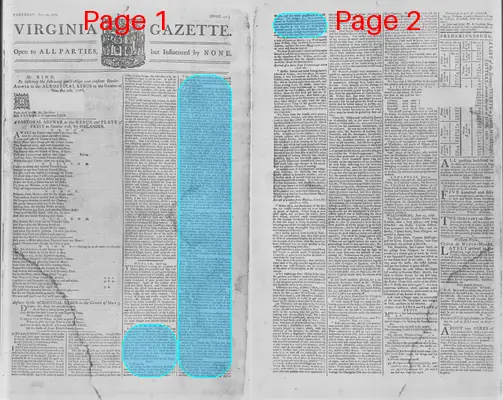
The Virginia Gazette
Williamsburg, Virginia
What is this article about?
On April 20, 1763, John Wilkes appeared at the Court of King's Bench in London to surrender himself on charges related to the North Briton No. 45 and a poem. He delivered a speech defending his actions, alleging ministerial persecution and illegal record alterations. The court declined to accept his surrender, deeming it improper. Wilkes then departed to Surrey amid a peaceful crowd.
Merged-components note: These components form a continuous report on John Wilkes' court appearance and immediate aftermath, with direct textual continuation across the page break.
Clippings
1 of 2
OCR Quality
Full Text
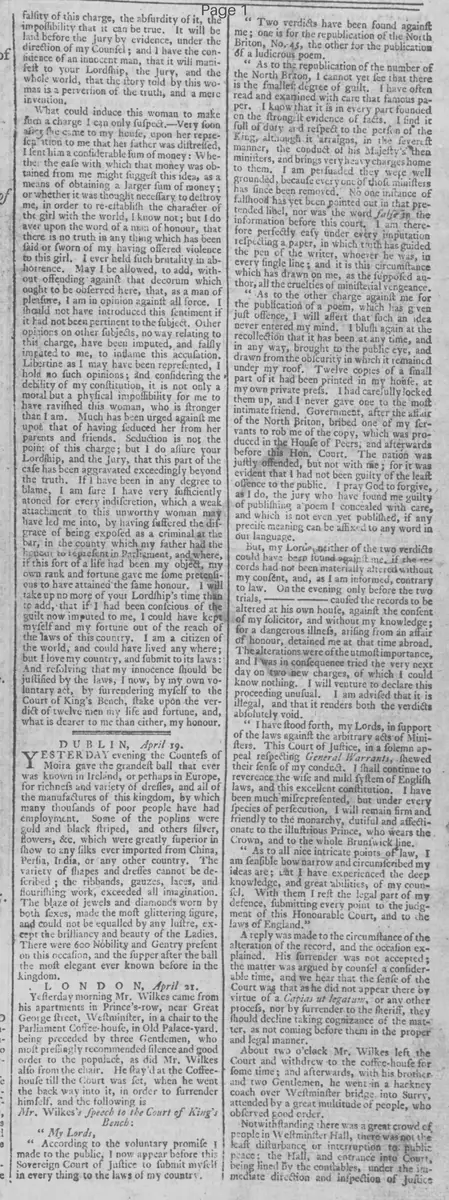
Yesterday morning Mr. Wilkes came from his apartments in Prince's-row, near Great George-street, Westminster, in a chair to the Parliament Coffee-house, in Old Palace-yard, being preceded by three Gentlemen, who most pressingly recommended silence and good order to the populace, as did Mr. Wilkes also from the chair. He stay'd at the Coffee-house till the Court was set, when he went the back way into it, in order to surrender himself, and the following is Mr. Wilkes's Speech to the Court of King's Bench:
"My Lords,
According to the voluntary promise I made to the public, I now appear before this Sovereign Court of Justice to submit myself in every thing to the laws of my country.
Two verdicts have been found against me: one is for the republication of the North Briton, No. 45, the other for the publication of a ludicrous poem.
As to the republication of the number of the North Briton, I cannot yet see that there is the smallest degree of guilt. I have often read and examined with care that famous paper. I know that it is in every part founded on the strongest evidence of facts. I find it full of duty and respect to the person of the King, although it arraigns, in the severest manner, the conduct of his Majesty's then ministers, and brings very heavy charges home to them. I am persuaded they were well grounded, because every one of those ministers has since been removed. No one instance of falsehood has yet been pointed out in that pretended libel, nor was the word false in the information before this court. I am therefore perfectly easy under every imputation respecting a paper, in which truth has guided the pen of the writer, whoever he was, in every single line: and it is this circumstance which has drawn on me, as the supposed author, all the cruelties of ministerial vengeance.
As to the other charge against me for the publication of a poem, which has given just offence, I will assert that such an idea never entered my mind. I blush again at the recollection that it has been at any time, and in any way, brought to the public eye, and drawn from the obscurity in which it remained under my roof. Twelve copies of a small part of it had been printed in my house, at my own private press. I had carefully locked them up, and I never gave one to the most intimate friend. Government, after the affair of the North Briton, bribed one of my servants to rob me of the copy, which was produced in the House of Peers; and afterwards before this Hon. Court. The nation was justly offended, but not with me: for it was evident that I had not been guilty of the least offence to the public. I pray God to forgive, as I do, the jury who have found me guilty of publishing a poem I concealed with care, and which is not even yet published, if any precise meaning can be affixed to any word in our language.
But, my Lords, either of the two verdicts could have been found against me, if the records had not been materially altered without my consent, and, as I am informed, contrary to law. On the evening only before the two trials, [the Attorney-General] caused the records to be altered at his own house, against the consent of my solicitor, and without my knowledge; for a dangerous illness, arising from an affair of honour, detained me at that time abroad. The alterations were of the utmost importance, and I was in consequence tried the very next day on two new charges, of which I could know nothing. I will venture to declare this proceeding unusual. I am advised that it is illegal, and that it renders both the verdicts absolutely void.
I have stood forth, my Lords, in support of the laws against the arbitrary acts of Ministers. This Court of Justice, in a solemn appeal respecting General Warrants, shewed their sense of my conduct. I shall continue to reverence the wise and mild system of English laws, and this excellent constitution. I have been much misrepresented, but under every species of persecution, I will remain firm and friendly to the monarchy, dutiful and affectionate to the illustrious Prince, who wears the Crown, and to the whole Brunswick line.
As to all nice intricate points of law, I am sensible how narrow and circumscribed my ideas are: But I have experienced the deep knowledge, and great abilities, of my counsel. With them I rest the legal part of my defence, submitting every point to the judgment of this Honourable Court, and to the laws of England."
A reply was made to the circumstance of the alteration of the record, and the occasion explained. His surrender was not accepted: the matter was argued by counsel a considerable time, and we hear that the sense of the Court was that as he did not appear there by virtue of a Capias ut legatum, or any other process, nor by surrender to the sheriff, they should decline taking cognizance of the matter, as not coming before them in the proper and legal manner.
About two o'clock Mr. Wilkes left the Court and withdrew to the coffee-house for some time; and afterwards, with his brother and two Gentlemen, he went in a hackney coach over Westminster bridge into Surry, attended by a great multitude of people, who observed good order.
Notwithstanding there was a great crowd of people in Westminster Hall, there was not the least disturbance or interruption to public peace: the Hall, and entrance into Court, being lined by the constables, under the immediate direction and inspection of Justice.
Welch, and the other magistrates of Westminster. The judges, &c. were indeed attended to Westminster Hall by a greater number of constables than usual, and the constables and beadles in the city of Westminster, mounted guard at the watch-houses, but no crowd nor noise, though we are informed great numbers left the town for fear of riots.
What sub-type of article is it?
What keywords are associated?
What entities or persons were involved?
Where did it happen?
Foreign News Details
Primary Location
London
Event Date
Yesterday Morning (April 20)
Key Persons
Outcome
his surrender was not accepted; the court declined taking cognizance as he did not appear by proper process.
Event Details
Mr. Wilkes arrived at the Parliament Coffee-house, recommended order to the crowd, entered the Court of King's Bench to surrender himself, and delivered a speech defending against charges for republication of North Briton No. 45 and a poem, alleging ministerial vengeance, illegal record alterations, and his loyalty to the King. The Court rejected the surrender after argument.