Thank you for visiting SNEWPapers!
Sign up free
Editorial
February 19, 1825
Concord Register
Concord, Merrimack County, New Hampshire
What is this article about?
The Concord Register editorial congratulates the peaceful election of John Quincy Adams as U.S. President by the House of Representatives on February 19, 1825, highlighting the breakdown of the caucus system, Adams' non-partisan rise, New England's influence, and preference for a statesman over a military figure.
Clipping
OCR Quality
98%
Excellent
Full Text
Concord Register
SATURDAY, FEBRUARY 19, 1825.
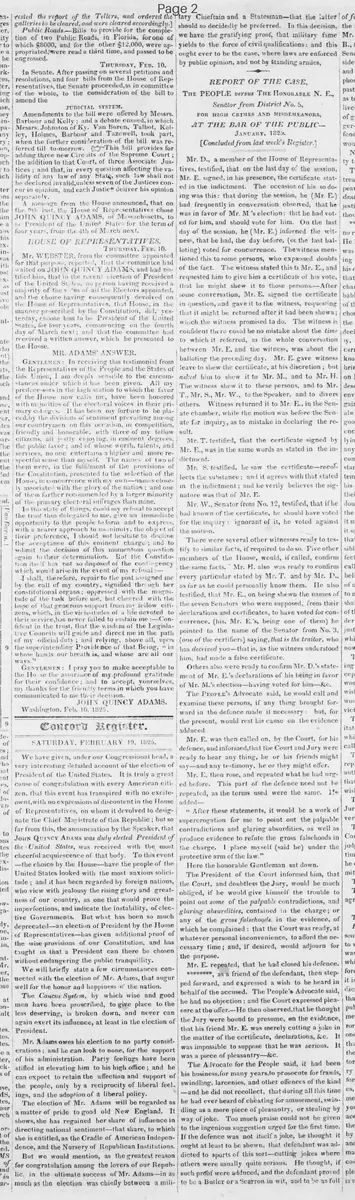
We have given, under our Congressional head, a very interesting detailed account of the election of President of the United States. It is truly a great cause of congratulation with every American citizen, that this event has transpired with no excitement, with no expressions of discontent in the House of Representatives, on whom it devolved to designate the Chief Magistrate of this Republic; but so far from this, the annunciation by the Speaker, that John Quincy Adams was duly elected President of the United States, was received with the most cheerful acquiescence of that body. To this event -the choice by the House--have the people of the United States looked with the most anxious solicitude; and it has been regarded by foreign nations, who view with jealousy the rising glory and greatness of our country, as one that would prove the imperfections, and indicate the instability, of elective Governments. But what has been so much deprecated-an election of President by the House of Representatives--has given additional proof of the wise provisions of our Constitution, and has taught us that a President can there be chosen without endangering the public tranquillity.
We will briefly state a few circumstances connected with the election of Mr. Adams, that augur well for the honor and happiness of the nation.
The Caucus System, by which wise and good men have been proscribed, to give place to the less deserving, is broken down, and never can again exert its influence, at least in the election of President.
Mr. Adams owes his election to no party considerations; and he can look to none, for the support of his administration. Party feelings have been stifled in elevating him to his high office; and he can expect to retain the affection and support of the people, only by a reciprocity of liberal feelings, and the adoption of a liberal policy.
The election of Mr. Adams will be regarded as a matter of pride to good old New England. It shows, she has regained her share of influence in directing national sentiment--that share, to which she is entitled, as the Cradle of American Independence, and the Nursery of Republican Institutions.
But we would mention, as the greatest reason for congratulation among the lovers of our Republic, in the ultimate success of Mr. Adams—in as much as the election was chiefly between a military Chieftain and a Statesman-that the latter should so decidedly be preferred. In this decision, we have the gratifying proof, that military fame yields to the force of civil qualifications: and this ought ever to be the case, where laws are enforced by public opinion, and not by standing armies.
SATURDAY, FEBRUARY 19, 1825.
We have given, under our Congressional head, a very interesting detailed account of the election of President of the United States. It is truly a great cause of congratulation with every American citizen, that this event has transpired with no excitement, with no expressions of discontent in the House of Representatives, on whom it devolved to designate the Chief Magistrate of this Republic; but so far from this, the annunciation by the Speaker, that John Quincy Adams was duly elected President of the United States, was received with the most cheerful acquiescence of that body. To this event -the choice by the House--have the people of the United States looked with the most anxious solicitude; and it has been regarded by foreign nations, who view with jealousy the rising glory and greatness of our country, as one that would prove the imperfections, and indicate the instability, of elective Governments. But what has been so much deprecated-an election of President by the House of Representatives--has given additional proof of the wise provisions of our Constitution, and has taught us that a President can there be chosen without endangering the public tranquillity.
We will briefly state a few circumstances connected with the election of Mr. Adams, that augur well for the honor and happiness of the nation.
The Caucus System, by which wise and good men have been proscribed, to give place to the less deserving, is broken down, and never can again exert its influence, at least in the election of President.
Mr. Adams owes his election to no party considerations; and he can look to none, for the support of his administration. Party feelings have been stifled in elevating him to his high office; and he can expect to retain the affection and support of the people, only by a reciprocity of liberal feelings, and the adoption of a liberal policy.
The election of Mr. Adams will be regarded as a matter of pride to good old New England. It shows, she has regained her share of influence in directing national sentiment--that share, to which she is entitled, as the Cradle of American Independence, and the Nursery of Republican Institutions.
But we would mention, as the greatest reason for congratulation among the lovers of our Republic, in the ultimate success of Mr. Adams—in as much as the election was chiefly between a military Chieftain and a Statesman-that the latter should so decidedly be preferred. In this decision, we have the gratifying proof, that military fame yields to the force of civil qualifications: and this ought ever to be the case, where laws are enforced by public opinion, and not by standing armies.
What sub-type of article is it?
Partisan Politics
Constitutional
What keywords are associated?
Presidential Election
John Quincy Adams
House Election
Caucus System
New England
Statesman Vs Military
What entities or persons were involved?
John Quincy Adams
House Of Representatives
New England
Military Chieftain
Editorial Details
Primary Topic
Election Of John Quincy Adams As President By The House Of Representatives
Stance / Tone
Congratulatory And Supportive Of Constitutional Process And Adams' Victory
Key Figures
John Quincy Adams
House Of Representatives
New England
Military Chieftain
Key Arguments
Peaceful Election Without Excitement Or Discontent
Proof Of Constitution's Wise Provisions
Breakdown Of The Caucus System
Election Based On Non Partisan Considerations
Pride In New England's Influence
Preference For Statesman Over Military Leader