Thank you for visiting SNEWPapers!
Sign up free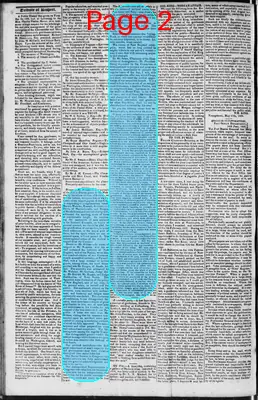
Martinsburg Gazette And Public Advertiser
Martinsburg, Berkeley County, West Virginia
What is this article about?
Public dinner at Faneuil Hall, Boston, on the 5th instant, honoring Mr. Webster with speeches by Webster, Everett, Gorham, Burges, and others on New England policy and national affairs, including toasts and Webster's critique of opposition to the administration.
Clipping
OCR Quality
Full Text
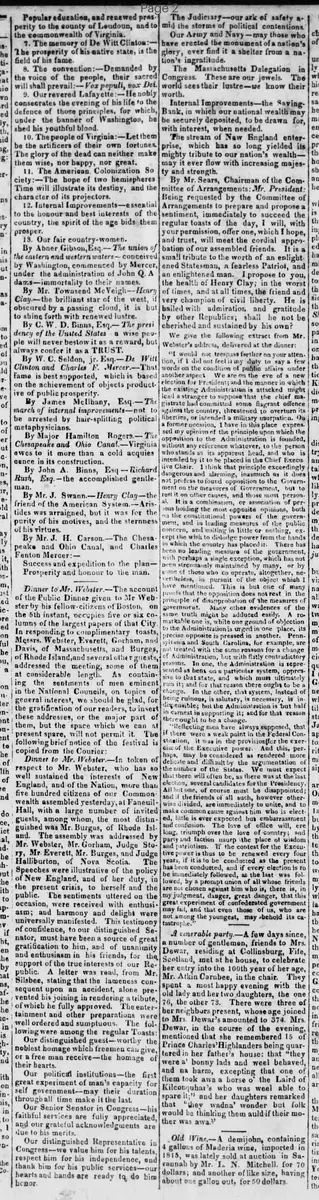
Dinner to Mr. Webster. In token of respect to Mr. Webster, who has so well sustained the interests of New England, and of the Nation, more than five hundred citizens of our Commonwealth assembled yesterday, at Faneuil-Hall, with a large number of invited guests, among whom, the most distinguished was Mr. Burges, of Rhode Island. The assembly was addressed by Mr. Webster, Mr. Gorham, Judge Story, Mr. Everett, Mr. Burges, and Judge Halliburton, of Nova Scotia. The Speeches were illustrative of the policy of New England, and of her duty, in the present crisis, to herself and the public. The sentiments uttered on the occasion, were received with enthusiasm; and harmony and delight were universally manifested. This testimony of confidence, to our distinguished Senator, must have been a source of great gratification to him, and of unanimity and enthusiasm in his friends, for the support of the true interests of our Republic. A letter was read, from Mr. Silsbee, stating that the lameness consequent upon an accident, alone prevented his joining in rendering a tribute, of which he fully approved. The entertainment and other preparations were well ordered and sumptuous. The following were among the regular Toasts:
Our distinguished guest-worthy the noblest homage which freemen can give, or a free man receive--the homage of their hearts.
Our political institutions-the first great experiment of man's capacity for self government--may their duration through all time make it the last.
Our Senior Senator in Congress-his faithful services are fully appreciated, and our grateful acknowledgments are due to his merits.
Our distinguished Representative in Congress-we value him for his talents, respect him for his independence, and thank him for his public services-our hearts and hands are ready to do him honor.
The Judiciary--our ark of safety amid the storms of political contentions.
Our Army and Navy-may those who have erected the monument of a nation's glory, ever find it a shelter from a nation's ingratitude.
The Massachusetts Delegation in Congress. These are our jewels. The world sees their lustre-we know their worth.
Internal Improvements-the Saving Bank, in which our national wealth may be securely deposited, to be drawn for, with interest, when needed.
The stream of New England enterprize, which has so long yielded its mighty tribute to our nation's wealth-may it ever flow with increasing majesty and strength.
By Mr. Sears, Chairman of the Committee of Arrangements: Mr. President: Being requested by the Committee of Arrangements to prepare and propose a sentiment, immediately to succeed the regular toasts of the day, I will, with your permission, offer one, which I hope, and trust, will meet the cordial approbation of our assembled friends. It is a small tribute to the worth of an enlightened Statesman, a fearless Patriot, and an enlightened man. I propose to you, the health of Henry Clay; in the worst of times, and at all times, the friend and very champion of civil liberty. He is hailed with admiration and gratitude by other Republics; shall he not be cherished and sustained by his own?
We give the following extract from Mr. Webster's address, delivered at the dinner:
"I would not trespass farther on your attention, if I did not feel it my duty to say a few words on the condition of public affairs under another aspect. We are on the eve of a new election for President; and the manner in which the existing Administration is attacked might lead a stranger to suppose that the chief magistrate had committed some flagrant offence against the country, threatened to overturn its liberties, or intended a military usurpation. On a former occasion, I have in this place expressed my opinion of the principle upon which the opposition to the Administration is founded, without any reference whatever, to the person who stands as its apparent head, and who is intended by it to be placed in the Chief Executive Chair. I think that principle exceedingly dangerous and alarming, inasmuch as it does not profess to found opposition to the Government on the measures of Government, but to rest it on other causes, and those most personal. It is a combination, or association of persons holding the most opposite opinions, both on the constitutional powers of the government, and in leading measures of the public concern, and uniting in little or nothing, except the wish to dislodge power from the hands in which the country has placed it. There has been no leading measure of the government, with perhaps a single exception, which has not been strenuously maintained by many, or by some of those who co-operate, altogether, nevertheless, in pursuit of the object which I have mentioned. This is but one of many proofs that the opposition does not rest in the principle of disapprobation of the measures of government. Many other evidences of the same truth might be adduced easily. A remarkable one is, while one ground of objection to the Administration is urged in one place, its precise opposite is pressed in another. Pennsylvania and South Carolina, for example, are not treated with the same reasons for a change of Administration, but with flatly contradictory reasons. In one, the Administration is represented as bent on a particular system, oppressive to that state, and which must ultimately ruin it; and for that reason there ought to be a change. In the other, that system, instead of being ruinous, is salutary, is necessary, is indispensable; but the Administration is but half in earnest in supporting it; and for that reason there ought to be a change.
"Reflecting men have always supposed, that if there were a weak point in the Federal Constitution, it was in the provision for the exercise of the Executive power. And this, perhaps, may be considered as rendered more delicate and difficult by the augmentation of the number of the States. We must expect that there will often be, as there was at the last election, several candidates for the Presidency. All but one, of course must be disappointed; and if the friends of all such, however otherwise divided, are immediately to unite, and to make common cause against him who is elected, little is ever expected but embarrassment and confusion. The love of office will, ere long, triumph over the love of country; and party and faction usurp the place of wisdom and patriotism. The contest for the Executive power is thus to be renewed every four years, if it is to be conducted as the present has been conducted, and if every election is to be immediately followed, as the last was followed, by a prompt union of all whose friends are not chosen against him who is, there is, in my judgment, danger, great danger, that this great experiment of confederated government may fail, and that even those of us, who are not among the youngest, may behold its catastrophe."
What sub-type of article is it?
What themes does it cover?
What keywords are associated?
What entities or persons were involved?
Where did it happen?
Story Details
Key Persons
Location
Faneuil Hall, Boston
Event Date
5th Instant
Story Details
Over five hundred citizens and guests assembled at Faneuil Hall for a dinner honoring Mr. Webster's service to New England and the nation. Speeches by Webster, Gorham, Story, Everett, Burges, and Halliburton addressed New England policy and national duties amid crisis. Enthusiastic toasts celebrated institutions, senators, judiciary, military, and improvements. Webster's address critiqued the opposition to the administration as personal and dangerous, warning of risks to the republic from factional politics ahead of presidential election.