Thank you for visiting SNEWPapers!
Sign up free
Literary
November 24, 1930
Imperial Valley Press
El Centro, Imperial County, California
What is this article about?
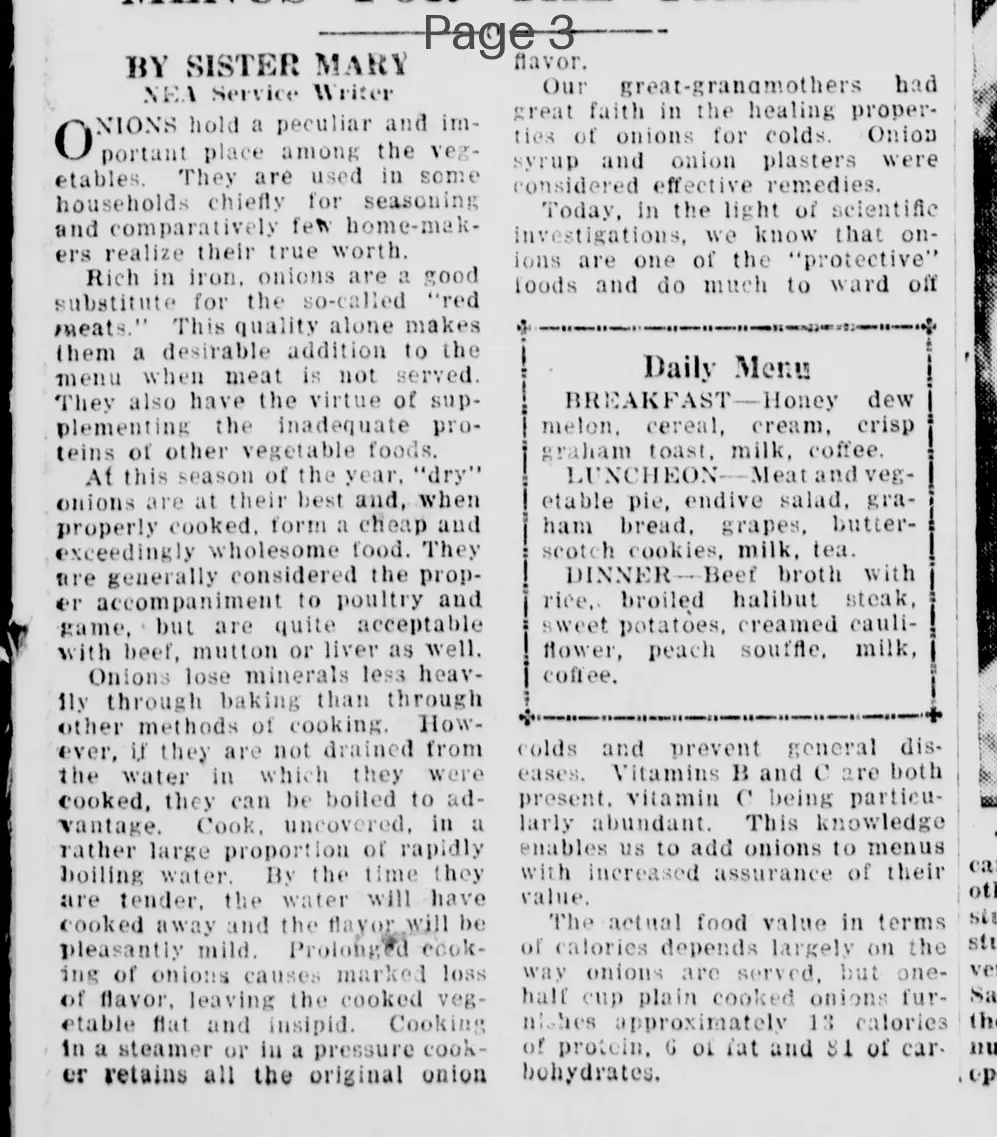
Article by Sister Mary discusses the nutritional benefits of onions as an iron-rich substitute for meat, their vitamins for preventing colds, cooking tips to preserve flavor and minerals, historical remedies, and provides a sample daily menu.
Clipping
OCR Quality
95%
Excellent
Full Text
BY SISTER MARY
NEA Service Writer
Onions hold a peculiar and important place among the vegetables. They are used in some households chiefly for seasoning and comparatively few home-makers realize their true worth.
Rich in iron, onions are a good substitute for the so-called "red meats." This quality alone makes them a desirable addition to the menu when meat is not served. They also have the virtue of supplementing the inadequate proteins of other vegetable foods.
At this season of the year, "dry" onions are at their best and, when properly cooked, form a cheap and exceedingly wholesome food. They are generally considered the proper accompaniment to poultry and game, but are quite acceptable with beef, mutton or liver as well.
Onions lose minerals less heavily through baking than through other methods of cooking. However, if they are not drained from the water in which they were cooked, they can be boiled to advantage. Cook, uncovered, in a rather large proportion of rapidly boiling water. By the time they are tender, the water will have cooked away and the flavor will be pleasantly mild. Prolonged cooking of onions causes marked loss of flavor, leaving the cooked vegetable flat and insipid. Cooking in a steamer or in a pressure cooker retains all the original onion favor.
Our great-grandmothers had great faith in the healing properties of onions for colds. Onion syrup and onion plasters were considered effective remedies.
Today, in the light of scientific investigations, we know that onions are one of the "protective" foods and do much to ward off colds and prevent general diseases. Vitamins B and C are both present, vitamin C being particularly abundant. This knowledge enables us to add onions to menus with increased assurance of their value.
The actual food value in terms of calories depends largely on the way onions are served, but one-half cup plain cooked onions furnishes approximately 13 calories of protein, 6 of fat and 81 of carbohydrates.
Daily Menu
BREAKFAST—Honey dew melon, cereal, cream, crisp graham toast, milk, coffee.
LUNCHEON—Meat and vegetable pie, endive salad, graham bread, grapes, butterscotch cookies, milk, tea.
DINNER—Beef broth with rice, broiled halibut steak, sweet potatoes, creamed cauliflower, peach souffle, milk, coffee.
NEA Service Writer
Onions hold a peculiar and important place among the vegetables. They are used in some households chiefly for seasoning and comparatively few home-makers realize their true worth.
Rich in iron, onions are a good substitute for the so-called "red meats." This quality alone makes them a desirable addition to the menu when meat is not served. They also have the virtue of supplementing the inadequate proteins of other vegetable foods.
At this season of the year, "dry" onions are at their best and, when properly cooked, form a cheap and exceedingly wholesome food. They are generally considered the proper accompaniment to poultry and game, but are quite acceptable with beef, mutton or liver as well.
Onions lose minerals less heavily through baking than through other methods of cooking. However, if they are not drained from the water in which they were cooked, they can be boiled to advantage. Cook, uncovered, in a rather large proportion of rapidly boiling water. By the time they are tender, the water will have cooked away and the flavor will be pleasantly mild. Prolonged cooking of onions causes marked loss of flavor, leaving the cooked vegetable flat and insipid. Cooking in a steamer or in a pressure cooker retains all the original onion favor.
Our great-grandmothers had great faith in the healing properties of onions for colds. Onion syrup and onion plasters were considered effective remedies.
Today, in the light of scientific investigations, we know that onions are one of the "protective" foods and do much to ward off colds and prevent general diseases. Vitamins B and C are both present, vitamin C being particularly abundant. This knowledge enables us to add onions to menus with increased assurance of their value.
The actual food value in terms of calories depends largely on the way onions are served, but one-half cup plain cooked onions furnishes approximately 13 calories of protein, 6 of fat and 81 of carbohydrates.
Daily Menu
BREAKFAST—Honey dew melon, cereal, cream, crisp graham toast, milk, coffee.
LUNCHEON—Meat and vegetable pie, endive salad, graham bread, grapes, butterscotch cookies, milk, tea.
DINNER—Beef broth with rice, broiled halibut steak, sweet potatoes, creamed cauliflower, peach souffle, milk, coffee.
What sub-type of article is it?
Essay
What keywords are associated?
Onions
Nutrition
Cooking Methods
Protective Foods
Daily Menu
Vitamins
Iron Substitute
What entities or persons were involved?
By Sister Mary, Nea Service Writer
Literary Details
Author
By Sister Mary, Nea Service Writer
Subject
Nutritional Value And Uses Of Onions
Form / Style
Informational Prose Essay
Key Lines
Rich In Iron, Onions Are A Good Substitute For The So Called "Red Meats."
Today, In The Light Of Scientific Investigations, We Know That Onions Are One Of The "Protective" Foods And Do Much To Ward Off Colds And Prevent General Diseases.
The Actual Food Value In Terms Of Calories Depends Largely On The Way Onions Are Served, But One Half Cup Plain Cooked Onions Furnishes Approximately 13 Calories Of Protein, 6 Of Fat And 81 Of Carbohydrates.