Thank you for visiting SNEWPapers!
Sign up free
Domestic News
January 25, 1803
The New Hampshire Gazette
Portsmouth, Rockingham County, New Hampshire
What is this article about?
Governor Caleb Strong addresses the Massachusetts Legislature on January 14, 1803, praising peace and prosperity, urging support for agriculture, manufactures, and fisheries, and discussing economic policies and administrative matters.
Clipping
OCR Quality
95%
Excellent
Full Text
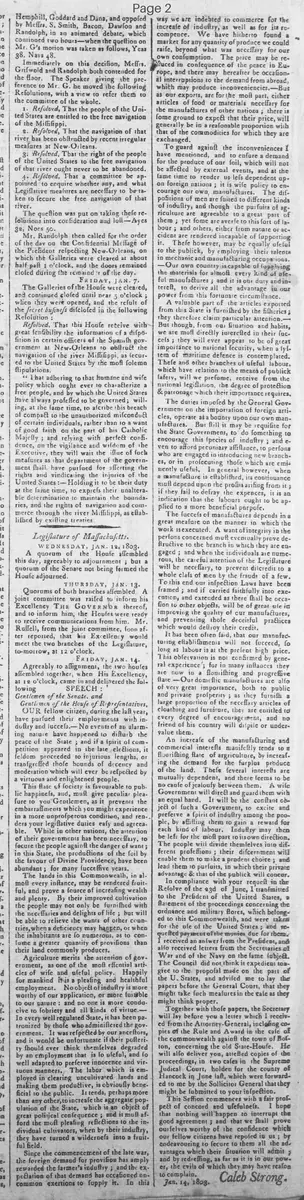
Legislature of Massachusetts.
WEDNESDAY, JAN. 12, 1803.
A quorum of the House assembled this day, agreeably to adjournment; but a quorum of the Senate not being formed the House adjourned.
THURSDAY, JAN. 13.
Quorums of both branches assembled, A joint committee was raised to inform his Excellency The Governor thereof, and to inform him, the Houses were ready to receive communications from him. Mr. Russell, from the joint committee, soon after reported, that his Excellency would meet the two branches of the Legislature, to-morrow, at 12 o'clock.
FRIDAY, JAN. 14.
Agreeably to appointment, the two houses assembled together, when His Excellency, at 12 o'clock, came in and delivered the following SPEECH:
Gentlemen of the Senate, and Gentlemen of the House of Representatives,
OUR fellow citizens, during the last year, have pursued their employments with industry and success.-No events of an alarming nature have happened to disturb the peace of the State; and if a spirit of competition appeared in the late elections, it seldom proceeded to injurious lengths, or transgressed those bounds of decency and moderation which will ever be respected by a virtuous and enlightened people.
This state of society is favourable to public happiness, and, must give peculiar pleasure to you Gentlemen, as it prevents the embarrassments which you might experience in a more unprosperous condition, and renders your legislative duties easy and agreeable. While in other nations, the attention of their governments has been necessary, to secure the people against the danger of want; in this State, the productions of the soil by the favour of Divine Providence, have been abundant; for many successive years.
The lands in this Commonwealth, in almost every instance, may be rendered fruitful, and prove a source of increasing wealth and plenty. By their improved cultivation the people may not only be furnished with the necessaries and delights of life; but will be able to relieve the wants of other countries. when a deficiency may happen, or when the inhabitants are so numerous, as to consume a greater quantity of provisions than their land commonly produces.
Agriculture merits the attention of government. as one of the most essential articles of wise and useful policy. Happily for mankind it is a pleasing and healthful employment. No object of industry is more worthy of our application, or more suitable to our nature: and no one is more conducive to sobriety and all kinds of virtue.-- In every well regulated State, it has been patronized by those who administered the government. It was respected by our ancestors, and it would be unfortunate if their posterity should ever think themselves degraded by an employment that is so useful, and so well adapted to preserve innocence and virtuous manners. The labor which is employed in clearing uncultivated lands and making them productive, is obviously beneficial to the public. It tends, perhaps more than any other, to increase the aggregate population of the State, which is an object of great political consequence; and it must afford the most pleasing reflections to the individual cultivators, when by their industry, they have turned a wilderness into a fruitful field.
Since the commencement of the late war, the foreign demand for provision has amply rewarded the farmer's industry; and the expectation of that demand has occasioned uncommon exertions to supply it. In this way we are indebted to commerce for the increase of industry, as well as for its recompence. We have hitherto found a market for any quantity of produce we could raise, beyond what was necessary for our own consumption, The price may be reduced in consequence of the peace in Europe, and there may hereafter be occasional interruptions to the demand from abroad, which may produce inconveniencies.-But as our exports, are for the most part, either articles of food or materials necessary for the manufactures of other nations; there is some ground to expect that their price, will generally be in a reasonable proportion with that of the commodities for which they are exchanged.
To guard against the inconveniences I have mentioned, and to ensure a demand for the produce of our soil, which will not be affected by external events, and at the same time to render us less dependent upon foreign nations; it is wise policy to encourage our own. manufactures. The dispositions of men are suited to different kinds of industry, and though the pursuits of agriculture are agreeable to a great part of them; yet some are averse to this sort of labour; and others, either from nature or accident are rendered incapable of supporting it. These however, may be equally useful to the publick, by employing their talents in mechanic and manufacturing occupations. -Our own country is capable of supplying the materials for almost every kind of useful manufactures; and it is our duty and interest, to derive all the advantage in our power from this fortunate circumstance.
A valuable part of the articles exported from this State is furnished by the fisheries; they therefore claim particular attention.— But though, from our Situation and habits, we are most directly interested in their success; they will ever appear to be of great importance to national security, when a system of maritime defence is contemplated. These and other branches of useful labour. which have relation to the means of publick safety. will we presume. receive from the national legislation, the degree of protection & patronage which their importance requires.
The duties imposed by the General Government on the importation of foreign articles, operate as a bounty upon our own manufactures. But still it may be requisite for the State Governments, to do something to encourage this species of industry; and even to afford pecuniary assistance, to persons who are engaged in introducing new branches, or in prosecuting those which are eminently useful, In general however, when a manufacture is established, its continuance must depend upon the profits arising from it; if they fail to defray the expences, it is an indication that the labours ought to be applied to a more beneficial purpose.
The success of manufactures depends in a great measure on the manner in which the work is executed. A want of integrity in the persons concerned must eventually prove destructive to the branch in which they are engaged; and when the individuals are numerous, the careful attention of the Legislature will be necessary, to prevent discredit to a whole class of men by the frauds of a few. To this end our Inspection Laws have been framed; and if carried faithfully into execution, and extended as there shall be occasion to other objects, will be of great use in improving the quality of our manufactures, and preventing those deceitful practices which would destroy their credit.
It has been often said, that our manufacturing establishments will not succeed, so long as labour is at the present high price. This observation is not confirmed by general experience'; for in many instances they are now in a flourishing and progressive state--Our domestic manufactures are also of very great importance, both to public and private prosperity; as they furnish a large proportion of the necessary articles of cloathing and furniture, they are entitled to every degree of encouragement, and no friend of his country will despise or undervalue them.
An increase of the manufacturing and commercial interests manifestly tends to a flourishing state of agriculture, by increasing the demand for the surplus produce of the land. These several interests are mutually dependent, and there seems to be no cause of jealousy between them. A wise Government will direct and guard them with an equal hand. It will be the constant object of such a Government, to excite and preserve a spirit of industry among the people, by assisting them to gain a reward for each kind of labour. Industry may then be left for the most part to its own direction. The people will divide themselves into different professions: their discernment will enable them to make a prudent choice; and lead them to pursuits, in which their private advantage & that of the publick will concur.
In compliance with your request in the Resolve of the 23d of June, I transmitted to the President of the United States, statement of the proceedings concerning the ordnance and military stores, which belonged to this Commonwealth, and were taken for the use of the United States; and requested payment of the monies due for them I received an answer from the President, and also received letters from the Secretaries War and of the Navy on the same Subject. The Council did not think it expedient to agree to those proposal made on the part of the U. States, and advised me to lay the papers before the General Court, that they might take such measures in the case as they might think proper.
Together with those papers, the Secretary will lay before you a letter which I received from the Attorney-General, enclosing co pies of the Rule and Award in the case of the commonwealth against the town of Boston, concerning the old State-House. He will also deliver you, attested copies of the proceedings, in two cases in the Supreme Judicial Court, holden for the county of Hancock in June last, which were forwarded to me by the Solicitor General that they might be submitted to your inspection.
This Session commences with a fair prospect of concord and usefulness. I hope that nothing will happen to interrupt the good agreement; and that we shall prove ourselves worthy of the confidence which our fellow citizens have reposed in us; by endeavouring to secure to them all the advantages which their situation will admit; and by redressing, as far as it is in our power, the evils of which they may have reason to complain,
Jan. 14, 1803.
Caleb Strong
WEDNESDAY, JAN. 12, 1803.
A quorum of the House assembled this day, agreeably to adjournment; but a quorum of the Senate not being formed the House adjourned.
THURSDAY, JAN. 13.
Quorums of both branches assembled, A joint committee was raised to inform his Excellency The Governor thereof, and to inform him, the Houses were ready to receive communications from him. Mr. Russell, from the joint committee, soon after reported, that his Excellency would meet the two branches of the Legislature, to-morrow, at 12 o'clock.
FRIDAY, JAN. 14.
Agreeably to appointment, the two houses assembled together, when His Excellency, at 12 o'clock, came in and delivered the following SPEECH:
Gentlemen of the Senate, and Gentlemen of the House of Representatives,
OUR fellow citizens, during the last year, have pursued their employments with industry and success.-No events of an alarming nature have happened to disturb the peace of the State; and if a spirit of competition appeared in the late elections, it seldom proceeded to injurious lengths, or transgressed those bounds of decency and moderation which will ever be respected by a virtuous and enlightened people.
This state of society is favourable to public happiness, and, must give peculiar pleasure to you Gentlemen, as it prevents the embarrassments which you might experience in a more unprosperous condition, and renders your legislative duties easy and agreeable. While in other nations, the attention of their governments has been necessary, to secure the people against the danger of want; in this State, the productions of the soil by the favour of Divine Providence, have been abundant; for many successive years.
The lands in this Commonwealth, in almost every instance, may be rendered fruitful, and prove a source of increasing wealth and plenty. By their improved cultivation the people may not only be furnished with the necessaries and delights of life; but will be able to relieve the wants of other countries. when a deficiency may happen, or when the inhabitants are so numerous, as to consume a greater quantity of provisions than their land commonly produces.
Agriculture merits the attention of government. as one of the most essential articles of wise and useful policy. Happily for mankind it is a pleasing and healthful employment. No object of industry is more worthy of our application, or more suitable to our nature: and no one is more conducive to sobriety and all kinds of virtue.-- In every well regulated State, it has been patronized by those who administered the government. It was respected by our ancestors, and it would be unfortunate if their posterity should ever think themselves degraded by an employment that is so useful, and so well adapted to preserve innocence and virtuous manners. The labor which is employed in clearing uncultivated lands and making them productive, is obviously beneficial to the public. It tends, perhaps more than any other, to increase the aggregate population of the State, which is an object of great political consequence; and it must afford the most pleasing reflections to the individual cultivators, when by their industry, they have turned a wilderness into a fruitful field.
Since the commencement of the late war, the foreign demand for provision has amply rewarded the farmer's industry; and the expectation of that demand has occasioned uncommon exertions to supply it. In this way we are indebted to commerce for the increase of industry, as well as for its recompence. We have hitherto found a market for any quantity of produce we could raise, beyond what was necessary for our own consumption, The price may be reduced in consequence of the peace in Europe, and there may hereafter be occasional interruptions to the demand from abroad, which may produce inconveniencies.-But as our exports, are for the most part, either articles of food or materials necessary for the manufactures of other nations; there is some ground to expect that their price, will generally be in a reasonable proportion with that of the commodities for which they are exchanged.
To guard against the inconveniences I have mentioned, and to ensure a demand for the produce of our soil, which will not be affected by external events, and at the same time to render us less dependent upon foreign nations; it is wise policy to encourage our own. manufactures. The dispositions of men are suited to different kinds of industry, and though the pursuits of agriculture are agreeable to a great part of them; yet some are averse to this sort of labour; and others, either from nature or accident are rendered incapable of supporting it. These however, may be equally useful to the publick, by employing their talents in mechanic and manufacturing occupations. -Our own country is capable of supplying the materials for almost every kind of useful manufactures; and it is our duty and interest, to derive all the advantage in our power from this fortunate circumstance.
A valuable part of the articles exported from this State is furnished by the fisheries; they therefore claim particular attention.— But though, from our Situation and habits, we are most directly interested in their success; they will ever appear to be of great importance to national security, when a system of maritime defence is contemplated. These and other branches of useful labour. which have relation to the means of publick safety. will we presume. receive from the national legislation, the degree of protection & patronage which their importance requires.
The duties imposed by the General Government on the importation of foreign articles, operate as a bounty upon our own manufactures. But still it may be requisite for the State Governments, to do something to encourage this species of industry; and even to afford pecuniary assistance, to persons who are engaged in introducing new branches, or in prosecuting those which are eminently useful, In general however, when a manufacture is established, its continuance must depend upon the profits arising from it; if they fail to defray the expences, it is an indication that the labours ought to be applied to a more beneficial purpose.
The success of manufactures depends in a great measure on the manner in which the work is executed. A want of integrity in the persons concerned must eventually prove destructive to the branch in which they are engaged; and when the individuals are numerous, the careful attention of the Legislature will be necessary, to prevent discredit to a whole class of men by the frauds of a few. To this end our Inspection Laws have been framed; and if carried faithfully into execution, and extended as there shall be occasion to other objects, will be of great use in improving the quality of our manufactures, and preventing those deceitful practices which would destroy their credit.
It has been often said, that our manufacturing establishments will not succeed, so long as labour is at the present high price. This observation is not confirmed by general experience'; for in many instances they are now in a flourishing and progressive state--Our domestic manufactures are also of very great importance, both to public and private prosperity; as they furnish a large proportion of the necessary articles of cloathing and furniture, they are entitled to every degree of encouragement, and no friend of his country will despise or undervalue them.
An increase of the manufacturing and commercial interests manifestly tends to a flourishing state of agriculture, by increasing the demand for the surplus produce of the land. These several interests are mutually dependent, and there seems to be no cause of jealousy between them. A wise Government will direct and guard them with an equal hand. It will be the constant object of such a Government, to excite and preserve a spirit of industry among the people, by assisting them to gain a reward for each kind of labour. Industry may then be left for the most part to its own direction. The people will divide themselves into different professions: their discernment will enable them to make a prudent choice; and lead them to pursuits, in which their private advantage & that of the publick will concur.
In compliance with your request in the Resolve of the 23d of June, I transmitted to the President of the United States, statement of the proceedings concerning the ordnance and military stores, which belonged to this Commonwealth, and were taken for the use of the United States; and requested payment of the monies due for them I received an answer from the President, and also received letters from the Secretaries War and of the Navy on the same Subject. The Council did not think it expedient to agree to those proposal made on the part of the U. States, and advised me to lay the papers before the General Court, that they might take such measures in the case as they might think proper.
Together with those papers, the Secretary will lay before you a letter which I received from the Attorney-General, enclosing co pies of the Rule and Award in the case of the commonwealth against the town of Boston, concerning the old State-House. He will also deliver you, attested copies of the proceedings, in two cases in the Supreme Judicial Court, holden for the county of Hancock in June last, which were forwarded to me by the Solicitor General that they might be submitted to your inspection.
This Session commences with a fair prospect of concord and usefulness. I hope that nothing will happen to interrupt the good agreement; and that we shall prove ourselves worthy of the confidence which our fellow citizens have reposed in us; by endeavouring to secure to them all the advantages which their situation will admit; and by redressing, as far as it is in our power, the evils of which they may have reason to complain,
Jan. 14, 1803.
Caleb Strong
What sub-type of article is it?
Politics
Economic
Agriculture
What keywords are associated?
Massachusetts Legislature
Governor Speech
Caleb Strong
Agriculture
Manufactures
Fisheries
Economic Policy
What entities or persons were involved?
Caleb Strong
Mr. Russell
Where did it happen?
Massachusetts
Domestic News Details
Primary Location
Massachusetts
Event Date
January 14, 1803
Key Persons
Caleb Strong
Mr. Russell
Event Details
Governor Caleb Strong delivers his speech to the assembled Massachusetts Legislature, discussing peace, prosperity, agriculture, manufactures, fisheries, economic policies, and administrative matters including military stores and court cases.