Thank you for visiting SNEWPapers!
Sign up free
The Enquirer
Richmond, Henrico County, Virginia
What is this article about?
Sir James M'Intosh's 1804 address to Bombay Grand Jury highlights British government's famine relief efforts, importing rice to save ~100,000 lives amid 1803-1804 Indian famine; discusses Malthusian population principles in context of Indostan.
Clipping
OCR Quality
Full Text
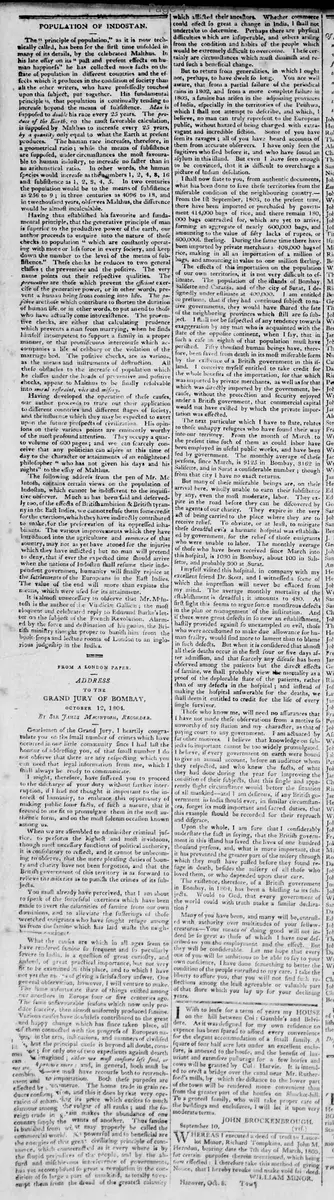
The 'principle of population,' as it is now technically called, has been for the first time unfolded in many of its details, by the celebrated Malthus. In his late essay on its 'past and present effects on human happiness' he has collected more facts on the state of population in different countries and the effects which it produces in the condition of society than all the other writers, who have professedly touched upon this subject, put together. His fundamental principle is, that population is continually tending to increase beyond the means of subsistence. Man is supposed to double his race every 25 years. The produce of the Earth, on the most favorable calculation, is supposed by Malthus to increase every 25 years, by a quantity only equal to what the Earth at present produces. The human race increases, therefore, in a geometrical ratio; while the means of subsistence are supposed, under circumstances the most favorable to human industry, to increase no faster than in an arithmetical ratio. In other words, the human species would increase as the numbers 1, 2, 4, 8, 16 and subsistence as 1, 2, 3, 4, 5. In two centuries the population would be to the means of subsistence as 256 to 9: in three centuries as 4096 to 18, and in two thousand years, observes Malthus, the difference would be almost incalculable.
Having thus established his favourite and fundamental principle, that the generative principle of man is superior to the productive power of the earth, our author proceeds to enquire into the nature of those checks to population 'which are constantly operating with more or less force in every society, and keep down the number to the level of the means of subsistence.' These checks he reduces to two general classes: the preventive and the positive. The very name points out their respective qualities. The preventive are those which prevent the efficient exercise of the generative power, or in other words, prevent a human being from coming into life. The positive are those which contribute to shorten the duration of human life, or in other words, to put an end to those who have actually come into existence. The preventive checks, are either that calculating prudence which prevents a man from marrying, when he finds himself incompetent to support a family in a proper manner, or that promiscuous intercourse which accompanies a life of celibacy or the violation of the marriage bed. The positive checks, are as various as the means and instruments of destruction. All these obstacles to the increase of population which he classes under the heads of preventive and positive checks, appear to Malthus to be finally resolvable into moral restraint, vice and misery.
Having developed the operation of these causes, our author proceeds to trace out their application to different countries and different stages of society, and the influence which they may be expected to exert upon the future prospects of civilization. His opinions on these various points are eminently worthy of the most profound attention. They occupy a quarto volume of 600 pages; and we can scarcely conceive that any politician can aspire at this time of day to the character or attainments of an enlightened philosopher 'who has not given his days and his nights' to the essay of Malthus.
The following address from the pen of Mr. McIntosh, contains certain views on the population of Indostan, which cannot be indifferent to the inquisitive observer. Much as has been said and deservedly too, of the effects of British ambition & British tyranny in the East Indies, we cannot refuse them some credit for the exertions, which they have indirectly contributed to make, for the preservation of its oppressed inhabitants. The various improvements which they have introduced into the agriculture and commerce of that country, may not as yet have atoned for the injuries which they have inflicted: but no man will pretend to deny, that if ever the expected time should arrive when the nations of Indostan shall resume their independent government, humanity will finally rejoice at the settlements of the Europeans in the East Indies. The value of the end will more than expiate the means, which were used for its attainment.
It is almost unnecessary to observe that Mr. M'Intosh is the author of the Vindiciae Gallicae; the most eloquent and celebrated reply to Edmund Burke's letter on the subject of the French Revolution. Alarmed by the force and destination of his genius, the British ministry thought proper to banish him from the book-shops and lecture rooms of London to an inglorious judgeship in the Indies.
FROM A LONDON PAPER.
ADDRESS
TO THE
GRAND JURY OF BOMBAY,
OCTOBER 12, 1804.
By SIR JAMES M'INTOSH, RECORDER.
Gentlemen of the Grand Jury,
I heartily congratulate you on the small number of crimes which have occurred in our little community since I had last the honour of addressing you, of that small number I do not observe that there are any respecting which you can need that legal information from me, which I shall always be ready to communicate.
I might, therefore, have suffered you to proceed to the discharge of your duty without farther interruption, if I had not thought it important to the interest of humanity, to embrace this opportunity of making public some facts, of such a nature, that it seemed to me fit to promulgate them in the most authentic form, and on the most solemn occasion known among us.
When we are assembled to administer criminal justice, to perform the highest and most invidious, though most necessary functions of political authority, it is consolatory to reflect, and it cannot be unbecoming to observe, that the more pleasing duties of bounty and charity have not been forgotten, and that the British government of this territory is as forward to relieve the miseries as to punish the crimes of its subjects.
You must already have perceived, that I am about to speak of the successful exertions which have been made to avert the calamities of famine from our own dominions, and to alleviate the sufferings of those wretched emigrants who have sought refuge among us from the famine which has laid waste the neighbouring continent.
What the causes are which in all ages seem to have rendered famine so frequent and so peculiarly severe in India, is a question of great curiosity, and indeed, of great practical importance, but not very fit to be examined in this place, and to which I have not yet the means of giving a satisfactory answer. One general observation, however, I will venture to make. The same unfortunate state of things existed among our ancestors in Europe four or five centuries ago. The same unfavourable seasons which now only produce scarcity, then almost uniformly produced famine. Various causes have doubtless contributed to the great and happy change which has since taken place, all of them connected with the progress of European nations in the arts, institutions, and manners of civilized life; but the principal cause is beyond all doubt, commerce: for only one of two expedients against dearth can be imagined; either we must consume less food, or we must procure more; and, in general, both must be combined. We must have recourse both to retrenchment and to importation, effected by commerce. The home trade in grain reduces consumption, and this it does by that very operation which excites the clamour among the vulgar of all ranks; and the foreign trade of one country supplies the wants of another. Thus famine is banished from what may properly be called the commercial world. So powerful and so beneficial are the energies of that great civilizing principle of commerce, which counteracted as it every where is by the stupid prejudices of the people, and by the absurd and mischievous interference of governments, has yet accomplished so great a revolution in the condition of so large a part of mankind, as totally to exempt them from the dread of the greatest calamity which afflicted their ancestors.
Whether commerce could effect so great a change in India, I shall not undertake to determine. Perhaps there are physical difficulties which are insuperable, and others arising from the condition and habits of the people which would be extremely difficult to overcome. These certainly are circumstances which must diminish and retard such a beneficial change.
But to return from generalities, in which I ought not, perhaps, to have dwelt so long: You are well aware, that from a partial failure of the periodical rains in 1803, and from a more complete failure in 1804, a famine has arisen in the adjoining provinces of India, especially in the territories of the Peishwa, which I shall not attempt to describe, and which, I believe, no man can truly represent to the European public, without hazard of being charged with extravagant and incredible fiction. Some of you have seen its ravages; all of you have heard accounts of them from accurate observers. I have only seen the fugitives who fled before it, and who have found an asylum in this island. But even I have seen enough to be convinced, that it is difficult to overcharge a picture of Indian desolation.
I shall now state to you, from authentic documents, what has been done to save these territories from the miserable condition of the neighbouring country. From the 1st September, 1804, to the present time, there have been imported or purchased by government 414,000 bags of rice, and there remain 180,000 bags contracted for, which are yet to arrive, forming an aggregate of nearly 600,000 bags, and amounting to the value of fifty lacks of rupees, or 600,000l. sterling. During the same time there have been imported by private merchants 400,000 bags of rice, making in all an importation of a million of bags, and amounting in value to one million sterling.
The effects of this importation on the population of our own territories, it is not very difficult to estimate. The population of the islands of Bombay, Salsette and Caranja, and of the city of Surat, I designedly under estimate at 400,000. I am entitled to presume, that if they had continued subject to native governments, they would have shared the fate of the neighboring provinces which still are so subject. I shall not be suspected of any tendency towards exaggeration by any man who is acquainted with the state of the opposite continent, when I say, that in such a case an eighth of that population must have perished. Fifty thousand human beings have, therefore, been saved from death in its most miserable form by the existence of a British government in this island. I conceive myself entitled to take credit for the whole benefits of the importation, for that which was imported by private merchants, as well as for that which was directly imported by the government, because, without the protection and security enjoyed under a British government, that commercial capital would not have existed by which the private importation was effected.
The next particular which I have to state, relates to those unhappy refugees who have found their way into our territory. From the month of March to the present time such of them as could labor have been employed in useful public works, and have been fed by government. The monthly average of these persons, since March, is 9125 in Bombay, 3162 in Salsette, and in Surat a considerable number; though from that city I have no exact returns.
But many of these miserable beings are, on their arrival here, wholly unable to earn their subsistence by any, even the most moderate, labor. They expire in the road before they can be discovered by the agents of our charity. They expire in the very act of being carried to the place where they are to receive relief. To obviate, or at least, to mitigate these dreadful evils a humane hospital was established by government, for the relief of those emigrants who were unable to labor. The monthly average of those who have been received since March into this hospital, is 1050 in Bombay, about 100 in Salsette, and probably 500 at Surat.
I myself visited this hospital, in company with my excellent friend Dr. Scott, and I witnessed a scene of which the impression will never be effaced from my mind. The average monthly mortality of the establishment is dreadful; it amounts to 480. At first sight this seems to argue some monstrous defects in the plan or management of the institution. And if there were great defects in so new an establishment, hastily provided against so unexampled an evil, those who were accustomed to make due allowance for human frailty, would find more to lament than to blame in such defects. But when it is considered that almost all these deaths occur in the first four or five days after admission, and that scarcely any disease has been observed among the patients but the direct effects of famine, we shall probably view the mortality as a proof of the deplorable state of the patients, rather than of any defects in the hospital; and instead of making the hospital answerable for the deaths, we shall deem it entitled to credit for the life of every single survivor.
Those who know me, will need no assurances that I have not made these observations from a motive so unworthy of my station and my character, as that of paying court to any government. I am actuated by far other motives. I believe that knowledge on subjects so important cannot be too widely promulgated. I believe, if every government on earth were bound to give an annual account, before an audience whom they respected, and who knew the facts, of what they had done during the year for improving the condition of their subjects, that this single and apparently slight circumstance would better the situation of all mankind—and I am desirous, if any British government in India should ever, in similar circumstances, forget its most important and sacred duties, that this example should be recorded for their reproach and disgrace.
Upon the whole, I am sure that I considerably understate the fact in saying, that the British government in this island has saved the lives of one hundred thousand persons, and, what is more important, that it has prevented the greater part of the misery through which they must have passed before they found refuge in death, besides the misery of all those who loved them, or who depended upon their care.
The existence, therefore, of a British government in Bombay, in 1804, has been a blessing to its subjects. Would to God, that every government of the world could with truth make a similar declaration?
Many of you have been, and many will be, entrusted with authority over multitudes of your fellow-creatures. Your means of doing good will not indeed be so great as those of which I have now described to you the employment and the effect. But they will be considerable. Let me hope that every one of you will be ambitious to be able to say to your own conscience, I have done something to better the condition of the people entrusted to my care. I take the liberty to assure you, that you will not find such reflections among the least agreeable or valuable part of that store which you lay up for your declining years.
What sub-type of article is it?
What keywords are associated?
What entities or persons were involved?
Where did it happen?
Foreign News Details
Primary Location
Bombay, Indostan
Event Date
October 12, 1804
Key Persons
Outcome
british government saved approximately 100,000 lives through rice imports (1 million bags worth 1 million sterling) and relief for refugees; prevented famine deaths in bombay territories; high hospital mortality (480 monthly) due to famine effects.
Event Details
Sir James M'Intosh addresses Bombay Grand Jury on low crime and famine relief efforts against 1803-1804 famine from failed rains in adjoining Indian provinces; details government and private rice imports from September 1804, employment of 9,125+ refugees monthly in public works, hospital for 1,050+ unable to labor with high initial mortality; credits commerce and British administration for averting disaster.