Thank you for visiting SNEWPapers!
Sign up free
Literary
September 12, 1840
The New England Weekly Review
Hartford, Hartford County, Connecticut
What is this article about?
A young Pawnee Loup brave assembles warriors for a vengeful raid on a rival tribe, destroying their village and capturing Niskagah, daughter of their chief. Doomed for ritual sacrifice amid a buffalo scarcity, she is rescued by the brave, who returns her to her ruined homeland, igniting romance, as his devoted wife urges his pursuit of happiness.
Merged-components note: Continuation of the story 'INDIAN TRAITS' by Mrs. Seba Smith across pages 1 and 2.
Clippings
1 of 2
OCR Quality
95%
Excellent
Full Text
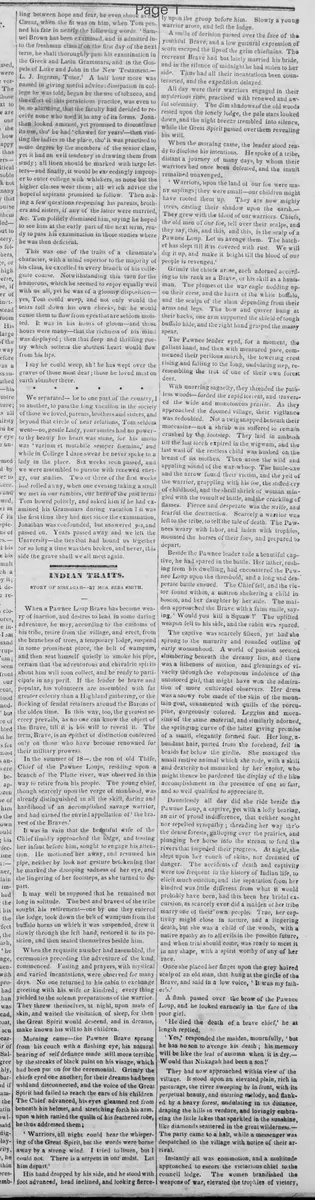
INDIAN TRAITS.
STORY OF NISKAGAH—BY MRS. SEBA SMITH.
When a Pawnee Loup Brave has become weary of inaction, and desires to lead in some daring adventure, he may, according to the customs of his tribe, retire from the village, and erect, from the branches of trees, a temporary lodge, suspend in some prominent place, the belt of wampum, and then seat himself quietly to smoke his pipe, certain that the adventurous and chivalric spirits about him will soon collect, and be ready to participate in any peril. If the leader be brave and popular, his volunteers are assembled with far greater celerity than a Highland gathering, or the flocking of feudal retainers around the Barons of the olden time. In this way, too, the greatest secrecy prevails, as no one can know the object of the Brave, till it is his will to reveal it. The term, Brave, is an epithet of distinction conferred only on those who have become renowned for their military prowess.
In the summer of 18—, the son of old Thief Chief of the Pawnee Loups, residing upon a branch of the Platte river, was observed in this way to retire from his people. The young chief, though scarcely upon the verge of manhood, was already distinguished in all the skill, daring and hardihood of an accomplished savage warrior, and had earned the envied appellation of 'the bravest of the Braves.'
It was in vain that the beautiful wife of the Chief timidly approached the lodge, and tossing her infant before him, sought to engage his attention. He motioned her away, and resumed his pipe, neither by look nor gesture betokening that he marked the drooping sadness of her eye, and the lingering of her footsteps, as she turned to depart.
It may well be supposed that he remained not long in solitude. The best and bravest of the tribe sought his retirement—one by one they entered the lodge, took down the belt of wampum from the buffalo horns on which it was suspended, drew it slowly through the left hand, restored it to its position, and then seated themselves beside him.
When the requisite number had assembled, the ceremonies preceding the adventure of the kind, commenced. Fasting and prayers, with mystical and varied incantations, were observed for many days. No one returned to his cabin to exchange greeting with his wife or kindred; every thing yielded to the solemn preparations of the warrior. They threw themselves, at night, upon mats of skin, and waited the visitation of sleep, for then the Great Spirit would descend, and in dreams, make known his will to his children.
Morning came—the Pawnee Brave sprang from his couch with a flashing eye, his natural bearing of self defiance made still more terrible by the streaks of black paint on his visage, which had been put on for the ceremonial. Grimly the chiefs eyed one another; for their dreams had been wild and disconnected, and the voice of the Great Spirit had failed to reach the ears of his children. The Chief advanced, his eyes gleamed red from beneath his helmet, and stretching forth his arm, upon which rattled the quills of his feathered robe, he thus addressed them;
Warriors, all night could hear the whispering of the Great Spirit, but the words were borne away by a strong wind. I tried to listen, but I could not. There is a serpent in our midst. Let him depart.
His hand dropped by his side, and he stood with foot advanced, head inclined, and looking fiercely upon the group before him. Slowly a young warrior arose, and left the lodge.
A smile of derision passed over the face of the youthful Brave, and a low guttural expression of scorn escaped the lips of the grim chieftains. The recreant Brave had but lately married his bride, and in the silence of midnight he had stolen to her side. Thus had all their incantations been counteracted, and the expedition delayed.
All day were their warriors engaged in their mysterious rites, practised with renewed and awful solemnity. The dim shadows of the old woods rested upon the lonely lodge, the pale stars looked down, and the night breeze trembled into silence, while the Great Spirit passed over them revealing his will.
When the morning came, the leader stood ready to disclose his intentions. He spoke of a tribe distant a journey of many days, by whom their warriors had once been defeated, and the insult remained unavenged.
Warriors, upon the land of our foe were many saplings; they were small—our children might have rooted them up. They are now mighty trees, casting their shadow upon the earth.—They grew with the blood of our warriors. Chiefs, the old men of our foe, tell over their scalps, and they say, this, and this, and this, is the scalp of a Pawnee Loup. Let us avenge them. The hatchet has slept till it is covered with rust. We will dig it up, and make it bright till the blood of our people is revenged.'
Grimly the chiefs arose, each adorned according to his rank as a Brave, or his skill as a huntsman. The plumes of the war eagle nodding up on their crest, and the hairs of the white buffalo, and the scalps of the slain depending from their arms and legs. The bow and quiver hung at their backs, one arm supported the shield of tough buffalo hide, and the right hand grasped the massy spear.
The Pawnee leader eyed for a moment, the gallant band, and then with measured pace, commenced their perilous march, the towering crest rising and falling to the long, undulating step, resembling the trot of one of their own forest deer.
With unerring sagacity, they threaded the pathless woods—forded the rapid torrent, and traversed the wide and monotonous prairie. As they approached the doomed village, their vigilance was redoubled. Not a twig snapped beneath their moccasins—not a shrub was suffered to remain crushed by the footstep. They laid in ambush till the last torch expired in the wigwam, and the last wail of the restless child was hushed on the breast of its mother Then arose the wild and appalling sound of the war-whoop. The battle-axe and the arrow found their victim, and the yell of the warrior, grappling with his foe, the stifled cry of childhood, and the shrill shriek of woman mingled with the tumult of battle, and the crackling of flames. Fierce and desperate was the strife, and fearful the destruction. Scarcely a warrior was left to the tribe, to tell the tale of death. The Pawnees weary with labor, and laden with trophies, mounted the horses of their foes, and prepared to depart.
Beside the Pawnee leader rode a beautiful captive, he had spared in the battle. Her father, rushing from his dwelling, had encountered the Pawnee Loup upon the threshold, and a long and desperate battle ensued. The Chief fell, and the victor found within, a matron sheltering a child in bosom, and her daughter by her side. The maiden approached the Brave with a faint smile, saying, 'Would you kill a Squaw?' The uplifted weapon fell to his side, and the cabin was spared.
The captive was scarcely fifteen, yet had she sprung to the maturity and rounded outline of early womanhood. A world of passion seemed slumbering beneath the dreamy lids, and there was a litheness of motion. and gleamings of vivacity through the voluptuous indolence of the untutored girl, that might have won the admiration of more cultivated observers. Her dress was a snowy robe made of the skin of the mountain goat, ornamented with quills of the porcupine, gorgeously colored. Leggins and moccasins of the same material, and similarly adorned. the springing curve of the latter giving promise of a small. elegantly formed foot. Her long, abundant hair, parted from the forehead, fell in braids far below the girdle. She managed the small restive animal which she rode, with a skill and dexterity not unmarked by her captor, who might thence be pardoned the display of the like accomplishment in the presence of one so fair. and so well qualified to appreciate it.
Dauntlessly all day did she ride beside the Pawnee Loup, a captive, yet with a lofty bearing, an air of proud indifference, that neither sought nor repelled sympathy; threading her way thro' the dense forests, galloping over the prairies, and plunging her horse into the streams to ford the rivers that impeded their progress. At night, she slept upon her couch of skins, nor dreamed of danger. The accidents of death and captivity were too frequent in the history of Indian life, to elicit much emotion, and the separation from her kindred was little different from what it would probably have been, had this been her bridal excursion, as scarcely ever did a maiden of her tribe marry one of their own people. True, her captivity might close in torture, and a lingering death, but she was a child of the woods, with a native apathy as to all evils in the possible future, and when trial should come, was ready to meet it in any shape, with a spirit worthy of any of her race.
Once she placed her finger upon the grey haired scalp of an old man, that hung at the girdle of the Brave, and said in a low voice, 'It was my father's.'
A flush passed over the brow of the Pawnee Loup, and he looked earnestly in the face of the poor girl.
'He died the death of a brave chief,' he at length replied.
'Yes,' responded the maiden, mournfully, 'but he has no son to avenge his death; his memory will be like the leaf of autumn when it is dry.—Would that Niskagah had been a son!'
They had now approached within view of the village. It stood upon an elevated plain, rich in pasturage, the river sweeping by in front, with its perpetual beauty, and untiring melody, and flanked by a heavy forest, undulating in its distance, draping the hills in verdure, and lovingly embracing the little lakes that sparkled in the sunshine, like diamonds scattered in the great wilderness.—The party came to a halt, while a messenger was despatched to the village with notice of their arrival.
Instantly all was commotion, and a multitude approached to escort the victorious chief to the council lodge. The women brandished the weapons of war, elevated the trophies of victory,
and led the way with cries of exultation. The
wife of the leader conveyed the captive to her own
cabin, presented her with parched corn and venison,
and spread the mats for her repose.
Solemnly and in silence assembled the chiefs in
council, to hear the result of the expedition, and
determine the fate of the prisoner. The Pawnee
leader gave the particulars of the enterprise, with
a brevity becoming the character of a chief, already
renowned, not only for his skill in battle
but wisdom at the council hall. Revenge, rather
than plunder, had been the incitement to action
and they had returned, laden with the scalps of
the foe, and a daughter of the chief of the tribe,
to await the will of the council board. The warriors
of their foemen had fallen in battle, and women
and children alone remained to tell, in after
years, of the deadly vengeance of the Pawnee
Loup.
It was the great festival of the Buffalo Hunt,
but a mortality had appeared amongst them, and
the animals were sickly and scarce, and hardly
rewarded the labor of the hunter. Their Medicine
men had hinted at a solemn sacrifice necessary
to appease the wrath of the malignant
spirit.
An old man arose, trembling with age, his hair
white with the frosts of a century. He bowed
heavily upon his staff, and cast his dim eyes over
the assembly.
"Brothers, I am an old man; the hunters that
went with me to the chase, have departed. The
warriors that followed me to battle, are not.—
The sapling that I bent when a child, is now a
gnarled tree, gray with the moss of years—such
am I. Many suns ago the evil spirits destroyed
our game as they do now. We had forgotten
to do them honor. Then we offered them a human
sacrifice at our great festival, and they were
appeased, and the buffalo and the deer came down
to drink in our rivers, and feed upon the great
prairies. The Great Spirit has reserved the
captive maiden, that his children may do what is
right,"
Low sounds of applause spread over the assembly,
and when the chiefs separated, it was
to prepare, the next day, for the great sacrifice
which should avert the evils that threatened their
tribe.
Niskagah was in the cabin of her captor when
told of the fate that awaited her. An instant flush
mounted to her cheek and temples, as if a pang
had forced the blood, in a strong current, from the
heart, and then it retreated, leaving in its place
a fearful pallor. She raised her dark eyes imploringly
to the face of the Pawnee Loup, but she
met only the stolid look of an unsympathising
heart. Ashamed of her weakness, she raised
herself to her full height, threw back the masses
of her jetty hair, and addressed him in a tone
of defiance.
Niskagah is the daughter of a great chief—she
fears not to die. The Pawnee Loup is a brave
chief—he took the scalp of an old man; and she
laughed in scorn.
For a moment lightning seemed to dart from
the fierce eyes of the young chief; and then he
folded his arms and moved not while she continued—
"The Pawnee Loups know not how to torture
their enemies—they are faint-hearted. They
should have spared our chiefs to teach them.—
Our young men had eaten the hearts of the Pawnee
Loup warriors; it made them strong. Every
chief had the scalp of a Pawnee Loup at his girdle.
Would Niskagah might die by the hands
of a brave people—but the Pawnee Loups are
faint-hearted—they cannot torture her."
The night came on, burdened with wind and
rain. The tall grass of the prairies undulated
like the vexed waters of the ocean, and the river,
swollen by the mountain torrents, roared over
its rocky channel, foaming and tumultuous. Niskagah
rose from her bed of skins, and looked
forth into the darkness of the night. She thought
not of escape, for she had witnessed the defence
of the village, and knew the attempt was useless.
She was alone in the midst of the solitude of the
night, and the wild uproar of the elements, and
now her woman's nature returned, and she pressed
her hands upon her brow and wept bitterly.—
All that instinctive clinging to life that belongs to
humanity in every condition, pressed upon her,
and made her recoil from the prospect of its
speedy termination, with all the wildness of terror.
The mode too, protracted and horrible
glared up before the eyes of the lone girl, and
her flesh already palpitated under the tortures
of the burning pitch, or quivered under the knife.
The pride of her race, and the daring bitterness
of her own proud spirit forsook her, now that she
was alone with none to witness her weakness,
and powerful—very powerful became her woman's
ature, with its shrinking dependence, its
dread of solitary suffering, and tendril-like
reaching for support. It may be that a vague
dream of rescue from her gallant captor haunted
her imagination, but she remembered his cold,
unsympathising look, and the long night wore on:
and still he slept. Hope died within her, and
gave place to a wildness of excitement, and she
rushed forth into the tempest.
Passing a cabin door, she was arrested by low
moans from within, and companionship, even in
suffering, drew her towards it. Suddenly a young
mother raised the skins that concealed the entrance,
and stood in the tempest, her long hair
streaming in the wind, and she gave utterance to
her sorrow in words like these:
"Alas! why didst thou leave me, my child ?—
My bosom is full of nourishment; why didst thou
go? Who will nurse thee, my infant—who comfort
and shelter thee? I cannot stay in my cabin
while the cold wind is blowing about thee, and
the rain sinking into thy bed. The skins are
wet my child, and thy cheek is cold and damp
Come to my bosom! Let me feed thee; and dry
the rain from thy hair. I cannot rest in my wigwam—I
cannot be warm and sheltered, whilst
thou art cold in thy little grave."
Then she sank down upon the threshold, and
uttered low wailing. It was the first sorrow of
the young savage, the grief of the untutored mother
at the loss of her first born.
Niskagah envied the lot of the unconscious
child, that had thus gone to the land of spirits, ere
it had known the bitterness of life. Yet the grief
of another has allayed the excitement of her own
heart, and she returned to the cabin, with the renewed
apathy of her people, and the gleamings
of hope that can never quite desert the young
heart. She slept long and soundly, and awoke
only to the sound of the wild birds as they blithely
hailed the purity of the morning. The heavy
dew weighed down the herbage, and the clouds
rolled away where the mountain top seemed to
beckon their coming. The river poured on with
its swollen waters, chafing its rock bed, and its
hollow voice was heard where it plunged down a
chasm of rocks, sending up a volume of spray,
upon which the morning sun was showering
rainbow gems, and covering it as with a diadem.
The wife of the Pawnee Loup presented the
captive venison and fruits, but she motioned her
away, saying, 'Niskagah will talk with the Great
Spirit—she will soon be in the land of shadows,'
then turning her face to the wall, she folded her
robe over her bosom, and awaited those who
should lead her to the stake.
All things were in readiness. Women were
there, eager with expectation, and children, awed
by the presence of their seniors, looked breathlessly
at the elevated stake and instruments of torture.
Warriors were there adorned with paint
and the trophies of battle, and helmets nodding
with plumes, but conspicuous in the midst was
the son of the chief, with the eagle crest towering
above the chiefs of the tribe. Wildly did the
Medicine Man pursue the preliminary ceremonies,
singing chants in a low, guttural tone, keeping
time with a measured step, and then tossing
his arms in the air, raising his voice to a piercing
scream, the bells of his robe jingling, and
scalps fluttering in the wind. At length bounding
from the ground, he returned, slowly leading
in the victim, her wrists crossed meekly before
her, and her upbound hair falling like a black
veil nearly to her feet. Her step was feeble, and
her lips compressed, as if to crowd back all memory
of weakness.
As she approached the stake, she raised her
eyes timidly from the ground, and encountered
those of the young Pawnee Loup. Instantly the
shrinking girl became the proud child of the woods
sending back the gaze of the eager multitude with
a look of fearless defiance, and approaching the
instruments of torture, with a step almost of alacrity.
A shout of exultation burst from the crowd
at the noble bearing of the prisoner.
There was a rush—and the whole multitude
sprang to their feet. The Pawnee Loup had
bounded into the arena, and borne the captive
from their midst—and off over the broad prairies,
and up the roar of the cataract was seen the tall
form of the warrior, and the robes of the fearless
maiden, as their fleet horses panted for the desert.
Not a bow was sprung, nor javelin poised. It was
an impulse from the Great Spirit, which it were
impious to counteract. Rapidly and in silence the
fugitives pursued their flight. The Pawnee Loup
scarcely glanced at his companion, as she gave
the reins to her steed, and kept by his side, fearless
and unhesitating, her eye dancing with renewed
hopes and happiness, and a smile playing
upon her lip as they welled up from her young
heart. At night, when the Chief spread her skins
in the shadow of the great forest, and watched her
slumbers at a distance, Niskagah slept with the
security of a child. When she awoke, she laved
her face in the brook that bubbled at her feet, and
braided her abundant hair, using it for a mirror
Seven days had they pursued their perilous way
through the wilderness, greeted only by the howl
of the wild beast, and the barking of Wish-ton
wish, when Niskagah knew they were approaching
the country of her own people.
They were now on the outskirts of the forest,
and the chief pointed to the hills behind which
arose the smoke of their cabins. Niskagah heard
him in silence. When he turned to depart, she
laid her hand timidly upon his arm, and with the
pathos of nature, said—
The home of Niskagah is desolate. Grass
grows in the footpath of our warriors, and the
council-fire is extinguished. The hunter has
ceased from the chase. The blood of our chiefs
is still wet upon the threshold. I would not behold
it.
'Niskagah is a proud maiden,' said the Brave.
'She will be Chief of her tribe, and she will teach
her young men to take vengeance on the Pawnee
Loups. Niskagah must be the wife of a great
chief, who has many wives, for she would scorn
to cook his venison, and make his wampum belts
and moccasins.'
The girl sprang to his side, all the passion of
her nature beaming from her dark flashing eyes.
The Chief bent his looks admiringly upon the
beautiful girl, and her lids fell under his ardent
gaze. Her head dropped, and her voice was low
and sweet.
'Niskagah is proud; she is the daughter of a
great chief—but she is not too proud to love—and
love would make her very gentle'—and her round
lip quivered with the timidity of her sex.
It may be that the Pawnee Loup remembered
his own fair bride, singing a lullaby to his child—
for he turned away, and Niskagah remained motionless
till the forest hid him from her view, and
then in weariness and solitude sought the ruins of
her village.
When the Brave returned to his own council
hall, none questioned his right to do as he had done
He was wise in council, and brave in battle, and
his will had the authority of law. But his wife
saw the glowing gloom upon his brow, and that
her own smiles could not dispel it. His wigwam
was lonely, and the game he killed in the chase
went to the cabins of others, for he had few to eat
it. She tried often to give utterance to the thoughts
of her heart, but they died upon her lips. But she
had determined on the great sacrifice, for her love
sought only the happiness of its object
She had nursed her infant to sleep, and laid him
on the skins beside its father, and then in a low
voice she said—
'The Brave grows weary of his cabin—it is
lonely. Niskagah is very beautiful, and she loves
the Pawnee Loup.'
She said no more, but pressed her lips to the
cheek of her child, and when she raised her head
a tear had fallen upon it. The Chief took her to
his bosom, and the wife wept long and bitterly.—
Yet she urged his departure, for she saw the beauty
of the captive was still fresh in his memory.
With woman, love is ever the same, whether in
the halls of elegance and refinement, or the simple
cabin of the savage—it is still true to its nature—still
self-sacrificing and enduring; twining
flowers and verdure about the shrine of its idol,
while its own heart is desolate and broken.
STORY OF NISKAGAH—BY MRS. SEBA SMITH.
When a Pawnee Loup Brave has become weary of inaction, and desires to lead in some daring adventure, he may, according to the customs of his tribe, retire from the village, and erect, from the branches of trees, a temporary lodge, suspend in some prominent place, the belt of wampum, and then seat himself quietly to smoke his pipe, certain that the adventurous and chivalric spirits about him will soon collect, and be ready to participate in any peril. If the leader be brave and popular, his volunteers are assembled with far greater celerity than a Highland gathering, or the flocking of feudal retainers around the Barons of the olden time. In this way, too, the greatest secrecy prevails, as no one can know the object of the Brave, till it is his will to reveal it. The term, Brave, is an epithet of distinction conferred only on those who have become renowned for their military prowess.
In the summer of 18—, the son of old Thief Chief of the Pawnee Loups, residing upon a branch of the Platte river, was observed in this way to retire from his people. The young chief, though scarcely upon the verge of manhood, was already distinguished in all the skill, daring and hardihood of an accomplished savage warrior, and had earned the envied appellation of 'the bravest of the Braves.'
It was in vain that the beautiful wife of the Chief timidly approached the lodge, and tossing her infant before him, sought to engage his attention. He motioned her away, and resumed his pipe, neither by look nor gesture betokening that he marked the drooping sadness of her eye, and the lingering of her footsteps, as she turned to depart.
It may well be supposed that he remained not long in solitude. The best and bravest of the tribe sought his retirement—one by one they entered the lodge, took down the belt of wampum from the buffalo horns on which it was suspended, drew it slowly through the left hand, restored it to its position, and then seated themselves beside him.
When the requisite number had assembled, the ceremonies preceding the adventure of the kind, commenced. Fasting and prayers, with mystical and varied incantations, were observed for many days. No one returned to his cabin to exchange greeting with his wife or kindred; every thing yielded to the solemn preparations of the warrior. They threw themselves, at night, upon mats of skin, and waited the visitation of sleep, for then the Great Spirit would descend, and in dreams, make known his will to his children.
Morning came—the Pawnee Brave sprang from his couch with a flashing eye, his natural bearing of self defiance made still more terrible by the streaks of black paint on his visage, which had been put on for the ceremonial. Grimly the chiefs eyed one another; for their dreams had been wild and disconnected, and the voice of the Great Spirit had failed to reach the ears of his children. The Chief advanced, his eyes gleamed red from beneath his helmet, and stretching forth his arm, upon which rattled the quills of his feathered robe, he thus addressed them;
Warriors, all night could hear the whispering of the Great Spirit, but the words were borne away by a strong wind. I tried to listen, but I could not. There is a serpent in our midst. Let him depart.
His hand dropped by his side, and he stood with foot advanced, head inclined, and looking fiercely upon the group before him. Slowly a young warrior arose, and left the lodge.
A smile of derision passed over the face of the youthful Brave, and a low guttural expression of scorn escaped the lips of the grim chieftains. The recreant Brave had but lately married his bride, and in the silence of midnight he had stolen to her side. Thus had all their incantations been counteracted, and the expedition delayed.
All day were their warriors engaged in their mysterious rites, practised with renewed and awful solemnity. The dim shadows of the old woods rested upon the lonely lodge, the pale stars looked down, and the night breeze trembled into silence, while the Great Spirit passed over them revealing his will.
When the morning came, the leader stood ready to disclose his intentions. He spoke of a tribe distant a journey of many days, by whom their warriors had once been defeated, and the insult remained unavenged.
Warriors, upon the land of our foe were many saplings; they were small—our children might have rooted them up. They are now mighty trees, casting their shadow upon the earth.—They grew with the blood of our warriors. Chiefs, the old men of our foe, tell over their scalps, and they say, this, and this, and this, is the scalp of a Pawnee Loup. Let us avenge them. The hatchet has slept till it is covered with rust. We will dig it up, and make it bright till the blood of our people is revenged.'
Grimly the chiefs arose, each adorned according to his rank as a Brave, or his skill as a huntsman. The plumes of the war eagle nodding up on their crest, and the hairs of the white buffalo, and the scalps of the slain depending from their arms and legs. The bow and quiver hung at their backs, one arm supported the shield of tough buffalo hide, and the right hand grasped the massy spear.
The Pawnee leader eyed for a moment, the gallant band, and then with measured pace, commenced their perilous march, the towering crest rising and falling to the long, undulating step, resembling the trot of one of their own forest deer.
With unerring sagacity, they threaded the pathless woods—forded the rapid torrent, and traversed the wide and monotonous prairie. As they approached the doomed village, their vigilance was redoubled. Not a twig snapped beneath their moccasins—not a shrub was suffered to remain crushed by the footstep. They laid in ambush till the last torch expired in the wigwam, and the last wail of the restless child was hushed on the breast of its mother Then arose the wild and appalling sound of the war-whoop. The battle-axe and the arrow found their victim, and the yell of the warrior, grappling with his foe, the stifled cry of childhood, and the shrill shriek of woman mingled with the tumult of battle, and the crackling of flames. Fierce and desperate was the strife, and fearful the destruction. Scarcely a warrior was left to the tribe, to tell the tale of death. The Pawnees weary with labor, and laden with trophies, mounted the horses of their foes, and prepared to depart.
Beside the Pawnee leader rode a beautiful captive, he had spared in the battle. Her father, rushing from his dwelling, had encountered the Pawnee Loup upon the threshold, and a long and desperate battle ensued. The Chief fell, and the victor found within, a matron sheltering a child in bosom, and her daughter by her side. The maiden approached the Brave with a faint smile, saying, 'Would you kill a Squaw?' The uplifted weapon fell to his side, and the cabin was spared.
The captive was scarcely fifteen, yet had she sprung to the maturity and rounded outline of early womanhood. A world of passion seemed slumbering beneath the dreamy lids, and there was a litheness of motion. and gleamings of vivacity through the voluptuous indolence of the untutored girl, that might have won the admiration of more cultivated observers. Her dress was a snowy robe made of the skin of the mountain goat, ornamented with quills of the porcupine, gorgeously colored. Leggins and moccasins of the same material, and similarly adorned. the springing curve of the latter giving promise of a small. elegantly formed foot. Her long, abundant hair, parted from the forehead, fell in braids far below the girdle. She managed the small restive animal which she rode, with a skill and dexterity not unmarked by her captor, who might thence be pardoned the display of the like accomplishment in the presence of one so fair. and so well qualified to appreciate it.
Dauntlessly all day did she ride beside the Pawnee Loup, a captive, yet with a lofty bearing, an air of proud indifference, that neither sought nor repelled sympathy; threading her way thro' the dense forests, galloping over the prairies, and plunging her horse into the streams to ford the rivers that impeded their progress. At night, she slept upon her couch of skins, nor dreamed of danger. The accidents of death and captivity were too frequent in the history of Indian life, to elicit much emotion, and the separation from her kindred was little different from what it would probably have been, had this been her bridal excursion, as scarcely ever did a maiden of her tribe marry one of their own people. True, her captivity might close in torture, and a lingering death, but she was a child of the woods, with a native apathy as to all evils in the possible future, and when trial should come, was ready to meet it in any shape, with a spirit worthy of any of her race.
Once she placed her finger upon the grey haired scalp of an old man, that hung at the girdle of the Brave, and said in a low voice, 'It was my father's.'
A flush passed over the brow of the Pawnee Loup, and he looked earnestly in the face of the poor girl.
'He died the death of a brave chief,' he at length replied.
'Yes,' responded the maiden, mournfully, 'but he has no son to avenge his death; his memory will be like the leaf of autumn when it is dry.—Would that Niskagah had been a son!'
They had now approached within view of the village. It stood upon an elevated plain, rich in pasturage, the river sweeping by in front, with its perpetual beauty, and untiring melody, and flanked by a heavy forest, undulating in its distance, draping the hills in verdure, and lovingly embracing the little lakes that sparkled in the sunshine, like diamonds scattered in the great wilderness.—The party came to a halt, while a messenger was despatched to the village with notice of their arrival.
Instantly all was commotion, and a multitude approached to escort the victorious chief to the council lodge. The women brandished the weapons of war, elevated the trophies of victory,
and led the way with cries of exultation. The
wife of the leader conveyed the captive to her own
cabin, presented her with parched corn and venison,
and spread the mats for her repose.
Solemnly and in silence assembled the chiefs in
council, to hear the result of the expedition, and
determine the fate of the prisoner. The Pawnee
leader gave the particulars of the enterprise, with
a brevity becoming the character of a chief, already
renowned, not only for his skill in battle
but wisdom at the council hall. Revenge, rather
than plunder, had been the incitement to action
and they had returned, laden with the scalps of
the foe, and a daughter of the chief of the tribe,
to await the will of the council board. The warriors
of their foemen had fallen in battle, and women
and children alone remained to tell, in after
years, of the deadly vengeance of the Pawnee
Loup.
It was the great festival of the Buffalo Hunt,
but a mortality had appeared amongst them, and
the animals were sickly and scarce, and hardly
rewarded the labor of the hunter. Their Medicine
men had hinted at a solemn sacrifice necessary
to appease the wrath of the malignant
spirit.
An old man arose, trembling with age, his hair
white with the frosts of a century. He bowed
heavily upon his staff, and cast his dim eyes over
the assembly.
"Brothers, I am an old man; the hunters that
went with me to the chase, have departed. The
warriors that followed me to battle, are not.—
The sapling that I bent when a child, is now a
gnarled tree, gray with the moss of years—such
am I. Many suns ago the evil spirits destroyed
our game as they do now. We had forgotten
to do them honor. Then we offered them a human
sacrifice at our great festival, and they were
appeased, and the buffalo and the deer came down
to drink in our rivers, and feed upon the great
prairies. The Great Spirit has reserved the
captive maiden, that his children may do what is
right,"
Low sounds of applause spread over the assembly,
and when the chiefs separated, it was
to prepare, the next day, for the great sacrifice
which should avert the evils that threatened their
tribe.
Niskagah was in the cabin of her captor when
told of the fate that awaited her. An instant flush
mounted to her cheek and temples, as if a pang
had forced the blood, in a strong current, from the
heart, and then it retreated, leaving in its place
a fearful pallor. She raised her dark eyes imploringly
to the face of the Pawnee Loup, but she
met only the stolid look of an unsympathising
heart. Ashamed of her weakness, she raised
herself to her full height, threw back the masses
of her jetty hair, and addressed him in a tone
of defiance.
Niskagah is the daughter of a great chief—she
fears not to die. The Pawnee Loup is a brave
chief—he took the scalp of an old man; and she
laughed in scorn.
For a moment lightning seemed to dart from
the fierce eyes of the young chief; and then he
folded his arms and moved not while she continued—
"The Pawnee Loups know not how to torture
their enemies—they are faint-hearted. They
should have spared our chiefs to teach them.—
Our young men had eaten the hearts of the Pawnee
Loup warriors; it made them strong. Every
chief had the scalp of a Pawnee Loup at his girdle.
Would Niskagah might die by the hands
of a brave people—but the Pawnee Loups are
faint-hearted—they cannot torture her."
The night came on, burdened with wind and
rain. The tall grass of the prairies undulated
like the vexed waters of the ocean, and the river,
swollen by the mountain torrents, roared over
its rocky channel, foaming and tumultuous. Niskagah
rose from her bed of skins, and looked
forth into the darkness of the night. She thought
not of escape, for she had witnessed the defence
of the village, and knew the attempt was useless.
She was alone in the midst of the solitude of the
night, and the wild uproar of the elements, and
now her woman's nature returned, and she pressed
her hands upon her brow and wept bitterly.—
All that instinctive clinging to life that belongs to
humanity in every condition, pressed upon her,
and made her recoil from the prospect of its
speedy termination, with all the wildness of terror.
The mode too, protracted and horrible
glared up before the eyes of the lone girl, and
her flesh already palpitated under the tortures
of the burning pitch, or quivered under the knife.
The pride of her race, and the daring bitterness
of her own proud spirit forsook her, now that she
was alone with none to witness her weakness,
and powerful—very powerful became her woman's
ature, with its shrinking dependence, its
dread of solitary suffering, and tendril-like
reaching for support. It may be that a vague
dream of rescue from her gallant captor haunted
her imagination, but she remembered his cold,
unsympathising look, and the long night wore on:
and still he slept. Hope died within her, and
gave place to a wildness of excitement, and she
rushed forth into the tempest.
Passing a cabin door, she was arrested by low
moans from within, and companionship, even in
suffering, drew her towards it. Suddenly a young
mother raised the skins that concealed the entrance,
and stood in the tempest, her long hair
streaming in the wind, and she gave utterance to
her sorrow in words like these:
"Alas! why didst thou leave me, my child ?—
My bosom is full of nourishment; why didst thou
go? Who will nurse thee, my infant—who comfort
and shelter thee? I cannot stay in my cabin
while the cold wind is blowing about thee, and
the rain sinking into thy bed. The skins are
wet my child, and thy cheek is cold and damp
Come to my bosom! Let me feed thee; and dry
the rain from thy hair. I cannot rest in my wigwam—I
cannot be warm and sheltered, whilst
thou art cold in thy little grave."
Then she sank down upon the threshold, and
uttered low wailing. It was the first sorrow of
the young savage, the grief of the untutored mother
at the loss of her first born.
Niskagah envied the lot of the unconscious
child, that had thus gone to the land of spirits, ere
it had known the bitterness of life. Yet the grief
of another has allayed the excitement of her own
heart, and she returned to the cabin, with the renewed
apathy of her people, and the gleamings
of hope that can never quite desert the young
heart. She slept long and soundly, and awoke
only to the sound of the wild birds as they blithely
hailed the purity of the morning. The heavy
dew weighed down the herbage, and the clouds
rolled away where the mountain top seemed to
beckon their coming. The river poured on with
its swollen waters, chafing its rock bed, and its
hollow voice was heard where it plunged down a
chasm of rocks, sending up a volume of spray,
upon which the morning sun was showering
rainbow gems, and covering it as with a diadem.
The wife of the Pawnee Loup presented the
captive venison and fruits, but she motioned her
away, saying, 'Niskagah will talk with the Great
Spirit—she will soon be in the land of shadows,'
then turning her face to the wall, she folded her
robe over her bosom, and awaited those who
should lead her to the stake.
All things were in readiness. Women were
there, eager with expectation, and children, awed
by the presence of their seniors, looked breathlessly
at the elevated stake and instruments of torture.
Warriors were there adorned with paint
and the trophies of battle, and helmets nodding
with plumes, but conspicuous in the midst was
the son of the chief, with the eagle crest towering
above the chiefs of the tribe. Wildly did the
Medicine Man pursue the preliminary ceremonies,
singing chants in a low, guttural tone, keeping
time with a measured step, and then tossing
his arms in the air, raising his voice to a piercing
scream, the bells of his robe jingling, and
scalps fluttering in the wind. At length bounding
from the ground, he returned, slowly leading
in the victim, her wrists crossed meekly before
her, and her upbound hair falling like a black
veil nearly to her feet. Her step was feeble, and
her lips compressed, as if to crowd back all memory
of weakness.
As she approached the stake, she raised her
eyes timidly from the ground, and encountered
those of the young Pawnee Loup. Instantly the
shrinking girl became the proud child of the woods
sending back the gaze of the eager multitude with
a look of fearless defiance, and approaching the
instruments of torture, with a step almost of alacrity.
A shout of exultation burst from the crowd
at the noble bearing of the prisoner.
There was a rush—and the whole multitude
sprang to their feet. The Pawnee Loup had
bounded into the arena, and borne the captive
from their midst—and off over the broad prairies,
and up the roar of the cataract was seen the tall
form of the warrior, and the robes of the fearless
maiden, as their fleet horses panted for the desert.
Not a bow was sprung, nor javelin poised. It was
an impulse from the Great Spirit, which it were
impious to counteract. Rapidly and in silence the
fugitives pursued their flight. The Pawnee Loup
scarcely glanced at his companion, as she gave
the reins to her steed, and kept by his side, fearless
and unhesitating, her eye dancing with renewed
hopes and happiness, and a smile playing
upon her lip as they welled up from her young
heart. At night, when the Chief spread her skins
in the shadow of the great forest, and watched her
slumbers at a distance, Niskagah slept with the
security of a child. When she awoke, she laved
her face in the brook that bubbled at her feet, and
braided her abundant hair, using it for a mirror
Seven days had they pursued their perilous way
through the wilderness, greeted only by the howl
of the wild beast, and the barking of Wish-ton
wish, when Niskagah knew they were approaching
the country of her own people.
They were now on the outskirts of the forest,
and the chief pointed to the hills behind which
arose the smoke of their cabins. Niskagah heard
him in silence. When he turned to depart, she
laid her hand timidly upon his arm, and with the
pathos of nature, said—
The home of Niskagah is desolate. Grass
grows in the footpath of our warriors, and the
council-fire is extinguished. The hunter has
ceased from the chase. The blood of our chiefs
is still wet upon the threshold. I would not behold
it.
'Niskagah is a proud maiden,' said the Brave.
'She will be Chief of her tribe, and she will teach
her young men to take vengeance on the Pawnee
Loups. Niskagah must be the wife of a great
chief, who has many wives, for she would scorn
to cook his venison, and make his wampum belts
and moccasins.'
The girl sprang to his side, all the passion of
her nature beaming from her dark flashing eyes.
The Chief bent his looks admiringly upon the
beautiful girl, and her lids fell under his ardent
gaze. Her head dropped, and her voice was low
and sweet.
'Niskagah is proud; she is the daughter of a
great chief—but she is not too proud to love—and
love would make her very gentle'—and her round
lip quivered with the timidity of her sex.
It may be that the Pawnee Loup remembered
his own fair bride, singing a lullaby to his child—
for he turned away, and Niskagah remained motionless
till the forest hid him from her view, and
then in weariness and solitude sought the ruins of
her village.
When the Brave returned to his own council
hall, none questioned his right to do as he had done
He was wise in council, and brave in battle, and
his will had the authority of law. But his wife
saw the glowing gloom upon his brow, and that
her own smiles could not dispel it. His wigwam
was lonely, and the game he killed in the chase
went to the cabins of others, for he had few to eat
it. She tried often to give utterance to the thoughts
of her heart, but they died upon her lips. But she
had determined on the great sacrifice, for her love
sought only the happiness of its object
She had nursed her infant to sleep, and laid him
on the skins beside its father, and then in a low
voice she said—
'The Brave grows weary of his cabin—it is
lonely. Niskagah is very beautiful, and she loves
the Pawnee Loup.'
She said no more, but pressed her lips to the
cheek of her child, and when she raised her head
a tear had fallen upon it. The Chief took her to
his bosom, and the wife wept long and bitterly.—
Yet she urged his departure, for she saw the beauty
of the captive was still fresh in his memory.
With woman, love is ever the same, whether in
the halls of elegance and refinement, or the simple
cabin of the savage—it is still true to its nature—still
self-sacrificing and enduring; twining
flowers and verdure about the shrine of its idol,
while its own heart is desolate and broken.
What sub-type of article is it?
Prose Fiction
What themes does it cover?
War Peace
Love Romance
Moral Virtue
What keywords are associated?
Pawnee Loup
Niskagah
Indian Captivity
War Expedition
Tribal Sacrifice
Native Romance
Brave Sacrifice
What entities or persons were involved?
By Mrs. Seba Smith
Literary Details
Title
Story Of Niskagah
Author
By Mrs. Seba Smith
Subject
Tale Of Vengeance, Captivity, And Romance Among The Pawnee Loups
Key Lines
Warriors, Upon The Land Of Our Foe Were Many Saplings; They Were Small—Our Children Might Have Rooted Them Up. They Are Now Mighty Trees, Casting Their Shadow Upon The Earth.—They Grew With The Blood Of Our Warriors.
Niskagah Is The Daughter Of A Great Chief—She Fears Not To Die. The Pawnee Loup Is A Brave Chief—He Took The Scalp Of An Old Man; And She Laughed In Scorn.
'Niskagah Is Proud; She Is The Daughter Of A Great Chief—But She Is Not Too Proud To Love—And Love Would Make Her Very Gentle'—And Her Round Lip Quivered With The Timidity Of Her Sex.
With Woman, Love Is Ever The Same, Whether In The Halls Of Elegance And Refinement, Or The Simple Cabin Of The Savage—It Is Still True To Its Nature—Still Self Sacrificing And Enduring; Twining Flowers And Verdure About The Shrine Of Its Idol, While Its Own Heart Is Desolate And Broken.