Thank you for visiting SNEWPapers!
Sign up free
The National Intelligencer And Washington Advertiser
Washington, District Of Columbia
What is this article about?
On August 5, 1806, the Nassau Court of Vice-Admiralty, under Judge Henry Moreton, condemned the ship Stork and its cargo of dried beef from Buenos Ayres to Havana via Bristol, RI, as an illegal voyage violating wartime trade prohibitions, despite claims by owner Hersey Bradford linked to importer D. Wolf.
Clipping
OCR Quality
Full Text
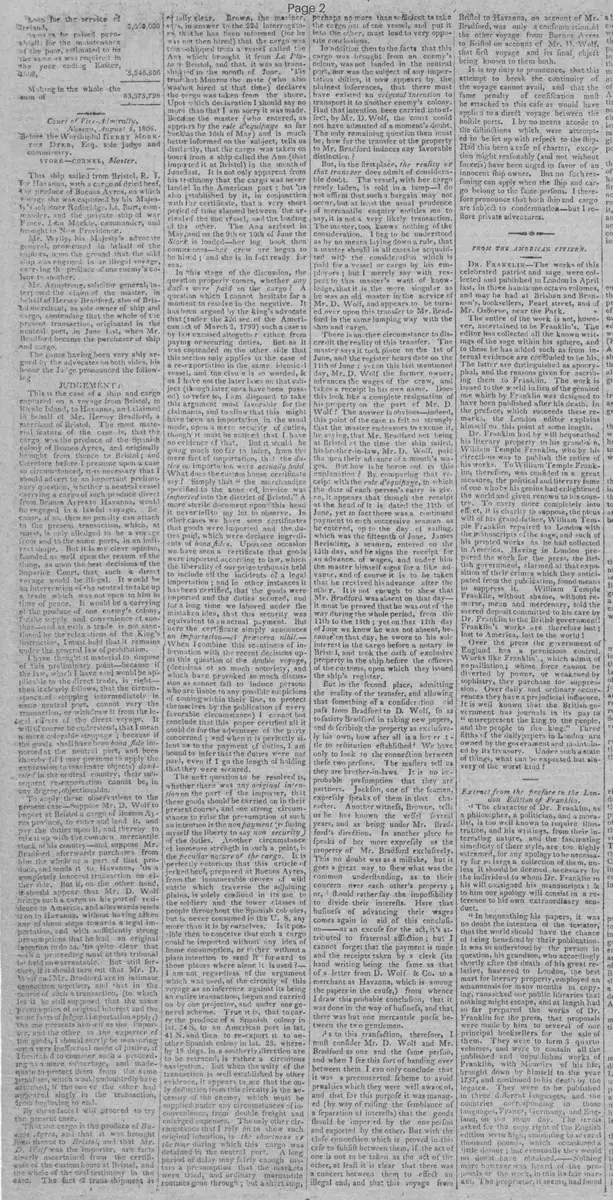
Nassau, August 5, 1806.
Before the Worshipful Henry Moreton, Esq. sole judge and commissary.
STORK, Cornel, Master.
This ship sailed from Bristol, R. I. for Havana, with a cargo of dried beef, the produce of Buenos Ayres, on which voyage she was captured by his Majesty's schooner Redbridge, Lt. Burt, commander, and the private ship of war Fancy, John Mackie, commander, and brought to New Providence.
Mr. Wylly, his Majesty's advocate general, prosecuted in behalf of the captors, on the ground that the said ship was engaged in an illegal voyage, carrying the produce of one enemy's country to another.
Mr. Armstrong, solicitor general, interposed the claim of the master, in behalf of Hersey Bradford, also of Bristol merchant, as sole owner of ship and cargo, contending that the whole of the present transaction, originated in the neutral port, in June last, when Mr. Bradford became the purchaser of ship and cargo.
The cause having been very ably argued by the advocates on both sides, his honor the Judge pronounced the following
JUDGEMENT:
This is the case of a ship and cargo captured on a voyage from Bristol, in Rhode Island, to Havana, and claimed in behalf of Mr. Hersey Bradford, a merchant of Bristol. The most material feature of the case is, that the cargo was the produce of the Spanish colony of Buenos Ayres, and originally brought from thence to Bristol; and therefore before I presume upon a case so circumstanced, it is necessary that I should advert to an important preliminary question, whether a neutral vessel carrying a cargo of such produce direct from Buenos Ayres to Havana, would be engaged in a lawful voyage. Because, if so, then no penalty can attach to the present transaction, which, at worst, is only alleged to be a voyage from and to the same ports, in an indirect shape. But it is my clear opinion, founded as well upon the reason of the thing, as upon the best decisions of the Superior Court, that such a direct voyage would be illegal. It would be an intervention of the neutral to take up a trade which was not open to him in time of peace. It would be a carrying of the produce of one enemy's colony, for the supply and convenience of another and as such a trade is not sanctioned by the relaxations of the King's instruction, I must hold that it remains under the general law of prohibition.
I have thought it material to dispose of this preliminary point—because if the law, which I have said would be applicable to the direct trade, is right—then it clearly follows, that the circumstance of stopping intermediately in some neutral port, cannot vary the transaction, or withdraw it from the legal effects of the direct voyage. It will of course be understood, that I mean a mere colorable stoppage; because if the goods shall have been bona fide imported at the neutral port, and been thereby (if I may presume to apply the expression to inanimate objects) domiciled in the neutral country, their subsequent re-exportation cannot be, in any degree, objectionable.
To apply these observations to the present case—Suppose Mr. D. Wolf to import at Bristol a cargo of Buenos Ayres produce, to enter and land it, and pay the duties upon it, and thereby to mix it up with the common mercantile stock of his country—and suppose Mr. Bradford afterwards purchases from him the whole or a part of that produce, and sends it to Havana, 'tis a completely innocent transaction on either side. But if, on the other hand, it should appear that Mr. D. Wolf brings such a cargo to his port of residence in America, and afterwards sends it on to Havana, without having taken any of those steps towards a legal importation, and with sufficiently strong presumptions that he had an original intention to do so, 'tis quite clear that such a proceeding must at this tribunal be held unwarrantable. But still further, if it should turn out that Mr. D. Wolf and Mr. Bradford are in intimate connection together, and that in the course of such a transaction, (to which let it be still supposed that the same presumption of original interest and the same facts of feigned importation apply,) the one presents himself as the importer, and the other as the exporter of the goods, I should surely be measuring out a very ineffectual mode of justice, if I hesitated to consider such a proceeding as a mere subterfuge, and inadequate to protect them from the same penalties, which would undoubtedly have attached, if the one or the other had appeared singly in the transaction, from beginning to end.
By these facts I will proceed to try the present case.
That the cargo is the produce of Buenos Ayres, and that it was brought from thence to Bristol, and that Mr. D. Wolf was the importer, are facts clearly ascertained from the certificate of the custom house at Bristol, and the whole of the oral testimony in the case. The fact of trans-shipment is especially clear. Brown, the mariner, says, in answer to the 22d interrogatory, that he has been informed (for he was not then hired) that the cargo was trans-shipped from a vessel called the Ann which brought it from La Plata to Bristol, and that it was so trans-shipped in the month of June. 'Tis true that Monroe the mate (who also was not hired at that time) declares the cargo was taken from the shore. Upon which declaration I should say no more than that I am sorry it was made. Because the master (who entered, as appears by the role d'equipage so far back as the 16th of May) and is much better informed on the subject, tells us distinctly, that the cargo was taken on board from a ship called the Ann (that imported it at Bristol) in the month of June last. It is not only apparent from his testimony that the cargo was never landed in the American port: but 'tis also established by it, in conjunction with the certificate, that a very short period of time elapsed between the arrival of the one vessel, and the loading of the other. The Ann arrived in May, and on the 9th or 10th of June the Stork is loaded—her log book then commences—her crew are begun to be hired: and she is in fact ready for sea.
In this stage of the discussion, the question properly comes, whether any duties were paid on the cargo? A question which I cannot hesitate for a moment to resolve in the negative. It has been argued by the king's advocate that (under the 32d sec. of the American act of March 2, 1799) such a case is by law excused altogether either from paying or securing duties. But as it was contended on the other side that this section only applies to the case of a re-exportation in the same identical vessel, and the clause is so worded, & as I have not the later laws on that subject (though later ones have been passed to refer to) I am disposed to take this argument most favorably for the claimants, and to allow that this might have been an importation in the usual mode, upon a mere security of duties, though it must be noticed that I have no evidence of that. But it would be going much too far to infer, from the mere fact of importation, that the duties on importation were actually paid. What does the custom house certificate say? Simply that "the merchandise specified in the annexed invoice was imported into the district of Bristol." A more sterile document upon this head it never fell to my lot to observe. In other cases we have seen certificates that goods were imported and the duties paid, which were decisive ingredients of bona fides. Upon one occasion we have seen a certificate that goods were imported according to law, which the liberality of our prize tribunals held to include all the incidents of a legal importation; and in other instances it has been certified, that the goods were imported and the duties secured, and for a long time we labored under the mistaken idea, that this security was equivalent to an actual payment. But here the certificate simply announces an importation—et præterea nihil.—
When I combine this scantiness of information with the recent decisions upon this question of the double voyage, (decisions of so much notoriety, and which have provoked so much discussion as cannot fail to induce persons who are liable to any possible suspicions of coming within their line, to protect themselves by the publication of every favorable circumstance) I cannot but conclude that this paper certified all it could do for the advantage of the party concerned; and when it is perfectly silent as to the payment of duties, I am bound to infer that the duties were not paid, even if I go the length of holding that they were secured.
The next question to be resolved is, whether there was any original intention on the part of the importer, that these goods should be carried on in their present course, and one strong circumstance to raise the presumption of such an intention is the non payment (refusing myself the liberty to say non security) of the duties. Another circumstance of immense strength in such a point, is the peculiar nature of the cargo. It is perfectly notorious that this article of jerked beef, prepared at Buenos Ayres, from the innumerable droves of wild cattle which traverse the adjoining plains, is solely confined in its use to the soldiery and the lower classes of people throughout the Spanish colonies, but is never consumed in the U. S. any more than it is by ourselves. Is it possible then to conceive that such a cargo could be imported without any idea of home consumption, or rather without a plain intention to send it forward to those places where alone it is used?—
I am not regardless of the argument which was used, of the circuity of this voyage as an inference against its being an entire transaction, begun and carried on by one projector, and under one general scheme. True it is, that to carry the produce of a Spanish colony in lat. 34 S. to an American port in lat. 41 N. and then to re-export it to another Spanish colony in lat. 23, whereby 13 degs. in a southerly direction are to be retraced, is rather a circuitous navigation. But when the unity of the transaction is well established by other evidence, it appears to me that the only deduction from this circuity is the necessity of the enemy, which must be supplied under any circumstances of inconvenience, from double freight and enlarged expenses. The only other circumstance that I rely on to shew such original intention, is the shortness of the time during which this cargo was detained in the neutral port. A long period of delay may fairly enough sustain a presumption that the markets were tried, and ordinary mercantile routines gone through; but a short stop, perhaps no more than sufficient to take the cargo out of one vessel, and put it into the other, must lead to very opposite conclusions.
In addition then to the facts that this cargo was brought from an enemy's colony, was not landed in the neutral port, nor was the subject of any importation duties, it now appears by the plainest inferences, that there must have existed an original intention to transport it to another enemy's colony. Had that intention been carried into effect, by Mr. D. Wolf, the court could not have admitted of a moment's doubt. The only remaining question then must be, how far the transfer of the property to Mr. Bradford induces any favorable distinction?
But, in the first place, the reality of that transfer does admit of considerable doubt. The vessel, with her cargo ready laden, is sold in a lump—I do not affirm that such a bargain may not occur, but at least the usual prudence of mercantile enquiry entitles me to say, it is not a very likely transaction. The master, too, knows nothing of the consideration. I beg to be understood as by no means laying down a rule, that a master should in all cases be acquainted with the consideration which is paid for a vessel or cargo by his employers; but I merely say with respect to this master's want of knowledge, that it is the more singular as he was an old master in the service of Mr. D. Wolf, and appears to be turned over upon this transfer to Mr. Bradford in the same lumping way with the ship and cargo.
There is another circumstance to discredit the reality of this transfer. The master says it took place on the 1st of June, and the register bears date on the 11th of June: yet on this last mentioned day, Mr. D. Wolf the former owner, advances the wages of the crew, and takes a receipt in his own name. Does this look like a complete resignation of his property on the part of Mr. D. Wolf? The answer is obvious—indeed, this point of the case is felt so strongly that the master endeavors to excuse it, by saying, that Mr. Bradford not being at Bristol at the time the ship sailed, his brother-in-law, Mr. D. Wolf, paid the men their advance of a month's wages. But how is he borne out in this explanation? By comparing that receipt with the role d'equipage, in which the date of each person's entry is given, it appears that though the receipt at the head of it is dated the 11th of June, yet in fact there was a continued payment to each successive seaman as he entered, up to the day of sailing: which was the fifteenth of June. James Breeding, a seaman, entered on the 15th day, and he signs the receipt for an advance of wages, and under him the master himself signs for a like advance, and of course it is to be taken that he received his advance after the other. It is not enough to shew that Mr. Bradford was absent on that day—it must be proved that he was out of the way during the whole period, from the 11th to the 15th: yet on that 11th day of June we know he was not absent, because on that day, he swore to his sole interest in the cargo before a notary in Bristol, and took the oath of exclusive property in the ship before the officers of the customs, upon which they issued the ship's register.
But in the second place, admitting the reality of the transfer, and allowing that something of a consideration did pass from Bradford to D. Wolf, so as to satisfy Bradford in taking new papers, and describing the property as exclusively his own, how after all is a better title to restitution established? We have only to look to the connection between these two persons. The masters tell us they are brother-in-laws. It is no improbable presumption that they are partners. Jackson, one of the seamen, expressly speaks of them in that character. Another witness, Browne, tells us he has known the vessel several years, and as being under Mr. Bradford's direction. In another place he speaks of her more expressly as the property of Mr. Bradford exclusively. This no doubt was a mistake, but it goes a great way to shew what was the common understanding, as to their concern over each other's property; or, I should rather say the impossibility to divide their interests. Here that business of advancing their wages comes again in aid of this conclusion—as an excuse for the act, it's attributed to fraternal affection; but I cannot forget that the payment is made and the receipts taken by a clerk (its hand writing being the same as that of a letter from D. Wolf & Co. to a merchant at Havana, which is among the papers in the cause,) from whence I draw this probable conclusion, that it was done in the way of business, and that there was but one mercantile purse between the two gentlemen.
As to this transaction, therefore, I must consider Mr. D. Wolf and Mr. Bradford as one and the same person, and when I see this sort of handing over between them I can only conclude that it was a preconcerted scheme to avoid penalties which they were well aware of, and that for this purpose it was managed (by way of raising the semblance of a separation of interests) that the goods should be imported by the one person and exported by the other. But with the close connection which is proved in this case to subsist between them, if the act of one is not to be taken as the act of the other, at least it is clear that there was a concert between them to effect an illegal end, and that this voyage from Bristol to Havana, on account of Mr. Bradford, was only a consummation of the other voyage from Buenos Ayres to Bristol on account of Mr. D. Wolf, that first voyage and its final object being known to them both.
It is my duty to pronounce, that this attempt to break the continuity of the voyage cannot avail, and that the same penalty of confiscation must be attached to this case as would have applied to a direct voyage between the hostile ports. I by no means accede to the distinctions which were attempted to be set up with respect to the ship. Had this been a case of charter, exception might reasonably (and not without success) have been urged in favor of an innocent ship owner. But no such reasoning can apply when the ship and cargo belong to the same persons. I therefore pronounce that both ship and cargo are subject to condemnation—but I restore private adventures.
What sub-type of article is it?
What keywords are associated?
What entities or persons were involved?
Where did it happen?
Foreign News Details
Primary Location
Nassau
Event Date
August 5, 1806
Key Persons
Outcome
ship stork and cargo condemned to confiscation; private adventures restored.
Event Details
The ship Stork, mastered by Cornel, was captured en route from Bristol, RI to Havana with dried beef from Buenos Ayres by HMS Redbridge and privateer Fancy, brought to New Providence. Prosecuted as illegal trade between enemy colonies via neutral port. Claim by owner Hersey Bradford rejected due to links with importer D. Wolf, trans-shipment without landing or duties, and presumed original intent. Judge Henry Moreton ruled the voyage a subterfuge violating wartime prohibitions.