Thank you for visiting SNEWPapers!
Sign up free
Gazette Of The United States And Daily Evening Advertiser
Philadelphia, Philadelphia County, Pennsylvania
What is this article about?
On February 12, the U.S. House of Representatives reported several bills on officer compensations, drawbacks, and treasury alterations; passed a loan reimbursement bill; appointed a committee on Ohio territory laws; and debated a militia organization bill, focusing on a clause for a select corps of young men, with arguments on costs, effectiveness, and morality.
Merged-components note: Merged continuation of Congress proceedings across pages due to sequential reading order and coherent topic flow.
Clippings
1 of 2
OCR Quality
Full Text
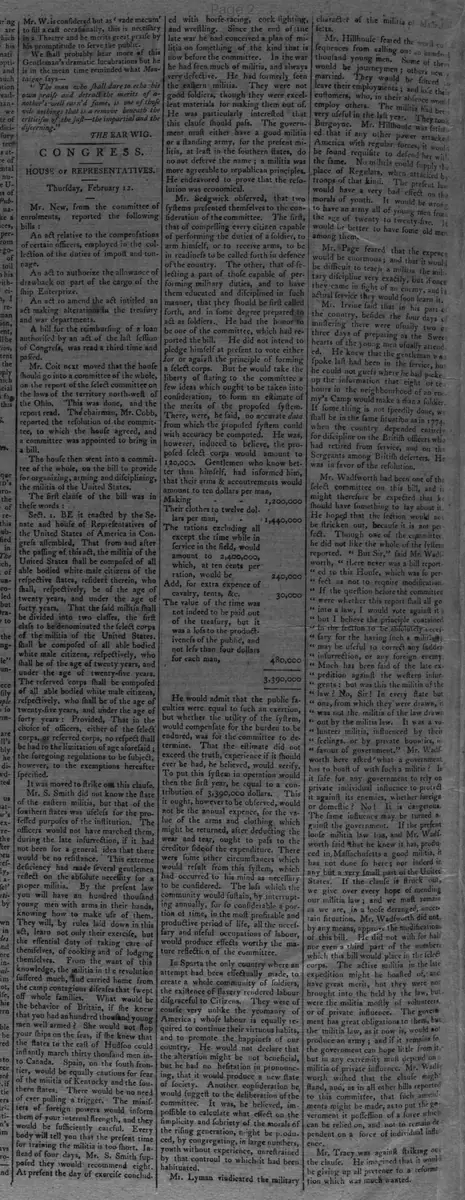
HOUSE OF REPRESENTATIVES.
Thursday, February 12.
Mr. New, from the committee of enrollments, reported the following bills:
An act relative to the compensations of certain officers, employed in the collection of the duties of impost and tonnage.
An act to authorize the allowance of drawback on part of the cargo of the ship Enterprize.
An act to amend the act intitled an act making alterations in the treasury and war departments.
A bill for the reimbursing of a loan authorized by an act of the last session of Congress, was read a third time and passed.
Mr. Coit next moved that the house should go into a committee of the whole, on the report of the select committee on the laws of the territory north-west of the Ohio. This was done, and the report read. The chairman, Mr. Cobb, reported the resolution of the committee, to which the house agreed, and a committee was appointed to bring in a bill.
The house then went into a committee of the whole, on the bill to provide for organizing, arming and disciplining, the militia of the United States.
The first clause of the bill was in these words:
Sect. 1. BE it enacted by the Senate and house of Representatives of the United States of America in Congress assembled, That from and after the passing of this act, the militia of the United States shall be composed of all able bodied white male citizens of the respective states, resident therein, who shall, respectively, be of the age of twenty years, and under the age of forty years. That the said militia shall be divided into two classes, the first class to be denominated the select corps of the militia of the United States. It shall be composed of all able bodied white male citizens, respectively, who shall be of the age of twenty years, and under the age of twenty-five years. The reserved corps shall be composed of all able bodied white male citizens, respectively, who shall be of the age of twenty-five years, and under the age of forty years: Provided, That in the choice of officers, either of the select corps, or reserved corps, no respect shall be had to the limitation of age aforesaid; the foregoing regulations to be subject, however, to the exemptions hereafter specified.
It was moved to strike out this clause.
Mr. S. Smith did not know the state of the eastern militia, but that of the southern states was useless for the professed purposes of the institution. The officers would not have marched them, during the late insurrection, if it had not been for a general idea that there would be no resistance. This extreme deficiency had made several gentlemen reflect on the absolute necessity for a proper militia. By the present law you will have an hundred thousand young men with arms in their hands, knowing how to make use of them. They will, by rules laid down in this act, learn not only their exercise, but the essential duty of taking care of themselves, of cooking and of lodging themselves. From the want of this knowledge, the militia in the revolution suffered much, and carried home from the camp contagious diseases that swept off whole families. What would be the behavior of Britain, if she knew that you had an hundred thousand young men well armed? She would not stop your ships on the seas, if she knew that the states to the east of Hudson could instantly march thirty thousand men into Canada. Spain, on the south frontier, would be equally cautious for fear of the militia of Kentucky and the southern states. There would be no need of ever pulling a trigger. The ministers of foreign powers would inform them of your internal strength, and they would be sufficiently careful. Every body will tell you that the present time for training the militia is too short. Instead of four days, Mr. S. Smith supposed they should recommend eight.
At present the day of exercise concluded with horse-racing, cock-fighting, and wrestling. Since the end of the late war he had conceived a plan of militia on something of the kind that is now before the committee. In the war he had seen much of militia, and always very defective. He had formerly seen the eastern militia. They were not good soldiers, though they were excellent materials for making them out of. He was particularly interested that this clause should pass. The government must either have a good militia or a standing army, for the present militia, at least in the southern states, do not deserve the name; a militia was more agreeable to republican principles. He endeavored to prove that the resolution was economical.
Mr. Sedgwick observed, that two systems presented themselves to the consideration of the committee. The first, that of compelling every citizen capable of performing the duties of a soldier, to arm himself, or to receive arms, to be in readiness to be called forth in defence of the country. The other, that of selecting a part of those capable of performing military duties, and to have them educated and disciplined in such manner, that they should be first called forth, and in some degree prepared to act as soldiers. He had the honor to be one of the committee, which had reported the bill. He did not intend to pledge himself at present to vote either for or against the principle of forming a select corps. But he would take the liberty of stating to the committee a few ideas which ought to be taken into consideration, to form an estimate of the merits of the proposed system.
There, were, he said, no accurate data from which the proposed system could with accuracy be computed. He was, however, induced to believe, the proposed select corps would amount to 120,000. Gentlemen who know better than himself, had informed him, that their arms & accoutrements would amount to ten dollars per man,
Making 1,200,000
Their clothes to twelve dol. lars per man,
1,440,000
The rations excluding all except the time while in service in the field, would amount to 2,400,000, which, at ten cents per ration, would be 240,000
Add, for extra expence of cavalry, tents, &c. 30,000
The value of the time was not indeed to be paid out of the treasury, but it was a loss to the productiveness of the public, and not less than four dollars for each man,
480,000
3,390,000
He would admit that the public finances were equal to such an exertion, but whether the utility of the system, would compensate for the burden to be endured, was for the committee to determine. That the estimate did not exceed the truth, experience if it should ever be had, he believed, would verify. To put this system in operation would then the first year, be equal to a contribution of 3,390,000 dollars. This it ought, however to be observed, would not be the annual expence, for the value of the arms and clothing which might be returned, after deducting the wear and tear, ought to pass to the credit side of the expenditure. There were some other circumstances which would result from this system, which had occurred to his mind as necessary to be considered. The loss which the community would sustain, by interrupting annually, for so considerable a portion of time, in the most profitable and productive period of life, all the necessary and useful occupations of labour, would produce effects worthy the mature reflection of the committee.
In Sparta the only country where an attempt had been effectually made, to create a whole community of soldiers, the existence of slavery rendered labour disgraceful to Citizens. They were of course very unlike the yeomanry of America; whose labour is equally requisite to continue their virtuous habits, and to promote the happiness of our country. He would not declare that the alteration might be not beneficial, but he had no hesitation in pronouncing, that it would produce a new state of society. Another consideration he would suggest to the deliberation of the committee. It was, he believed, impossible to calculate what effect on the simplicity and sobriety of the morals of the rising generation, might be produced, by congregating, in large numbers, youth without experience, unrestrained by that controul to which it had been habituated.
Mr. Lyman vindicated the military character of the militia of Massachusetts: etc.
Mr. Hillhouse feared the worst consequences from calling out an hundred thousand young men. Some of them would be journeymen; others newly married. They would be forced leave their employments; and lose their customers, who, in their absence would employ others. The militia had been very useful in the last war. They took Burgoyne. Mr. Hillhouse was satisfied that if any other power attacked America with regular forces, it would be found requisite to defend her with the same. No militia could supply the place of Regulars, when attacked by troops of that kind. The present law would have a very bad effect on the morals of youth. It would be wrong to have an army all of young men from the age of twenty to twenty-five. It would be better to have some old men among them.
Mr. Page feared that the expence would be enormous; and that it would be difficult to teach a militia the military discipline very exactly, but if once they came in sight of an enemy, and in actual service they would soon learn it.
Mr. Irvine said that in his part of the country, besides the four days of mustering there were usually two or three days of preparing as the Sweet hearts of the young men usually attended. He knew that the gentleman was spoke last had been in the service, but he could not guess where he had picked up the information that eight or ten hours in the neighbourhood of an enemy's Camp would make a man a soldier. If some thing is not speedily done, we shall be in the same situation as in 1774 when the country depended entirely for discipline on the British officers who had retired from service, and on the Sergeants among British deserters. He was in favor of the resolution.
Mr. Wadsworth had been one of the select committee on this bill, and it might therefore be expected that he should have something to say about it. He hoped that the section would not be stricken out, because it is not perfect. Though one of the committee. he did not like the whole of the system reported. "But Sir," said Mr. Wadsworth, "there never was a bill reported to this House, which was so perfect as not to require modification. If the question before the committee were whether this report shall all go into a law, I would vote against it; but I believe the principle contained in the section to be absolutely necessary for the having such a militia as may be useful to correct any sudden insurrection, or any foreign enemy. Much has been said of the late expedition against the western insurgents: but was this the militia of the law? No, Sir! In every state but one, from which they were drawn, it was not the militia of the law drawn out by the militia law. It was a volunteer militia, influenced by their feelings, or by private bounties, in favour of government." Mr. Wadsworth here asked what a government has to boast of with such a militia? Is it safe for any government to rely on private individual influence to protect it against its enemies, whether foreign or domestic? No! It is dangerous. The same influence may be turned against the government. If the present loose militia law has, and Mr. Wadsworth said that he knew it has, produced in, Massachusetts a good militia, it has not done so here; nor indeed in any but a very small part of the United States. If the clause is struck out, we give over every hope of mending our militia law; and we must remain as we are, in a loose deranged, uncertain situation. Mr. Wadsworth did not, by any means, approve the modifications of this bill. He did not wish for half nor even a third part of the numbers which this bill would place in the select corps. The active militia in the late expedition might be boasted of, and have great merit, but they were not brought into the field by the law, but. were the militia mostly of volunteers, or of private influence. The government has great obligations to them, but the militia law, as it now is, would not produce an army; and if it remains so, the government can hope little from it. but in any extremity must depend on a militia of private influence. Mr. Wadsworth wished that the clause might stand, and, as in all other bills reported to this committee, that such amendments might be made, as to put the government in possession of a force which can be relied on, and not to remain dependent on a force of individual influence.
Mr. Tracy was against striking out the clause. He imagined that it would be giving up all pretence to a reformation which was much wanted.
Mr. Heath was satisfied that we had as much need of a new militia, as we formerly had of a new constitution, instead of the old rope of sand of a confederation. He had seen militia going out to exercise, both officers and men, in a most careless and indifferent manner, with sticks, canes, and whips, and not one fire-lock among four of them. Was this the way to get a militia? Was this the sort of thing that the continent, in an hour of foreign or domestic danger, was to look up to? The clause may require to be modified, but it ought most certainly to be kept in. The greatest loss in the last war, came from want of training the militia properly.
Mr. Smith regretted, that the gentleman from Virginia, (Col. Page) had, from ill health, been prevented from proceeding on the late expedition. If he had not, he would have seen, that the description formerly given of the want of military information in the men from Maryland, would apply as well to those from Virginia. Another gentleman from Virginia, (Mr. Nicholas) did not believe that young men, from the same neighbourhood, would learn obedience to their officers. On the late expedition, the contrary was verified; and it was seen that the Virginia officers knew how to enforce obedience from the refractory. In one instance they punished with one hundred lashes. The good will do their duty—the bad must be compelled to obedience and good conduct.
In answering Mr. Sedgwick, he said. In the select committee he (Mr. Smith) had voted against the coat. The gentleman had voted for it, and now made the cost thereof one of the principal objections to the whole system It would be easy for a committee to determine against furnishing the coat, and prevent an expense which the gentleman states at 1,440,000 dollars.
The arms would cost nothing ; you have them already, in the repositories of the United States. Here were a million of dollars struck from the account. The tents that we have will do without new ones. The rations came next. They were guessed, and he believed with some accuracy, at two hundred thousand dollars per annum. Is a good effective militia, of an hundred thousand young men, worth less than two hundred thousand dollars a year ? As to the scruples about bringing so many young men together, Mr. Smith regarded this as the best time of life. The whole was only twenty days in the year, for five years, and surely a man will not grudge a hundred days of a whole life, spent in learning to defend so admirable a government. He thought that it would be well to employ the old officers of the revolutionary war, as long as you have them, in training this select corps. They are dropping fast off.
Alluding to the remarks on a land tax, he said that it was become the practice for gentlemen in that House, to bring in desultory observations, and then deduce unfair conclusions. He well remembered last session, a gentleman from Virginia proposed a set of resolutions, that have since been called Madison's resolutions. Mr. Smith was opposed to them. It was said, that they would involve America in a war with Britain. This story answered its purpose both without and within doors, but Mr. Smith, who was against the resolutions, had always considered this part of the objections as the most ridiculous thing imaginable. Mr. Hillhouse had regretted, that old men were not to be admitted into the select corps, for the sake of preserving the morality of the younger class. " I would ask that gentleman," said Mr. Smith, "whether he is more moral than he was twenty-five years ago ? It is the old that corrupt the young. [This observation produced a general smile.] Mr. Smith would have no scruple of trusting his own son in such a corps. He noticed that the English militia, whom he had seen before the war, were as well disciplined, in his opinion, as the regulars.
Mr. Hillhouse vindicated his objections to the select corps being composed of men from twenty to twenty-five years of age. He did not like to cut down the old tree, till he knew whether the young one would grow. What if the young tree should not grow, and we had cut down the old one? We should then be much worse off than we are now, because we should have nothing at all, and the present militia were, at least, much better than nothing.
Mr. Sedgwick rose to explain, relative to his voting in the select committee for coats to the select corps, and then arguing in the present committee against the whole scheme. The first part of his remarks was not distinctly heard, from an accidental noise. He complained, that Mr. S. Smith had spoken as if in anger. He, for his own part, never wished to point out the inconsistencies of gentlemen. Since he was now hardly pressed, he would ask the member, (Mr. S. Smith) how it happened, that when stating the expenses and resources of the Union, a few days ago, he had omitted eight hundred thousand dollars a year, that must be made on different loans. Mr. Sedgwick read the particulars from a memorandum before him; and insisted that the gentleman ought not to bring forward, at this time, what had passed in a select committee.
Mr. Giles and Mr. S. Smith rose both together. The former declared, that the gentleman was certainly out of order. The latter asked him, whether this affair of the 800,000 dollars had any reference to the resolution before the committee.
It was now generally requested that the committee might rise. The chairman asked leave to sit again.
Adjourned.
What sub-type of article is it?
What keywords are associated?
What entities or persons were involved?
Domestic News Details
Event Date
Thursday, February 12.
Key Persons
Outcome
bills reported on officer compensations, ship drawback, and treasury amendments; loan reimbursement bill passed; committee appointed for ohio territory laws bill; debate on militia bill clause for select corps continued without resolution, committee adjourned.
Event Details
The House reported and passed bills, agreed to a resolution on Ohio territory laws and appointed a committee; entered committee of the whole on militia organization bill, debating a motion to strike the first clause defining the militia and select corps of able-bodied white males aged 20-40, with speakers arguing for and against based on effectiveness, costs, morality, and historical experience.