Thank you for visiting SNEWPapers!
Sign up free
Story
November 1, 1905
The Abbeville Press And Banner
Abbeville, Abbeville County, South Carolina
What is this article about?
President Roosevelt meets with athletic advisers from Harvard, Princeton, and Yale at the White House to push for football reforms aimed at eliminating brutality and ensuring fair play, citing public concerns and his son's experiences.
Clipping
OCR Quality
98%
Excellent
Full Text
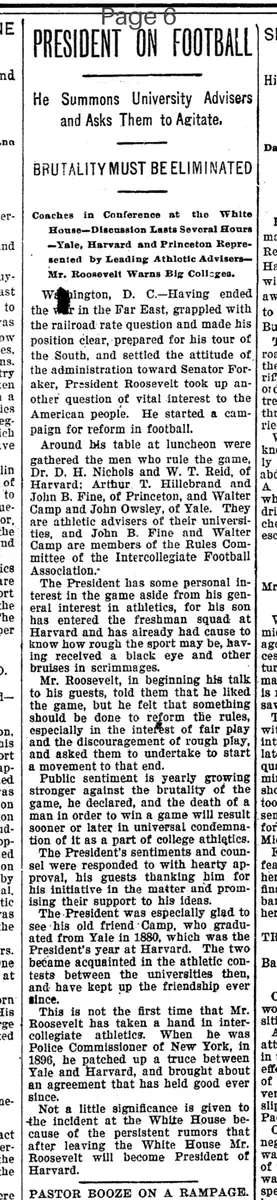
PRESIDENT ON FOOTBALL
He Summons University Advisers and Asks Them to Agitate.
BRUTALITY MUST BE ELIMINATED
Coaches in Conference at the White House—Discussion Lasts Several Hours—Yale, Harvard and Princeton Represented by Leading Athletic Advisers—Mr. Roosevelt Warns Big Colleges.
Washington, D. C.—Having ended the war in the Far East, grappled with the railroad rate question and made his position clear, prepared for his tour of the South, and settled the attitude of the administration toward Senator Foraker, President Roosevelt took up another question of vital interest to the American people. He started a campaign for reform in football.
Around his table at luncheon were gathered the men who rule the game, Dr. D. H. Nichols and W. T. Reid, of Harvard; Arthur T. Hillebrand and John B. Fine, of Princeton, and Walter Camp and John Owsley, of Yale. They are athletic advisers of their universities, and John B. Fine and Walter Camp are members of the Rules Committee of the Intercollegiate Football Association.
The President has some personal interest in the game aside from his general interest in athletics, for his son has entered the freshman squad at Harvard and has already had cause to know how rough the sport may be, having received a black eye and other bruises in scrimmages.
Mr. Roosevelt, in beginning his talk to his guests, told them that he liked the game, but he felt that something should be done to reform the rules, especially in the interest of fair play and the discouragement of rough play, and asked them to undertake to start a movement to that end. Public sentiment is yearly growing stronger against the brutality of the game, he declared, and the death of a man in order to win a game will result sooner or later in universal condemnation of it as a part of college athletics.
The President's sentiments and counsel were responded to with hearty approval, his guests thanking him for his initiative in the matter and promising their support to his ideas. The President was especially glad to see his old friend Camp, who graduated from Yale in 1880, which was the President's year at Harvard. The two became acquainted in the athletic contests between the universities then, and have kept up the friendship ever since.
This is not the first time that Mr. Roosevelt has taken a hand in intercollegiate athletics. When he was Police Commissioner of New York, in 1896, he patched up a truce between Yale and Harvard, and brought about an agreement that has held good ever since.
Not a little significance is given to the incident at the White House because of the persistent rumors that after leaving the White House Mr. Roosevelt will become President of Harvard.
He Summons University Advisers and Asks Them to Agitate.
BRUTALITY MUST BE ELIMINATED
Coaches in Conference at the White House—Discussion Lasts Several Hours—Yale, Harvard and Princeton Represented by Leading Athletic Advisers—Mr. Roosevelt Warns Big Colleges.
Washington, D. C.—Having ended the war in the Far East, grappled with the railroad rate question and made his position clear, prepared for his tour of the South, and settled the attitude of the administration toward Senator Foraker, President Roosevelt took up another question of vital interest to the American people. He started a campaign for reform in football.
Around his table at luncheon were gathered the men who rule the game, Dr. D. H. Nichols and W. T. Reid, of Harvard; Arthur T. Hillebrand and John B. Fine, of Princeton, and Walter Camp and John Owsley, of Yale. They are athletic advisers of their universities, and John B. Fine and Walter Camp are members of the Rules Committee of the Intercollegiate Football Association.
The President has some personal interest in the game aside from his general interest in athletics, for his son has entered the freshman squad at Harvard and has already had cause to know how rough the sport may be, having received a black eye and other bruises in scrimmages.
Mr. Roosevelt, in beginning his talk to his guests, told them that he liked the game, but he felt that something should be done to reform the rules, especially in the interest of fair play and the discouragement of rough play, and asked them to undertake to start a movement to that end. Public sentiment is yearly growing stronger against the brutality of the game, he declared, and the death of a man in order to win a game will result sooner or later in universal condemnation of it as a part of college athletics.
The President's sentiments and counsel were responded to with hearty approval, his guests thanking him for his initiative in the matter and promising their support to his ideas. The President was especially glad to see his old friend Camp, who graduated from Yale in 1880, which was the President's year at Harvard. The two became acquainted in the athletic contests between the universities then, and have kept up the friendship ever since.
This is not the first time that Mr. Roosevelt has taken a hand in intercollegiate athletics. When he was Police Commissioner of New York, in 1896, he patched up a truce between Yale and Harvard, and brought about an agreement that has held good ever since.
Not a little significance is given to the incident at the White House because of the persistent rumors that after leaving the White House Mr. Roosevelt will become President of Harvard.
What sub-type of article is it?
Historical Event
What themes does it cover?
Moral Virtue
Justice
What keywords are associated?
Football Reform
President Roosevelt
University Advisers
White House Meeting
Sports Brutality
Intercollegiate Athletics
Fair Play
What entities or persons were involved?
President Roosevelt
Dr. D. H. Nichols
W. T. Reid
Arthur T. Hillebrand
John B. Fine
Walter Camp
John Owsley
Where did it happen?
Washington, D. C.
Story Details
Key Persons
President Roosevelt
Dr. D. H. Nichols
W. T. Reid
Arthur T. Hillebrand
John B. Fine
Walter Camp
John Owsley
Location
Washington, D. C.
Story Details
President Roosevelt hosts luncheon with athletic advisers from Harvard, Princeton, and Yale at the White House to discuss reforming football rules to eliminate brutality and promote fair play, urging them to start a movement amid growing public sentiment against the game's roughness.