Thank you for visiting SNEWPapers!
Sign up free
The Holt County Sentinel
Oregon, Holt County, Missouri
What is this article about?
G. A. Graver, stage manager at Haverly's Brooklyn theater, shares anecdotes on how actors simulate deaths in plays, from shootings and poisonings to realistic illnesses, highlighting accidents, realism debates, and personal narrow escapes over 25 years. (214 characters)
Clipping
OCR Quality
Full Text
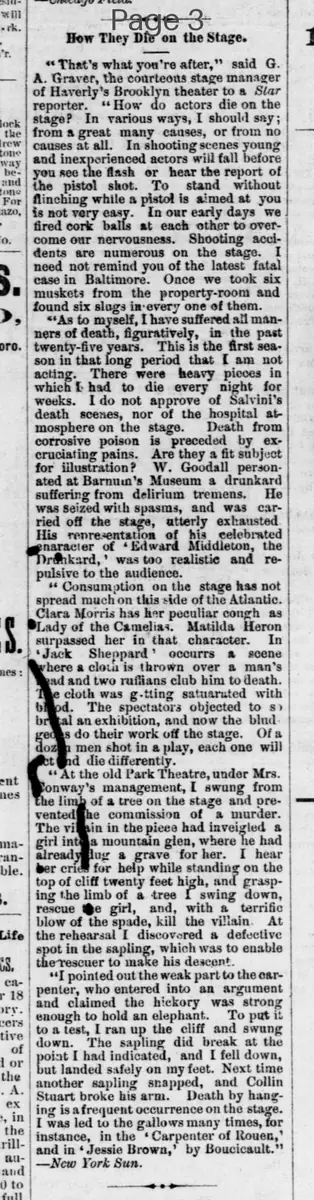
"That's what you're after," said G. A. Graver, the courteous stage manager of Haverly's Brooklyn theater to a Star reporter. "How do actors die on the stage? In various ways, I should say; from a great many causes, or from no causes at all. In shooting scenes young and inexperienced actors will fall before you see the flash or hear the report of the pistol shot. To stand without flinching while a pistol is aimed at you is not very easy. In our early days we fired cork balls at each other to overcome our nervousness. Shooting accidents are numerous on the stage. I need not remind you of the latest fatal case in Baltimore. Once we took six muskets from the property-room and found six slugs in every one of them.
"As to myself, I have suffered all manner of death, figuratively, in the past twenty-five years. This is the first season in that long period that I am not acting. There were heavy pieces in which I had to die every night for weeks. I do not approve of Salvini's death scenes, nor of the hospital atmosphere on the stage. Death from corrosive poison is preceded by excruciating pains. Are they a fit subject for illustration? W. Goodall personated at Barnum's Museum a drunkard suffering from delirium tremens. He was seized with spasms, and was carried off the stage, utterly exhausted. His representation of his celebrated character of Edward Middleton, the Drunkard, was too realistic and repulsive to the audience.
"Consumption on the stage has not spread much on this side of the Atlantic. Clara Morris has her peculiar cough as Lady of the Camelias. Matilda Heron surpassed her in that character. In Jack Sheppard occurs a scene where a cloth is thrown over a man's head and two ruffians club him to death. The cloth was getting saturated with blood. The spectators objected to so brutal an exhibition, and now the bludgeons do their work off the stage. Of a dozen men shot in a play, each one will die differently.
"At the old Park Theatre, under Mrs. Conway's management, I swung from the limb of a tree on the stage and prevented the commission of a murder. The villain in the piece had inveigled a girl into a mountain glen, where he had dug a grave for her. I hear her cries for help while standing on the top of cliff twenty feet high, and grasping the limb of a tree I swing down, rescue the girl, and, with a terrific blow of the spade, kill the villain. At the rehearsal I discovered a defective spot in the sapling, which was to enable the rescuer to make his descent.
"I pointed out the weak part to the carpenter, who entered into an argument and claimed the hickory was strong enough to hold an elephant. To put it to a test, I ran up the cliff and swung down. The sapling did break at the point I had indicated, and I fell down, but landed safely on my feet. Next time another sapling snapped, and Collin Stuart broke his arm. Death by hanging is a frequent occurrence on the stage. I was led to the gallows many times, for instance, in the Carpenter of Rouen, and in 'Jessie Brown,' by Boucicault."
-New York Sun.
What sub-type of article is it?
What themes does it cover?
What keywords are associated?
What entities or persons were involved?
Where did it happen?
Story Details
Key Persons
Location
Haverly's Brooklyn Theater, Baltimore, Barnum's Museum, Old Park Theatre
Event Date
Past Twenty Five Years
Story Details
Stage manager G. A. Graver discusses various methods actors die on stage, including shooting accidents, realistic portrayals of illnesses like consumption and delirium tremens, brutal scenes, and personal experiences like swinging rescues and hanging scenes, noting realism's limits and past mishaps.