Thank you for visiting SNEWPapers!
Sign up free
Rhode Island American And Gazette
Providence, Providence County, Rhode Island
What is this article about?
At a dinner in Providence, Rhode Island, on April 13, 1831, Congressman Tristam Burges addresses constituents, recounting his service, criticizing Secretary Van Buren and the Jackson administration, advocating the American System, and supporting National Republican candidates like Lemuel H. Arnold against State Republicans led by Governor Fenner.
Merged-components note: These sequential components continue the report on Mr. Burges' dinner, including his remarks and the subsequent toasts, forming a cohesive account of the event.
Clippings
1 of 2
OCR Quality
Full Text
Providence:
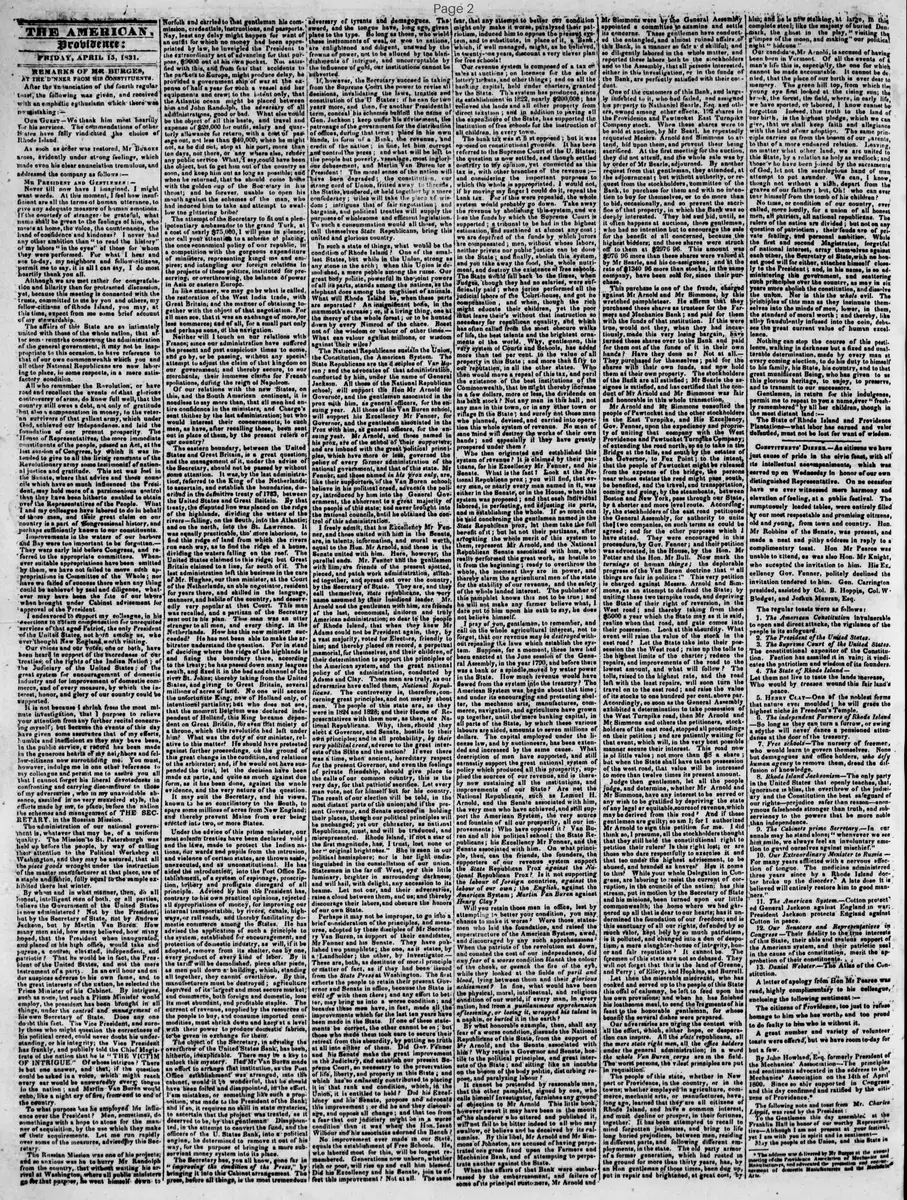
FRIDAY, APRIL 15, 1831.
REMARKS OF MR. BURGES.
AT THE DINNER FROM HIS CONSTITUENTS.
After the annunciation of the fourth regular toast, the following was given, and received with an emphatic enthusiasm in which there was no mistaking:--
Our Guest--We thank him most heartily for his services. The commendations of other States have fully vindicated the choice of Rhode Island.
As soon as order was restored, Mr. Burges arose, evidently under strong feelings, which made even his clear enunciation tremulous, and addressed the company as follows:--
Mr. President and Gentlemen:--
Never till now have I imagined, I might want words. At this moment, I feel how insufficient are all the terms of human utterance, to give any adequate measure of human emotions.
If the courtesy of strangers be grateful, what name shall be given to the feelings of him, who meets at home, the voice, the countenance, the hand of confidence and kindness? I never had any other ambition than 'to read the history' of my labors 'in the eyes of those for whom they were performed.' For what I hear and see to-day, my neighbors and fellow-citizens, permit me to say, it is all I can say, I do most heartily thank you all.
Although we are met rather for congratulation and hilarity than for protracted discussion, yet, because this meeting is connected with the trusts, committed to me by you and others, my fellow-citizens of Rhode Island, you may, at this time, expect from me some brief account of my stewardship.
The affairs of this State are so intimately united with those of the whole nation, that after some remarks concerning the administration of the general government, it may not be inappropriate to this occasion, to have reference to that of our own commonwealth which you and all other National Republicans are now laboring to place, in some respects, in a more satisfactory condition.
All who remember the Revolution, or have read and recollect the events of that glorious controversy of arms, do know full well, that the country still owes a debt, not only of gratitude but also a compensation in money, to the veteran survivors of that gallant army, which under God, achieved our independence, and laid the foundation of our present prosperity. The House of Representatives, the more immediate constituents of the people, passed an Act, at the last session of Congress, by which it was intended to give to all the living remnants of the Revolutionary army some testimonial of national justice and gratitude. This act was lost in the Senate, where that advice and those counsels which have so much influenced the President, may hold more of a parsimonious control than they have been hitherto enabled to obtain over the Representatives of the People. What I and my colleague have labored to do in behalf of those men, and their great claim on our country is a part of Congressional history, and perhaps sufficiently known to our constituents.
Improvements in the waters of our harbors and Bay were too important to be forgotten. They were early laid before Congress, and referred to the appropriate committees. Whenever suitable appropriations have been omitted by them, we have not failed to move such appropriations in Committee of the Whole; nor have we failed of success there when any thing could be achieved by zeal and diligence, whatever may have been the fate of our labors when brought under Cabinet advisement for approval of the President.
I endeavored to support my colleague, in his exertions to obtain compensation for unrequited services of that aged Patriot, the only President of the United States, not born among us, who ever thought New England worth visiting.
Our voices and our votes; one or both, have been heard in support of the sacredness of our treaties; of the rights of the Indian Nation; of the Judiciary of the United States; of the great system for encouragement of domestic industry and for improvement of domestic commerce, and of every measure, by which the interest, honor, and glory of our country could be supported.
It is not because I shrink from the most minute investigation, that I purpose to relieve your attention from any further recital concerning myself; but because the events of this day have given some assurance that of my efforts, humble and inefficient as they may have been, in the public service; a record has been made in the generous hearts of my neighbors and fellow-citizens now surrounding me. You must, however, indulge me in one other reference to my colleague and permit me to assure you all that I cannot forget his liberal devotedness in confronting and carrying discomfiture to those of my adversaries, who in my unavoidable absence, assailed in no very measured style, the efforts made by me, to place before the nation the schemes and management of THE SECRETARY, in the Russian Mission.
The administration of our national government is, whatever that may be, of a uniform quality. The Mission to St. Petersburg was held up before the people, by way of calling their attention to the Political Workshop at Washington, and they may be assured, that all the piece goods wrought under the instruction of the master manufacturer at that place, are of a staple and fabric, fully equal to the sample exhibited there last winter.
By whom and in what manner, then, do all honest, intelligent men of both, or all parties; believe the Government of the United States is now administered? Not by the President but by the Secretary of State, not by Andrew Jackson, but by Martin Van Buren: How many men said, how many believed, how many hoped, that the President when inaugurated, and placed in his high office, would take and pursue, a course; elevated, independent, and patriotic? That he would be in fact, the President of the United States, and not the mere instrument of a party. In an evil hour and under auspices adverse to his own fame, and to the great interests of the nation, he relected the Prime Minister of his Cabinet. By intrigues, such as none but such a Prime Minister would employ, the President has been brought in all things, under the control and management of his own Secretary of State. Does any one doubt this fact. The Vice President, and surely those who might question the correctness of his political creed, could never doubt his understanding, or his integrity; the Vice President has frankly, and publicly told the Chief Magistrate of the nation that he is 'THE VICTIM OF INTRIGUE.' Of whose intrigue? There is but one answer, and that, if the question could be asked in a voice, which might reach every ear would be answered by every tongue in the nation; and Martin Van Buren would echo, like a night cry of fire, from end to end of the country.
To what purpose has he employed his influence over the President? Men, sometimes, do something with a hope to atone for the manner of acquisition, by the use which they make of their acquirements. Let me run rapidly over some of the measures, advised by this Secretary.
The Russian Mission was one of his projects; and so anxious was he to hurry Mr. Randolph from the country, that without waiting his arrival at Washington where all public ministers go for that purpose, he went himself down to Norfolk and carried to that gentleman his commission, credentials, instructions, and passports. Nay, lest any delay might happen for want of an outfit for which no money had been appropriated by law, he inveigled the President to the extraordinary act of advancing for that purpose, $9000 out of his own pocket. Not satisfied with this, and from fear that accidents to the packets to Europe, might produce delay, he provided a government ship of war at the expense of half a year for such a vessel and her equipments and crew; to the intent only, that the Atlantic ocean might be placed between him and John Randolph, the adversary of all administrations, good or bad. What else could be the object of all this haste, and travel and expense of $20,000 for outfit, salary and quarterly allowance for return, with cost of passage out, not less than $40,000; when he might not, as he did not, stop at his port, more than ten days, nor there, or any where else, render any public service? What, I say, could have been the object, but to get him out of the country as soon, and keep him out as long as possible; and when he returned, that he should come home with the golden cup of the Secretary in his throat; and be forever, unable to open his mouth against the schemes of the man, who had induced him to take and attempt to swallow the glittering bribe?
The attempt of the Secretary to fit out a plenipotentiary ambassador to the grand Turk, at a cost of nearly $75,000, I will pass in silence; nor call your attention to a scheme of placing the once economical policy of our republic, in a competition with the gorgeous expenditure of ministers, representing kingdoms and empires; and entangling our foreign relations in the projects of those politics, instituted for preserving, or overthrowing, the balance of power in Asia or eastern Europe.
In like manner, we may go by what is called, the restoration of the West India trade, with Great Britain; and the manner of obtaining together with the object of that negotiation. For all men see, that it was an exchange of more, for less commerce; and of all, for a small part only and perhaps none, of the navigation.
Neither will I touch on our relations with France; since our administration have suffered the present and past auspicious times to come, and go by, or be passing, without any special attempt to adjust the claim of that kingdom on our government; and thereby secure, to our merchants, their immense claims for French spoliations, during the reign of Napoleon.
Of our relations with the new States, on this, and the South American continent, it is needless to say more than, that all men had entire confidence in the ministers, and Charges sent thither by the last administration; but who would interest their concernments; to such men, as have, after recalling those, been sent out in place of them, by the present rulers of our country?
The eastern boundary, between the United States and Great Britain, is a great question; and the management of it, under the advice of the Secretary, should not be passed by without some attention. It was, by the last administration, referred to the King of the Netherlands; to ascertain, and establish the boundaries, described in the definitive treaty of 1783, between the United States and Great Britain. By that treaty, the disputed line was placed on the ridge of the highlands, dividing the waters of the rivers--falling, on the south, into the Atlantic; and on the north, into the St. Lawrence. It was equally practicable, though more laborious, to find this ridge of land from which the rivers run each way, as to find the ridge of a house, dividing the waters falling on the roof. The United States claimed to this ridge; but Great Britain claimed to a line, far south of it. The last administration left this business in the care of Mr. Hughes, our then minister, at the Court of the Netherlands, an able negotiator, resident for years there, and skilled in the language, manners, and habits of the country, and deservedly very popular at that Court. This man was recalled, and a partizan of the Secretary sent out in his place. This man was an utter stranger to all men, and every thing, in the Netherlands. How has this new minister succeeded? He has not been able to make the arbitrator understand the question. For in stead of deciding where the ridge of the highlands is and fixing the boundary there, according to the treaty; he has passed down many leagues south, and fixed it in the bed and channel of the river St. Johns; thereby taking from the United States, and giving to Great Britain, several millions of acres of land. No one will accuse the unfortunate King, now of Holland only, of intentional partiality; but who does not see, that the moment Belgium was declared independent of Holland, this King became dependent on Great Britain, for even that moiety of a throne, which this revolution had left under him? What was the duty of our minister, relative to this matter? He should have protested against further proceedings, on the ground of this great change in the condition, and relations of the arbitrator; and, if he would not have suspended the trial; let the decision have been made ex parte, and quite as much against form, as it has been done, against the whole evidence, and the very nature of the question.
It may suit the Secretary, and his views, known to be so conciliatory to the South, to spare some millions of acres from New England; and thereby prevent Maine from ever being erected into two, or more States.
Under the advice of this prime minister, our most solemn treaties have been declared void; and the laws, made to protect the Indian nations; our wards and pupils from the intrusion, and violence of certain states, are thrown aside, unexecuted, and as unconstitutional. He has aided the introduction into the Post Office Establishment, of a system of espionage, proscription, bribery and profligate disregard of all principle. Advised by him the President has, contrary to his own practical opinions, rejected all appropriations of money, for improving our internal transportation, by rivers, canals, highways, or rail roads, and thereby facilitating domestic commerce among the States. He has advised the application of such a principle to the system, established for encouragement, and protection of domestic industry, as will, if it be adopted, remove from its shelter, one by one, every product of every kind of labor. By it the tariff will be demolished, piece after piece, as men pull down a building, which, standing all together, they cannot overthrow. By this, manufacturers must be destroyed; agriculture deprived of its largest and most secure market; and commerce, both foreign and domestic, lose its most abundant, and profitable staples. The current of revenue, supplied by the resources of the people to buy, and consume imported commodities, must shrink down and keep at a level with their power to produce domestic fabrics, to be given in exchange for them.
The object of the Secretary, in advising the overthrow of the United States Bank, has been, hitherto, inexplicable. There may be a key to unlock this mystery. Had Mr. Van Buren made an effort to arrange that institution, as the Post Office establishment was arranged, into this cabinet, would it be wonderful, that he should have been foiled and disappointed, in the effort. I am mistaken, or something like such a proposition; was made to the President of the Bank; and if so, it requires no skill in state mysteries; to ascertain that the project was treated, as it deserved to be, by that gentleman. Disappointed, in the attempt to convert the fund, and the officers of the U. States Bank, into a political engine, he determined to remove it out of his way, for the purpose of bringing a more subservient money system into its place.
The Secretary has, you all know, gone far in 'improving the condition of the Press,' by bringing it into this 'Cabinet arrangement.' The press, before all things, is the most tremendous adversary of tyrants and demagogues. That sword, and the tongue have, long ago, given place to the type. So long as those, who wield these instruments of weal, or woe to nations are enlightened and diligent, undawed by the frowns of power, not to be allured by the blandishments of intrigue, and incorruptible by the influence of gold, our institutions cannot be subverted.
If, however, the Secretary succeed in taking from the Supreme Court the power to revise all decisions, invalidating the laws, treaties and constitution of the U. States: if he can for two years more, and then, for another Presidential term, conceal his schemes behind the name of Gen. Jackson; keep under his advisement, through patronage of the government for the distribution of offices, during that term; place in his own hands, in form of a Bank, the revenue, and credit of the nation; in fine, let him corrupt and control the press; and what will be left to the people but poverty, vassalage, most inglorious debasement, and Martin Van Buren for a President! The moral sense of the nation will have been degraded; the constitution, our strong cord of Union, frittered away to threads the States, sundered, or held together by a mere confederacy; wiles will take the place of wisdom; intrigues that of fair negotiation; and bargains, and political treaties will supply the purposes of wholesome and efficient legislation.
To such a consummation would all those, who call themselves State Republicans, bring this united and glorious country.
In such a state of things, what would be the condition of Rhode Island? One of the smallest States, but while in this Union, strong as any stone in the arch; when this Union is demolished, a mere pebble among the ruins. Our great body politic, powerful in the joint powers of all its parts, stands among the nations, as the elephant does among the mightiest of animals. What will Rhode Island be, when these parts are separated? An insignificant bone, in the mammoth's carcass; or, if a living thing, one at the mercy of the whole forest; or to be hunted down by every Nimrod of the chase. Boast not of the wisdom or valour of other times. What can valour against millions, or wisdom against their wiles?
The National Republicans sustain the Union, the Constitution, the American System. The State Republicans are the disciples of Van Buren; and the advocates of that administration conducted by him, under the name of General Jackson. All those of the National Republican school; will support the Hon. Mr. Arnold for Governor, and the gentlemen associated in the Prox with him, as general officers, for the ensuing year. All those of the Van Buren school, will support his Excellency Mr. Fenner, for Governor, and the gentlemen associated in the Prox with him, as general officers, for the ensuing year. Mr. Arnold, and those named in his prox, are of the school of their supporters and are imbued with the great political principles, which have more or less, governed the policy of every former administration of the national government, and that of this state. Mr. Fenner, and those named in his prox only, are, like their supporters, of the Van Buren school believe in his political creed, advocate the policy, introduced by him into the General Government, abhorrent to a great majority of the people of this state; and never brought into the national councils, until he obtained the control of this administration.
I really admit; that his Excellency Mr. Fenner, and those united with him in the Senate, are, in talents, information, and moral worth, equal to the Hon. Mr. Arnold, and those in the Senate united with him. Here, however; the parallel ends. Mr. Fenner and the gentlemen with him, are friends of the present spotted, pieced, and patch work administration, stitched together; and spread out over the country, by the Secretary of State. They are, and they call themselves, state republicans, the party name assumed by their insidious leader. Mr. Arnold and the gentlemen with him, are friends of the last, economical, uniform and truly American administration; so dear to the people of Rhode Island, that when they knew Mr. Adams could not be President again, they, by a vast majority, voted for Electors, friendly to him; and thereby placed on record, a perpetual memorial, for themselves, and their children, of their determination to support the principles of the American system, and the great national policy of the administration, conducted by Adams and Clay. These men are truly, as our adversaries have called them, National Republicans. The controversy is, therefore, concerning great principles, and not merely about men. The people of this state are, as they were in 1824 and 1828; and their House of Representatives with them now, as then, are National Republicans. Why, then, should they elect Governor, and Senate, hostile to their own principles; and in all probability, by their very political creed, adverse to the great interests of the State and the nation? If ever there was a time, when ancient, hereditary respect for the present Governor, and even the feelings of private friendship, should give place to the calls of our common country, this is the very day, or that patriotic sacrifice. Let every man vote, not for himself but for his country. The result of our election will be told, in the most distant parts of the union; and if the present Governor, and Senate succeed in holding their places, though our political principles will be unchanged; yet our character, as national Republicans, must, and will be traduced, and misrepresented. Rhode Island, if not a star of the first magnitude, has, I trust, lost none of her original brightness. She is seen in our political hemisphere; nor is her light undistinguished in the constellation of our union. Statesmen in the far off West, eye this little luminary, brighter in surrounding darkness; and will hail, with delight, any accession to its beams. Let not our, and their adversaries, raise a cloud between them, and us; and thereby discourage their labors, and obscure the honors of our own State.
Perhaps it may not be improper, to go into a brief consideration of the principles, and measures, adopted by these disciples of Mr. Secretary Van Buren, in support of their candidates, Mr. Fenner and his Senate. They have published two pamphlets; the one, as it states, by a Landholder; the other, by Investigator. These are, both, as destitute of moral principle or matter of fact, as if they had been issued from the State Press at Washington. The first exhorts the people to retain their present Governor and Senate in office, because the State is well off with them there; and any effort to better, may bring us into a worse condition; and because these men have, in fact, made all the improvements which for the last ten years have been made in the State. If one of these statements be correct, the other cannot be so; but those who made them took care to secure their retreat from this absurdity, by putting no truth at all into either of them. Did Gov. Fenner and his Senate make the great improvement in the Judiciary, and establish our present Supreme Court, so necessary to the preservation of life, liberty, and property in this State; and which has so eminently contributed to placing it in that rank and condition, which, in the Union, it is entitled to hold? Did his Excellency and his Senate, propose and advocate this improvement; or did he and they discourage, and oppose all change; and that too from a fear that our judiciary might be in worse condition than it was when the Hon. Jona. Wilbour and his associates adorned the Bench?
No improvement ever made in our State equals the establishment of Free Schools. He, who labored most for this, will be longest remembered. Generations now unborn, whether rich or poor, will rise up and call him blessed. Did his Excellency and his Senate, join to effect this improvement? Not at all. The same fear, that any attempt to better our condition might only make it worse, paralyzed their patriotism, induced him to oppose the present system, and to substitute, in place of it, a Bank, which, if well managed, might, as he believed, in twenty-one years, discount a very clever plan for free schools!
Our revenue system is composed of a tax on sales at auctions; on licenses for the sale of lottery tickets, and other things; and on all the banking capital, held under charters, granted by the State. This system has produced, since its establishment in 1822, nearly $200,000; has relieved the lands and all other property from direct taxation; and in addition to paying all the expenditure of the State, has supported the institution of free schools for the instruction of all children, in every town.
The bank tax was at first opposed; but it was opposed on constitutional grounds. It has been referred to the Supreme Court of the U. States; the question is now settled, and though settled contrary to my opinion, yet connected as this tax is, with other branches of the revenue; and considering the important purposes to which the whole is appropriated, I would not, if by moving my finger I could do it, repeal the bank tax. For if this were repealed, the whole system would probably go down. Take away the revenue by abolishing this system, and we lose the funds by which the Supreme Court is supported; a tribunal to be had in the highest estimation, and sustained at almost any cost; we are deprived of the funds by which jurors are compensated; men, without whose labors, neither private nor public justice can be done in the State; and finally, abolish this system, and you take away the food, the whole nutriment, and destroy the existence of Free schools. The State would fall back to the times, when Judges, though they had no salaries, were sufficiently paid; when juries performed all the judicial labors of the Court-house, and got no compensation, and when, though the rich might educate their children, yet the poor must leave theirs without that instruction so necessary for republican equality, and which has often called from the most obscure walks of life, the best talents and the brightest ornaments of the world. Why, gentlemen, this very system of Courts and Schools, has added more than ten per cent. to the value of all property in this State; and more than fifty to our reputation, in all the other states. Who then would move a repeal of this tax, and peril the existence of the best institutions of the Commonwealth, that he might thereby increase in a few dollars, more or less, the dividends on his bank stock? Not any man in this hall; not any man in this town, or in any other town or village in the State; and surely not those men who planned, devised, and carried into operation this whole system of revenue. No men of sane mind will destroy the works of their own hands; and especially if they have greatly prospered under them?
Who then originated and established this system of revenue? It is claimed by their partisans, or his Excellency Mr. Fenner, and his Senate. What is the fact? Look at the National Republican prox; you will find, that every man, or nearly every man named in it, was either in the Senate, or in the House, when this system was proposed; and that each individual labored, in perfecting, and adjusting its parts, and in establishing the whole. If so much can be said concerning the gentlemen named in the State Republican prox, let them take the full benefit of it; but let not their partisans, after attributing the whole merit of this system to them, represent Mr. Arnold, and the National Republican Senate associated with him, who really performed this great work, as hostile to it from the beginning; ready to overthrow the whole, the moment they are in power, and thereby alarm the agricultural men of the state for the stability of our revenue, and the safety of the whole landed interest. The publisher of this pamphlet knows this not to be true; and he will not make any farmer believe what, I dare put to him upon his oath to say, he does not believe himself.
I pray of you, gentlemen, to remember, and call on the whole agricultural interest, not to forget, that our revenue may be destroyed without repealing the laws which establish the system.
Suppose, for a moment, these laws had been enacted at the June session of the General Assembly, in the year 1790, and before there was a bank or a spindle, moved by water power in the State. How much revenue would have flowed from the system into the treasury? The American System was, begun about that time; and under its encouraging and protecting shelter, the mechanic arts; manufactures, commerce, navigation, and agriculture have grown up together, until the mere banking capital, in all parts of the State, by which these various labors are aided, amounts to seven millions of dollars. The capital employed under the license law, and by auctioneers, has been extended and increased by the same cause. What description of men have supported, and still earnestly support the great national system of policy which produced all this prosperity, supplied the sources of our revenue, and is thereby now sustaining all the institutions, and improvements of our State? Are not the National Republicans, such as Lemuel H. Arnold, and the Senate associated with him, the very men who have achieved, and still support the American System, the very source and fountain of all our prosperity, all our improvements? Who have opposed it? Van Buren and all his political school; the State Republicans; his Excellency Mr. Fenner, and the Senate associated with him. On what principle, then, can the friends, the founders, the supporters of our revenue system support the State Republican Prox against the National Republican Prox? Is it not supporting the labour of foreign countries, against the labour of our own; the English, against the American System; Martin Van Buren against Henry Clay?
Will you retain those men in office, lest by attempting to better your condition, you may chance to make it worse? Were those statesmen who laid the foundation, and raised the superstructure of the American System, awed, and discouraged by any such apprehensions? When the patriots of the revolution sat down, and counted the cost of our independence, did any fear of a worse condition blanch the colour of the cheek, or quench the fire of the eye, while they looked at the fields of peril and blood, lying between them and their glorious achievement? In fine, what would have been the physical, moral, intellectual, and religious condition of our world, if every man, in every nation, had from a pusillanimous apprehension of lessening, or losing it, wrapped his talent in a napkin, or buried it in the earth?
By what honorable example, then, shall any fear of a worse condition, dissuade the National Republicans of this State, from the support of Mr. Arnold, and the Senate associated with him? Why retain a Governor and Senate, hostile to the political principles, and great interests of the State; and sitting like an incubus on the bosom of the body politic, disturbing repose, and paralyzing labour?
It cannot be pretended by reasonable men, that the other pamphlet, signed by one, who calls himself Investigator, furnishes any ground of objection to Mr. Arnold. This little book, however sweet it may have been in the mouth of the slanderer who uttered and published it, will not fail to be bitter indeed to all who may swallow, or believe and be deceived by its calumnies. By this libel, Mr. Arnold and Mr. Simmons of Johnston, are accused of having perpetrated one gross fraud upon the Farmers and Mechanics Bank, and of attempting to perpetrate another against the State.
When the affairs of that Bank were embarrassed by the embarrassment, and failure of some of its principal customers, Mr. Arnold and Mr. Simmons were by the General Assembly appointed committee to examine and settle its concerns. These gentlemen have conducted the entangled, and almost ruined affairs of this Bank, in a manner so fair and skillful; and so diligently labored in the whole matter, and reported these labors both to the stockholders and to the Assembly, that all persons interested, either in this investigation, or in the funds of the Bank, are perfectly satisfied with their conduct.
One of the customers of this Bank, and largely indebted to it, who had failed, and assigned his property to Nathaniel Searle, Esq. and others, owned among other effects, 112 shares in the Providence and Pawtucket East Turnpike Company stock. When these shares were to be sold at auction, by Mr. Searle, he repeatedly requested Messrs. Arnold and Simmons to attend, bid upon them, and prevent their being sacrificed. At the first meeting for the auction, they did not attend, and the whole sale was by order of Mr. Searle, adjourned. By another request from that gentleman, they attended, at the adjournment; but without authority, or request from the stockholders, committee of the Bank, to purchase for them and with no intention to buy for themselves, or to do more than to bid, occasionally, and so prevent the sacrifice of that property, in which the Bank was so deeply interested. They bid and bid, until, as it often happens at auctions, those gentlemen, who had no intention but to encourage the sale for the benefit of all concerned, became the highest bidders; and these shares were struck off to them at $2976 96. This amount was $976 96 more than these shares were valued at by Mr. Searle, and his co-assignees; and at the rate of $1340 96 more than stocks, in the same company, have been sold for, since their purchase.
This purchase is one of the frauds, charged against Mr. Arnold and Mr. Simmons, by this wretched pamphleteer. He affirms that they purchased these shares as trustees for the Farmers and Mechanics Bank; and paid for them with the funds of that institution. If this were true, would not they, when they had incautiously, made this very losing bargain, have turned these shares over to the Bank and paid for them out of the funds of it in their own hands? Have they done so? Not at all. They purchased for themselves; paid for the shares with their own funds, and now hold them as their own property. The stockholders of the Bank are all satisfied: Mr. Searle the assignee is satisfied, and has certified that the conduct of Mr. Arnold and Mr. Simmons was fair and honorable in this whole transaction.
Mr. Arnold and Mr. Simmons consulted the people of Pawtucket and the other stockholders in the East Turnpike, and His Excellency, Gov. Fenner, upon the expediency and propriety of uniting that company with the West Providence and Pawtucket Turnpike Company; of extending the road north, so as to take in the Bridge at the falls, and south by the estates of the Governor, to Fox Point; to the intent, that the people of Pawtucket might be released from the expense of the bridge, the persons near whose estates the road might pass south, be benefited, and the travel, and transportation, coming and going, by the steamboat, between Boston and New York, pass through our State, by a shorter and more level route. Accordingly, the stockholders of the east road petitioned the General Assembly, for authority to unite the two companies, on such terms as could be agreed; and for the other purposes which I have stated. They were encouraged in this procedure, by Gov. Fenner; and their petition was advocated, in the House, by the Hon. Mr. Potter and the Hon. Mr. Bull. Now mark the turnings of human things; the deplorable progress of the Van Buren doctrine that 'all things are fair in politics!' This very petition is charged against Messrs. Arnold and Simmons, as an attempt to defraud the State; by uniting these two turnpike roads, and depriving the State of their right of reversion, in the West road; and thereby taking from them $5000 a year which the State may as it is said, realize when that road, and gate comes into their possession. Look at this absurdity. What event will raise the value of the stock in the east road? Let the State take into their possession the West road; raise up the tolls to the highest limits of the charter; reduce the repairs, and improvements of the road to the lowest amount, and what will follow? The tolls, raised to the highest rate, and the road left with the least repairs, will soon turn the travel on to the east road; and raise the value of its stocks to one hundred per cent. above par. Accordingly, so soon as the General Assembly exhibited a determination to take possession of the West Turnpike road, then Mr. Arnold and Mr. Simmons and others the petitioners, stockholders of the east road, stopped all proceedings on their petition; and are patiently waiting for that event, which will, in the very best possible manner secure their interest. This road now is of little value; not more than $8 a share; but when the State shall have taken possession of the west road, that value will be increased to more than twelve times its present amount.
Judge then gentlemen, let all the people judge, and determine, whether Mr. Arnold and Mr. Simmons, have any interest to be served or any wish to be gratified by depriving the state of any legal or equitable, source of revenue, which may be derived from this road? And if those gentlemen are guilty; so am I; for I authorized Mr. Arnold to sign this petition for me. I did think so, I presume, all the stockholders thought that they still held the constitutional right to petition their rulers? Is this right lost; or are those who dare respectfully to exercise it and that too under the highest advisement, to be abused, and branded as knaves? How it come to this? While your whole Delegation in Congress, are laboring to resist the current of corruption, in the councils of the nation; has this stream, put in motion by the Secretary of State and his minions, been turned upon our little commonwealth; the home where we had garnered up all that is dear to our hearts; has it undermined the foundation of our freedom; and is this sanctuary of all our rights, defended by so much valor, kept holy by so much patriotism, is it polluted, and changed into a den of despotism, a mere slaughter-house of integrity, honor and fair reputation? It cannot be. The freemen of this state are not so debased. They will not forget that this is the land of Greene, and Perry; of Ellery, and Hopkins, and Burrell. Let then the miserable miscreant, who has cooked and served up to the people of this State this offal of calumny, be left to feed upon his own provisions; and when he has finished his loathsome meal, to send the fragments of his feast to the honorable gentleman, for whose benefit the several dishes were prepared.
Our adversaries are urging the contest with all the effort, which, either hope, or desperation can inspire. All the state republicans, all the mere state right men, all, the office holders under the general administration; in a word the whole Van Buren corps are in the field. The worst persons, the vilest principles are put in requisition.
The people of this state, whether in Newport or Providence, in the country, or in the towns; whether employed in agriculture, commerce, mechanic arts, or manufactures, have long ago, learned that they are all citizens of Rhode Island, and have a common interest, and must decline or prosper, in their fortunes, together: It has been attempted to recall to mind forgotten jealousies, and bring to life long buried prejudices, between men, residing in different parts, and following different employments, in the state. The old party armor of a former generation, which had rusted in the ground for more than thirty years, has, by an Hon. gentleman of those times, been dug up, put in repair and brightened, at great cost, by him; and he is now stalking, at large, in this complete steel like the majesty of buried Denmark, the ghost in the play, 'visiting the glimpses of the moon, and making our political night hideous.'
Our candidate, Mr. Arnold, is accused of having been born in Vermont. Of all the events of man's life this is, especially, the one of which he cannot be made accountable. It cannot be denied, that the place of our birth is ever dear to memory. The green hill top, from which the young eye first looked at the rising sun; the brook, the forest, the field, where, in early life, we have sported, or labored, I know cannot be forgotten. Indeed, this truth to the land of our birth, is the highest pledge, which we can give, that we shall keep faith and allegiance with the land of our adoption. The same principle carries us from the bosom of our parents, to that of a more endeared relation. Leaving, no matter what other land, we are united to this State, by a relation as holy as wedlock; and those who have been joined by the sacraments of God, let not the sacrilegious hand of man attempt to put asunder. We can, I know though not without a wish, depart from the graves of our fathers; but, Oh! who can ever tear himself from the tomb of his children?
No time, or condition of our country, ever called, more loudly, for a union of all honest men, all patriots, all national republicans. The rulers of the nation are divided; but not on any question of patriotism, their odds are of private feeling, and personal ambition. While the first and second Magistrates, forgetful of national interest, array themselves against each other, the Secretary of State, with no honest good will for either, attaches himself closely to the President and, in his name, is so administering this government, and scattering such principles over the country, as may in six years more abolish the constitution, and dissolve the union. Nor is this the whole evil. The principles of this man as they insinuate themselves into the minds of men, lower, in them, the standard of moral worth; and thereby, like alloy fraudulently infused into the coin, debases the great current value of human excellence.
Nothing can stop the course of this pestilence, walking in darkness but a fixed and unalterable determination, made by every man at every coming election, to do his duty to himself to his family, his State, his country, and to that great munificent Being, who has given to us this glorious heritage, to enjoy, to preserve, and to transmit to our successors.
Gentlemen, in return for this indulgence, permit me to repeat to you a name, ever 'freshly remembered' by all her children, though in the most distant land:--
The State of Rhode Island and Providence Plantations--what labor has earned and valor defended, must not be lost for want of wisdom.
Constituents' Dinner.--As citizens we have just cause of pride in the civic feast, with all its intellectual accompaniments,--which was served up on Wednesday in honor of our own distinguished Representative. On no occasion have we ever witnessed more harmony and elevation of feeling, at a public festival. The sumptuously loaded tables, were entirely filled by our most respectable and promising citizens, old and young, from town and country. Hon. Mr. Robbins of the Senate, was present, and made a neat and pithy address in reply to a complimentary toast. Hon. Mr. Pearce was unable to attend, as was also Hon. Mr. Knight, who accepted the invitation to him. His Excellency Gov. Fenner, politely declined the invitation tendered to him. Gen. Carrington presided, assisted by Col. B. Hoppin, Col. W. Blodget, and Joshua Mauran, Esq.
The regular toasts were as follows:
1. The American Constitution--invulnerable to open and direct attack, the vigilance of the people is its safeguard.
2. The President of the United States.
3. The Supreme Court of the United States.--The constitutional expositor of the Constitution. Faction has assailed it in vain; it vindicates the patriotism and wisdom of its founders.
4. The State of Rhode Island--Let them not live to taste the land's increase, Who would by treason wound this fair land's peace.
5. Henry Clay--One of the noblest forms that nature ever moulded; he will grace the highest niche in Freedom's Temple.
6. The independent Farmers of Rhode Island--So long as they can turn a furrow, or swing a scythe will never dance a pensioned attendance at the door of the treasury.
7. Free schools--The nursery of freemen, who would learn to govern themselves: None but demagogues and office holders, take defy human agency to remove them, dread the diffusion of knowledge.
8. Rhode Island Jacksonism--The only party in the United States that openly teaches, that, ignorance, is bliss, the overthrow of the judiciary and the Constitution the best safeguard of our rights--prejudice safer than reason--anonymous falsehoods stronger than truth, and subserviency to the powers that be more noble than independence.
9. The Cabinet's prime Secretary.--In our annals may he stand alone; whenever we see him smile, we always feel an involuntary emotion to guard ourselves against mischief.
10. Our Extraordinary Minister to Russia--For many years afflicted with a nervous affection of tongue. The medicine administered three years since by a Rhode Island doctor broke up the disorder? A late dose it is believed will entirely restore him to good manners.
11. The American System.--Cotton protected General Jackson against England in war; President Jackson protects England against Cotton in peace.
12. Our Senators and Representatives in Congress--Their fidelity to the true interests of this State, their able and zealous support of the American system, and their patriotic zeal in the cause of the constitution, merit the approbation of their constituents.
13. Daniel Webster.--The Atlas of the Constitution.
A letter of apology from Hon. Mr. Pearce was read, highly complimentary to his colleague, enclosing the following sentiment:--
The citizens of Providence, too just to refuse homage to him who has worth, and too proud to do fealty to him who is without it.
A great number and variety of volunteer toasts were offered; but we have room to-day for but a few.
By John Howland, Esq. formerly President of the Mechanics' Association--The principles and sentiments advocated in the address to the Mechanics' Association on the 14th of April, 1820.* Since so ably supported in Congress and this day confirmed and ratified by the citizens of Providence.
The following note and toast from Mr. Charles Lippitt, was read by the President:
To the Gentlemen this day assembled at the meeting of the Providence Association of Mechanics and Manufacturers, and advocated the promotion and encouragement of domestic Manufactures and the Mechanic Arts.
Although I am not present at your festival, Franklin Hall in honor of our worthy Representative, yet I am with you in spirit and in sentiment--May the people of the Union, and this State in particular, ever appreciate the worth and services of Tristam Burges.
* The address was delivered by Mr. Burges at the annual meeting.
Particular, in all such elections, elect the man best fitted for the office he is to fill, and whose language will comport with that divine moral principle required in the 5th Chapter and 12th verse of James.
By Col. Blodget—Rhode Island—May she never lack a Greene in the field, a Perry on the ocean, or a Burgess in the councils of the nation.
By Mr. Benjamin Aborn—Commerce and Manufactures, with the Kentucky Pilot, pledge for the high destinies of our country.
By Mr. Zachariah Allen—Poland; Liberty to the brave who take up arms to resist oppression.
Col. William Church being called on for a toast, addressed the meeting thus:
Mr. President—Our Fathers at the hazard of everything dear to them, declared this country free and independent, and it is our duty to preserve it. We should not suffer ourselves to be dependent on foreign nations for anything. It is a republican principle of our government, to protect our domestic industry and thereby render us independent of other nations. We are bound in justice to ourselves, to protect by a duty, all articles the growth of our own soil or that we can manufacture for ourselves. I will give you, Sir, Protection to Manufactures, the sure support of American Independence.
By Capt. Joshua Mauran—Our guest, Tristam Burgess, the able, fearless, watchful sentinel at his post.
5th ch. James 12th verse.—But above all things, my Brethren, swear not, neither by heaven, neither by the earth, neither by any other oath: but let your yea be yea; and your nay, nay; lest ye fall into condemnation.
What sub-type of article is it?
What themes does it cover?
What keywords are associated?
What entities or persons were involved?
Where did it happen?
Story Details
Key Persons
Location
Providence, Rhode Island
Event Date
1831 04 13
Story Details
Congressman Tristam Burges speaks at a constituent dinner, thanking supporters, detailing his congressional efforts on Revolutionary pensions, harbor improvements, treaties, and judiciary; criticizes Van Buren-led administration on foreign policy, Indian rights, tariffs, and bank; defends National Republicans and candidates like Arnold against State Republicans and Fenner; refutes pamphlets accusing Arnold of fraud; urges unity for American System and union preservation.