Thank you for visiting SNEWPapers!
Sign up free
The Evening Argus
Rock Island, Rock Island County County, Illinois
What is this article about?
Civil War-era editorial criticizes Massachusetts Governor John A. Andrew for conditioning troop recruitment on federal support for General Hunter's emancipation proclamation, labeling it treasonous and urging President Lincoln to suppress rebellion in Massachusetts like in the South.
Merged-components note: The second component contains the letter from Gov. Andrew that is discussed and quoted in the first editorial piece, forming a single coherent editorial on treason at the North.
Clipping
OCR Quality
Full Text
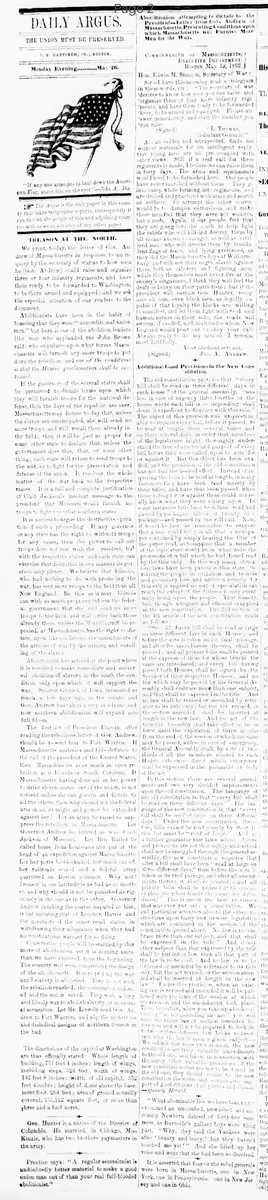
We print, to-day, the letter of Gov. Andrew of Massachusetts in response to an inquiry by the secretary of war as to how soon he (Gov. Andrew) could raise and organize three or four infantry regiments, and have them ready to be forwarded to Washington, to be there armed and equipped; and we ask the especial attention of our readers to the document.
Abolitionists have been in the habit of boasting that they were "unconditional union men," but here is one of the abolition leaders (the man who applauded the John Brown raid) who stipulates upon what terms Massachusetts will furnish any more troops to put down the rebellion, and one of the conditions is that the Hunter proclamation shall be sustained.
If the governors of the several states shall be permitted to dictate terms upon which they will furnish troops for the national defense, then the days of the republic are over. Massachusetts may dictate today that, unless the slaves are emancipated, she will send no more troops, and will recall those already in the field: then it will be just as proper for some other state to declare that, unless the government does this, that, or some other thing, such state will refuse to send troops to the war, or to fight for the preservation and defense of the union. It resolves the whole matter of the war back to the respective states. It is a full and complete justification of Claib Jackson's insolent message to the president that Missouri would furnish no troops to fight the other southern states.
It is useless to argue the destructive operation of such a proceeding. If any governor or any state has the right to withhold troops for any cause, then the power to call out troops does not rest with the president, but with the respective states and each state can exercise that discretion in any manner its governor may please. We believe that Illinois, who had nothing to do with producing the war, has sent more troops to the field than all New England. Be this as it may, Illinois can with as much propriety inform the federal government that she will send no more troops to the field, and will call back those already there, unless the Morrill tariff be repealed, as Massachusetts has the right to dictate upon like conditions, the amendments of the articles of war by the arming and enrolling of the slaves.
Abolitionism has arrived at the point where it is resolved to make immediate and universal abolition of slavery in the south the condition only upon which it will support the war. Senator Grimes, of Iowa, intimated as much a few days ago in the senate, and Gov. Andrew has taken a step in advance, and now northern abolitionism will expand into full bloom.
The first act of President Lincoln, after reading the rebellious letter of Gov. Andrew, should be to send him to Fort Warren. If Massachusetts mutinies and bids defiance to the call of the president of the United States, then Massachusetts is as much in open rebellion as is Florida or South Carolina. Massachusetts having done all in her power to drive eleven states out of the union, is not content unless she can govern and dictate to all the others. Then why should not the federal arm in all its might and power be extended against her? Let an army be raised to suppress the rebellion in Massachusetts.
Let Governor Andrew be hunted as was Claib Jackson of Missouri. Let Ben Butler be called home from Louisiana and put at the head of an expedition against Massachusetts. Let her ports be blockaded, her mails cut off, her railroads seized and a federal army quartered on Boston common. Why not? Treason in one latitude is as bad as in another, and why should it not be punished as rigorously in the one as in the other. Governor Andrew in taking the course imputed to him, is but imitating that of Letcher, Harris and the governors of the other rebel states, in withdrawing their allegiance when they had no constitutional warrant for so doing.
Conservative people will be startled by this move of abolitionism, yet it is nothing more than we have expected from the beginning. The country will soon comprehend the design of the abolitionists. It is to prolong the war until slavery is abolished. They do not wish the rebellion crushed, the constitution enforced and the union saved. They wish a long and bloody war to abolish slavery, or at least eternal separation. Let Mr. Lincoln send Gov. Andrew to Fort Warren, and nip the monstrous and diabolical designs of northern treason in the bud.
The dimensions of the capitol at Washington are thus officially stated: Whole length of building, 751 feet 4 inches; length of wings, including steps, 324 feet; width of wings 142 feet 8 inches; width of old capitol, 352 feet 4 inches; height of dome above the basement floor, 264 feet; area of ground actually covered, 153,112 square feet, or more than three and a half acres.
Gen. Hunter is a native of the District of Columbia. He married, in Chicago, Miss Kinzie, who has two brothers paymasters in the army.
Prentice says: "A regular secessionist is undoubtedly better material to make a good union man out of than your real full-blooded abolitionist."
Abolitionism attempting to dictate to the President--Letter from Gov. Andrew of Massachusetts. Presenting Conditions upon which Massachusetts will Furnish More Men for the War.
COMMONWEALTH OF MASSACHUSETTS.
Executive Department,
Boston May 19, 1862
Hon. Edwin M. Stanton, Secretary of War:
Sir--I have this morning read a telegram in these words, viz: "The secretary of war 'desires to know how soon you can raise and 'organize three or four more infantry regiments, and have them ready to be forwarded 'here, to be armed and equipped. Please answer immediately, and state the number you 'can raise. (Signed) L. Thomas, Adjutant General"
A call sudden and unexpected, finds me without materials for an intelligent reply. Our young men are all preoccupied with other views. Still if a real call for three regiments is made, I believe we can raise them in forty days. The arms and equipments would need to be furnished here. Our people have never marched without them. They go into camp while forming into regiments, and are drilled and practiced with arms and march as soldiers. To attempt the other course would be to dampen enthusiasm and make these men feel that they were not soldiers, but a mob. Again, if our people feel that they are going into the south to help fight the rebels who will kill and destroy them by all means known to savages, as well as civilized men; who will deceive them by fraudulent flags of truce, and lying pretenses, as they did the Massachusetts boys at Williamsburg and will use their negro slaves against them, both as laborers and fighting men, while they themselves must never fire at the enemy's magazines, I think they will feel the draft is heavy on their patriotism; but if the president will sustain Gen. Hunter, recognize all men, even black men, as legally capable of that loyalty the blacks are willing to manifest, and let them fight with God and human nature on their side, the roads will swarm, if needed, with multitudes whom New England would pour out to obey your call.
Always ready to do my utmost, I remain most faithfully,
Your obedient servant,
(Signed) JNO. A. ANDREW.
What sub-type of article is it?
What keywords are associated?
What entities or persons were involved?
Editorial Details
Primary Topic
Criticism Of Governor Andrew's Conditional Support For Union Troops Tied To Emancipation
Stance / Tone
Strongly Anti Abolitionist And Pro Unconditional Union War Effort, Labeling Northern Actions As Treason
Key Figures
Key Arguments