Thank you for visiting SNEWPapers!
Sign up free
The New Hampshire Gazette
Portsmouth, Rockingham County, New Hampshire
What is this article about?
The Watchman, Letter V, from Pennsylvania Journal (May 11), solemnly addresses British colonists, especially in Pennsylvania and the South, urging public virtue and military support against French threats during the war. Contrasts British freedoms and Protestant religion with oppression elsewhere, invoking Spartan examples and divine duty to defend liberties.
Merged-components note: Continuation of the 'WATCHMAN' editorial letter across pages 1 and 2, as the text flows directly from 'We' to 'have hewn out habitations'.
Clippings
1 of 2
OCR Quality
Full Text
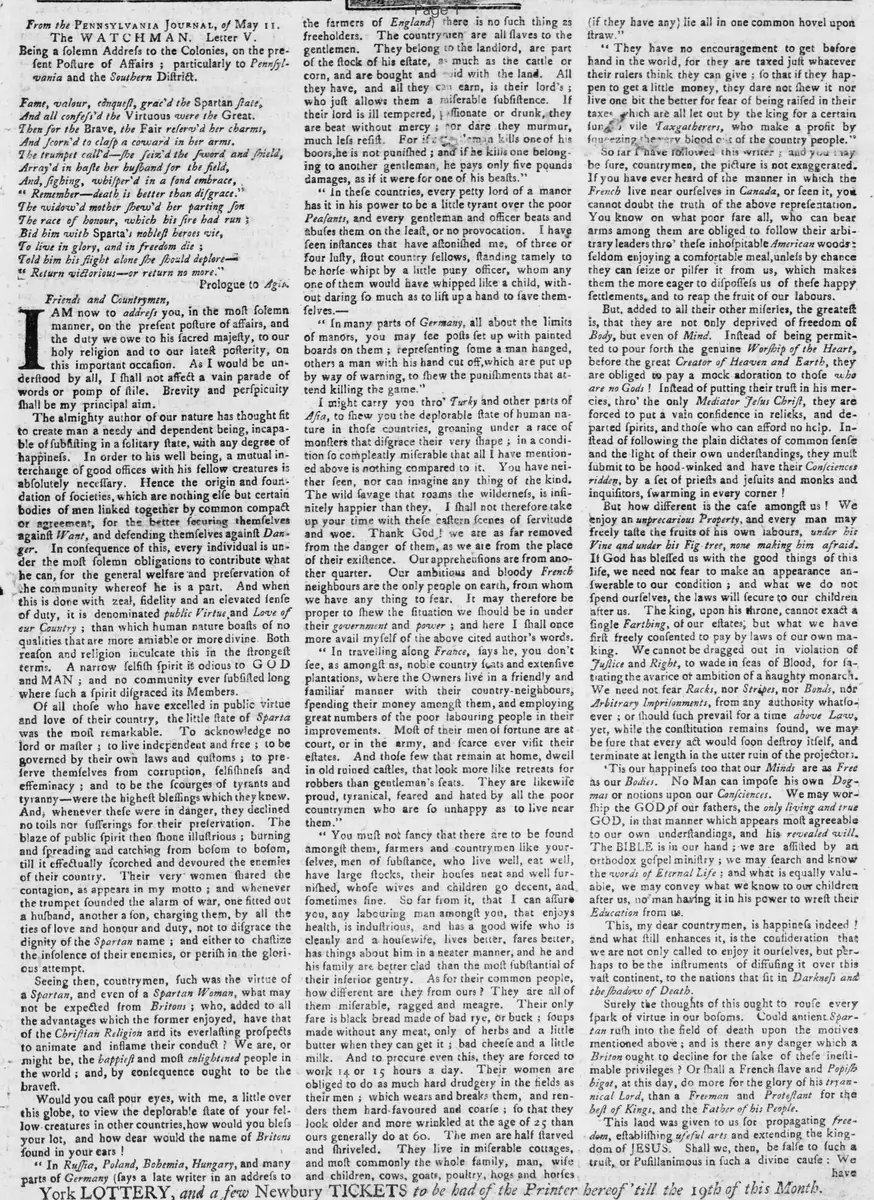
The WATCHMAN. Letter V.
Being a solemn Address to the Colonies, on the present Posture of Affairs; particularly to Pennsylvania and the Southern District.
Fame, valour, conquest grac'd the Spartan tale.
And all confest the Virtuous were the Great.
Then for the Brave, the Fair reserv'd her charms,
And scorn'd to clasp a coward in her arms.
The trumpet call'd-she seiz'd the sword and shield,
Array'd in haste her husband for the field.
And, sighing, whisper'd in a fond embrace,
"Remember death is better than disgrace."
The widow'd mother heav'd her parting son
The race of honour, which his sire had run;
Bid him with Sparta's noblest heroes vie,
To live in glory, and in freedom die;
Told him his flight alone she should deplore—
"Return victorious—or return no more."
Prologue to Agis.
Friends and Countrymen,
I am now to address you, in the most solemn manner, on the present posture of affairs, and the duty we owe to his sacred majesty, to our holy religion and to our latest posterity, on this important occasion. As I would be understood by all, I shall not affect a vain parade of words or pomp of style. Brevity and perspicuity shall be my principal aim.
The almighty author of our nature has thought fit to create man a needy and dependent being, incapable of subsisting in a solitary state, with any degree of happiness. In order to his well being, a mutual interchange of good offices with his fellow-creatures is absolutely necessary. Hence the origin and foundation of societies, which are nothing else but certain bodies of men linked together by common compact or agreement, for the better securing themselves against Want, and defending themselves against Danger. In consequence of this, every individual is under the most solemn obligations to contribute what he can, for the general welfare and preservation of the community whereof he is a part. And when this is done with zeal, fidelity and an elevated sense of duty, it is denominated public Virtue and Love of our Country; than which human nature boasts of no qualities that are more amiable or more divine. Both reason and religion inculcate this in the strongest terms. A narrow selfish spirit is odious to GOD and MAN; and no community ever subsisted long where such a spirit disgraced its Members.
Of all those who have excelled in public virtue and love of their country, the little state of Sparta was the most remarkable. To acknowledge no lord or master; to live independent and free; to be governed by their own laws and customs; to preserve themselves from corruption, selfishness and effeminacy; and to be the scourges of tyrants and tyranny—were the highest blessings which they knew. And, whenever these were in danger, they declined no toils nor sufferings for their preservation. The blaze of public spirit then shone illustrious; burning and spreading and catching from bosom to bosom, till it effectually scorched and devoured the enemies of their country. Their very women shared the contagion, as appears in my motto; and whenever the trumpet sounded the alarm of war, one fitted out a husband, another a son, charging them, by all the ties of love and honour and duty, not to disgrace the dignity of the Spartan name; and either to chastize the insolence of their enemies, or perish in the glorious attempt.
Seeing then, countrymen, such was the virtue of a Spartan, and even of a Spartan Woman, what may not be expected from Britons; who, added to all the advantages which the former enjoyed, have that of the Christian Religion and its everlasting prospects to animate and inflame their conduct? We are, or might be, the happiest and most enlightened people in the world; and, by consequence ought to be the bravest.
Would you cast your eyes, with me, a little over this globe, to view the deplorable state of your fellow creatures in other countries, how would you bless your lot, and how dear would the name of Britons sound in your ears!
"In Russia, Poland, Bohemia, Hungary, and many parts of Germany (says a late writer in an address to the farmers of England) there is no such thing as freeholders. The countrymen are all slaves to the gentlemen. They belong to the landlord, are part of the stock of his estate, as much as the cattle or corn, and are bought and sold with the land. All they have, and all they can earn, is their lord's; who just allows them a miserable subsistence. If their lord is ill tempered, passionate or drunk, they are beat without mercy; nor dare they murmur, much less resist. For if a gentleman kills one of his boors, he is not punished; and if he kills one belonging to another gentleman, he pays only five pounds damages, as if it were for one of his beasts."
"In these countries, every petty lord of a manor has it in his power to be a little tyrant over the poor Peasants, and every gentleman and officer beats and abuses them on the least, or no provocation. I have seen instances that have astonished me, of three or four lusty, stout country fellows, standing tamely to be horse-whipt by a little puny officer, whom any one of them would have whipped like a child, without daring so much as to lift up a hand to save themselves."
"In many parts of Germany, all about the limits of manors, you may see posts set up with painted boards on them; representing some a man hanged, others a man with his hand cut off, which are put up by way of warning, to shew the punishments that attend killing the game."
I might carry you thro' Turkey and other parts of Asia, to shew you the deplorable state of human nature in those countries, groaning under a race of monsters that disgrace their very shape; in a condition so compleatly miserable that all I have mentioned above is nothing compared to it. You have neither seen, nor can imagine any thing of the kind. The wild savage that roams the wilderness, is infinitely happier than they. I shall not therefore take up your time with these caterwauling scenes of servitude and woe. Thank God! we are as far removed from the danger of them, as we are from the place of their existence. Our apprehensions are from another quarter. Our ambitious and bloody French neighbours are the only people on earth, from whom we have any thing to fear. It may therefore be proper to shew the situation we should be in under their government and power: and here I shall once more avail myself of the above cited author's words.
"In travelling along France, says he, you don't see, as amongst us, noble country seats and extensive plantations, where the Owners live in a friendly and familiar manner with their country-neighbours, spending their money amongst them, and employing great numbers of the poor labouring people in their improvements. Most of their men of fortune are at court, or in the army, and scarce ever visit their estates. And those few that remain at home, dwell in old ruined castles, that look more like retreats for robbers than gentleman's seats. They are likewise proud, tyrannical, feared and hated by all the poor countrymen who are so unhappy as to live near them."
"You must not fancy that there are to be found amongst them, farmers and countrymen like yourselves, men of substance, who live well, eat well, have large stocks, their houses neat and well furnished, whose wives and children go decent, and sometimes fine. So far from it, that I can assure you, any labouring man amongst you, that enjoys health, is industrious, and has a good wife who is cleanly and a housewife, lives better, fares better, has things about him in a neater manner, and he and his family are better clad than the most substantial of their inferior gentry. As for their common people, how different are they from ours? They are all of them miserable, ragged and meagre. Their only fare is black bread made of bad rye, or buck; soups made without any meat, only of herbs and a little butter when they can get it; bad cheese and a little milk. And to procure even this, they are forced to work 14 or 15 hours a day. Their women are obliged to do as much hard drudgery in the fields as their men; which wears and breaks them, and renders them hard-favoured and coarse; so that they look older and more wrinkled at the age of 25 than ours generally do at 60. The men are half starved and shriveled. They live in miserable cottages, and most commonly the whole family, man, wife and children, cows, goats, poultry, hogs and horses (if they have any) lie all in one common hovel upon straw."
"They have no encouragement to get before hand in the world, for they are taxed just whatever their rulers think they can give; so that if they happen to get a little money, they dare not shew it nor live one bit the better for fear of being raised in their taxes which are all let out by the king for a certain sum; vile Taxgatherers, who make a profit by squeezing the very blood out of the country people."
So far I have followed this writer; and you may be sure, countrymen, the picture is not exaggerated. If you have ever heard of the manner in which the French live near ourselves in Canada, or even it, you cannot doubt the truth of the above representation. You know on what poor fare all, who can bear arms among them are obliged to follow their arbitrary leaders thro' these inhospitable American woods: seldom enjoying a comfortable meal, unless by chance they can seize or pilfer it from us, which makes them the more eager to dispossess us of these happy settlements, and to reap the fruit of our labours.
But, added to all their other miseries, the greatest is, that they are not only deprived of freedom of Body, but even of Mind. Instead of being permitted to pour forth the genuine Worship of the Heart, before the great Creator of Heaven and Earth, they are obliged to pay a mock adoration to those who are no Gods! Instead of putting their trust in his mercies, thro' the only Mediator Jesus Christ, they are forced to put a vain confidence in reliques, and departed spirits, and those who can afford no help. Instead of following the plain dictates of common sense and the light of their own understandings, they must submit to be hood-winked and have their Consciences ridden, by a set of priests and jesuits and monks and inquisitors, swarming in every corner!
But how different is the case amongst us! We enjoy an unprecarious Property, and every man may freely taste the fruits of his own labours, under his Vine and under his Fig-tree, none making him afraid. If God has blessed us with the good things of this life, we need not fear to make an appearance answerable to our condition; and what we do not spend ourselves, the laws will secure to our children after us. The king, upon his throne, cannot exact a single Farthing, of our estates; but what we have first freely consented to pay by laws of our own making. We cannot be dragged out in violation of Justice and Right, to wade in seas of Blood, for gratifying the avarice or ambition of a haughty monarch. We need not fear Racks, nor Stripes, nor Bonds, nor Arbitrary Imprisonments, from any authority whatsoever: or should such prevail for a time above Law, yet, while the constitution remains sound, we may be sure that every act would soon destroy itself, and terminate at length in the utter ruin of the projector.
Tis our happiness too that our Minds are as Free as our Bodies. No Man can impose his own Dogmas or notions upon our Consciences. We may worship the GOD of our fathers, the only living and true GOD, in that manner which appears most agreeable to our own understandings, and his revealed will. The BIBLE is in our hand;—we are assisted by an orthodox gospel ministry; we may search and know the words of Eternal Life; and what is equally valuable, we may convey what we know to our children after us, no man having it in his power to wrest their Education from us.
This, my dear countrymen, is happiness indeed! and what still enhances it, is the consideration that we are not only called to enjoy it ourselves, but perhaps to be the instruments of diffusing it over this vast continent, to the nations that sit in Darkness and the shadow of Death.
Surely the thoughts of this ought to rouze every spark of virtue in our bosoms. Could ancient Spartans rush into the field of death upon the motives mentioned above; and is there any danger which a Briton ought to decline for the sake of these inestimable privileges? Or shall a French slave and Popish bigot, at this day, do more for the glory of his tyrannical Lord, than a Freeman and Protestant for the best of Kings, and the Father of his People.
This land was given to us for propagating freedom, establishing useful arts and extending the kingdom of JESUS. Shall we, then, be false to Such a trust, or Pusillanimous in such a divine cause: We
have hewn out habitations for Ourselves in an uncultivated wilderness; shall we suffer them to fall a prey to the most perfidious of enemies? We have unfurled the MESSIAH'S banner in the remotest parts of the earth; and shall we suffer the bloody flag of Persecution to usurp its place? We have planted the blessed Gospel here, and shall we suffer Heathen error to return where the glad Tidings of Salvation have once been preached? No; countrymen! I know your souls rise at the very thought of such a conduct; and you would rather suffer ten thousand deaths (were so many possible) than be guilty of that which would entail infamy on yourselves, and ruin on your latest posterity.
Your readiness to join in the measures concerted for your safety, and to strike a decisive blow against the enemy, will determine your future happiness and safety as a people. And I may well trust, when so much is at stake, you will not be backward in offering your service for a few months under a General of humanity, experience and every amiable accomplishment. I hope even to hear that our Women will become advocates in such a cause, and entitle themselves to all the applauses so long paid to their Spartan predecessors!
I would not now wound you, with a disagreeable recapitulation of our past misconduct and fatal indolence, especially in these Southern colonies. Many a time has it been in our power to crush out this bloody war with the sole of our foot, before it blazed up to its present height--But this we sadly neglected; and Perhaps the all wise disposer of events meant to shew us, that when our affairs were at the worst, he was mighty to save.
Never was the Protestant Religion in a more desperate situation than towards the close of last campaign. The great and heroic King of Prussia stood ready to be swallowed up by the multitude of his enemies. The British nation was torn to pieces by intestine divisions; its helm continually Shifting hands; all bent on sordid views of self interest; few regarding the public good; Hanover hatefully given up; our secret expedition ending in disgrace; our forts in America lost; our people captivated or inhumanly murdered, and our fleets dispersed and shattered before the winds--Yet, even then, when no human eye could look for safety, the Lord interposed for the Protestant Religion. In the short space of two months, the king of Prussia extricated himself out of his difficulties, in a Manner that astonished all Europe, and will continue to be the admiration of ages to come! And had we only done our parts in America at that time, the pride of France would have been effectually humbled, and we should probably now have been rejoicing in an honourable peace.
But as that was not the case, the nation, in concert with the king of Prussia and other Protestant powers, has been obliged to make one grand push more for the general cause; and if that is unsuccessful, GOD knows what will become of our liberties and properties. This we may lay down as a certain truth, that the expence of the present war is far too great to be born longer by the powers concerned in it. The British nation is groaning under an almost unsupportable load of taxes. These Colonies are likewise drained to the utmost, and sinking under the burthen, as we all feel. Peace, then, there must be of some kind or other; and upon our success this campaign it depends, whether we shall dictate a Peace to the French, or they to us. Should the latter be the case, (which God forbid!) it would be a fatal peace to us.
Rise, then my countrymen! as you value the blessings you enjoy, and dread the evils that hang over you, rise and shew yourselves worthy of the name of Britons! Rise to secure to your posterity, peace, freedom and a pure religion! Rise to take vengeance on a perfidious nation for their breach of treaties, their detestable cruelties, and their horrid murders! Remember the cries of your captivated brethren, your orphan children, your helpless widows, and thousands of beggared families! Think of Monongahela, Fort William Henry, and those scenes of savage death, where the unburied bones of your fellow citizens lie strewed upon the plain, calling you to retrieve the honour of the British nation.
Thus animated and roused, my dear countrymen; and thus putting your confidence, where alone it can be put; go forth in humble boldness, and let the Lord do what seemeth him good!
What sub-type of article is it?
What keywords are associated?
What entities or persons were involved?
Editorial Details
Primary Topic
Urging Colonial Support Against French In The War
Stance / Tone
Patriotic Exhortation To Defend British And Protestant Liberties
Key Figures
Key Arguments
- societies require public virtue for preservation
- spartans exemplified bravery and independence
- british enjoy superior freedoms compared to slaves in russia, germany, france
- french oppression includes poverty, tyranny, and catholic idolatry
- colonists must fight to protect property, religion, and posterity
- past colonial indolence prolonged the war; now decisive action needed
- success this campaign determines favorable peace