Thank you for visiting SNEWPapers!
Sign up free
Editorial
October 12, 1863
The Daily Gate City
Keokuk, Lee County, Iowa
What is this article about?
Editorial critiques Bishop Hopkins and Rev. Van Sant's defense of slavery as a divine institution based on Scripture, noting it applies to white slavery and polygamy, not modern black slavery. Contrasts with Bishop Potter's protest against such views promoted by Pennsylvania Copperheads.
Clipping
OCR Quality
95%
Excellent
Full Text
Doctors Differ.
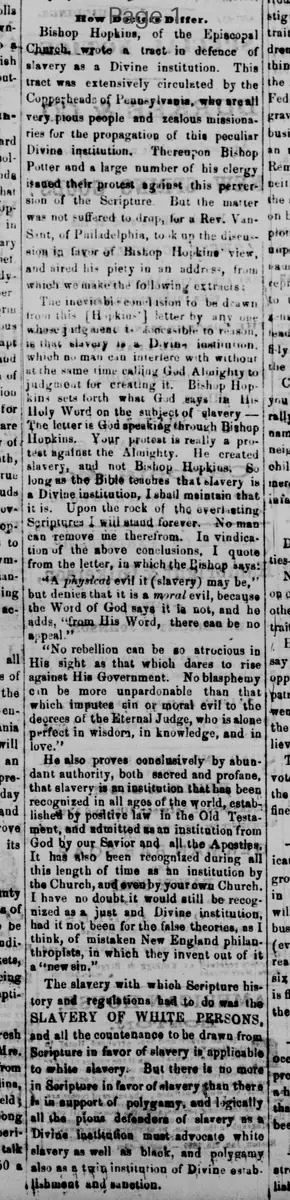
Bishop Hopkins, of the Episcopal Church, wrote a tract in defence of slavery as a Divine institution. This tract was extensively circulated by the Copperheads of Pennsylvania, who are all very pious people and zealous missionaries for the propagation of this peculiar Divine institution. Thereupon Bishop Potter and a large number of his clergy issued their protest against this perversion of the Scripture. But the matter was not suffered to drop, for a Rev. Van Sant, of Philadelphia, took up the discussion in favor of Bishop Hopkins' view, and aired his piety in an address, from which we make the following extracts:
The inevitable conclusion to be drawn from this (Hopkins') letter by any one whose judgment is susceptible to reason, is that slavery "a Divine institution, which no man can interfere with without at the same time calling God Almighty to judgment for creating it. Bishop Hopkins sets forth what God says in His Holy Word on the subject of slavery -- The letter is God speaking through Bishop Hopkins. Your protest is really a protest against the Almighty. He created slavery, and not Bishop Hopkins; So long as the Bible teaches that slavery is Divine institution, I shall maintain that it is. Upon the rock of the everlasting Scriptures I will stand forever. No man can remove me therefrom. In vindication of the above conclusions, I quote from the letter, in which the Bishop says: physical evil it (slavery) may be," but denies that it is a moral evil, because the Word of God says it is not, and he adds, "From His Word, there can be no appeal."
"No rebellion can be so atrocious in His sight as that which dares to rise against His Government. No blasphemy can be more unpardonable than that which imputes sin or moral evil to the decrees of the Eternal Judge, who is alone perfect in wisdom, in knowledge, and in love."
He also proves conclusively by abundant authority, both sacred and profane, that slavery is an institution that has been recognized in all ages of the world, established by positive law in the Old Testament, and admitted as an institution from God by our Savior and all the Apostles. It has also been recognized during all this length of time as an institution by the Church, and even by your own Church.
I have no doubt it would still be recognized as a just and Divine institution, had it not been for the false theories, as I think, of mistaken New England philanthropists, in which they invent out of it a new sin,"
The slavery with which Scripture history and regulations had to do was the SLAVERY OF WHITE PERSONS. and all the countenance to be drawn from Scripture in favor of slavery is applicable to white slavery: But there is no more in Scripture in favor of slavery than there is in support of polygamy, and logically all the pious defenders of slavery as a Divine Institution must advocate white slavery as well as black, and polygamy also as a twin institution of Divine establishment.
Bishop Hopkins, of the Episcopal Church, wrote a tract in defence of slavery as a Divine institution. This tract was extensively circulated by the Copperheads of Pennsylvania, who are all very pious people and zealous missionaries for the propagation of this peculiar Divine institution. Thereupon Bishop Potter and a large number of his clergy issued their protest against this perversion of the Scripture. But the matter was not suffered to drop, for a Rev. Van Sant, of Philadelphia, took up the discussion in favor of Bishop Hopkins' view, and aired his piety in an address, from which we make the following extracts:
The inevitable conclusion to be drawn from this (Hopkins') letter by any one whose judgment is susceptible to reason, is that slavery "a Divine institution, which no man can interfere with without at the same time calling God Almighty to judgment for creating it. Bishop Hopkins sets forth what God says in His Holy Word on the subject of slavery -- The letter is God speaking through Bishop Hopkins. Your protest is really a protest against the Almighty. He created slavery, and not Bishop Hopkins; So long as the Bible teaches that slavery is Divine institution, I shall maintain that it is. Upon the rock of the everlasting Scriptures I will stand forever. No man can remove me therefrom. In vindication of the above conclusions, I quote from the letter, in which the Bishop says: physical evil it (slavery) may be," but denies that it is a moral evil, because the Word of God says it is not, and he adds, "From His Word, there can be no appeal."
"No rebellion can be so atrocious in His sight as that which dares to rise against His Government. No blasphemy can be more unpardonable than that which imputes sin or moral evil to the decrees of the Eternal Judge, who is alone perfect in wisdom, in knowledge, and in love."
He also proves conclusively by abundant authority, both sacred and profane, that slavery is an institution that has been recognized in all ages of the world, established by positive law in the Old Testament, and admitted as an institution from God by our Savior and all the Apostles. It has also been recognized during all this length of time as an institution by the Church, and even by your own Church.
I have no doubt it would still be recognized as a just and Divine institution, had it not been for the false theories, as I think, of mistaken New England philanthropists, in which they invent out of it a new sin,"
The slavery with which Scripture history and regulations had to do was the SLAVERY OF WHITE PERSONS. and all the countenance to be drawn from Scripture in favor of slavery is applicable to white slavery: But there is no more in Scripture in favor of slavery than there is in support of polygamy, and logically all the pious defenders of slavery as a Divine Institution must advocate white slavery as well as black, and polygamy also as a twin institution of Divine establishment.
What sub-type of article is it?
Slavery Abolition
Moral Or Religious
What keywords are associated?
Slavery Divine Institution
Biblical Slavery
White Slavery
Polygamy
Bishop Hopkins
Copperheads
Episcopal Church
What entities or persons were involved?
Bishop Hopkins
Bishop Potter
Rev. Van Sant
Copperheads Of Pennsylvania
Episcopal Church
Editorial Details
Primary Topic
Critique Of Pro Slavery Biblical Defenses
Stance / Tone
Anti Slavery Critique
Key Figures
Bishop Hopkins
Bishop Potter
Rev. Van Sant
Copperheads Of Pennsylvania
Episcopal Church
Key Arguments
Slavery Defended As Divine By Hopkins And Van Sant Via Scripture
Protest By Potter Seen As Against God
Biblical Slavery Refers To White Persons, Not Black
Scriptural Support For Slavery Equates To Support For Polygamy
Pro Slavery Views Promoted By Pious Copperheads