Thank you for visiting SNEWPapers!
Sign up free
Editorial
October 25, 1913
The Savannah Tribune
Savannah, Chatham County, Georgia
What is this article about?
The editorial stresses that Masons must pay annual dues promptly as a key obligation, criticizes those who neglect this duty despite ability, and urges informing new members to prevent delinquency and maintain lodge integrity. Signed by New England Craftsman.
Clipping
OCR Quality
98%
Excellent
Full Text
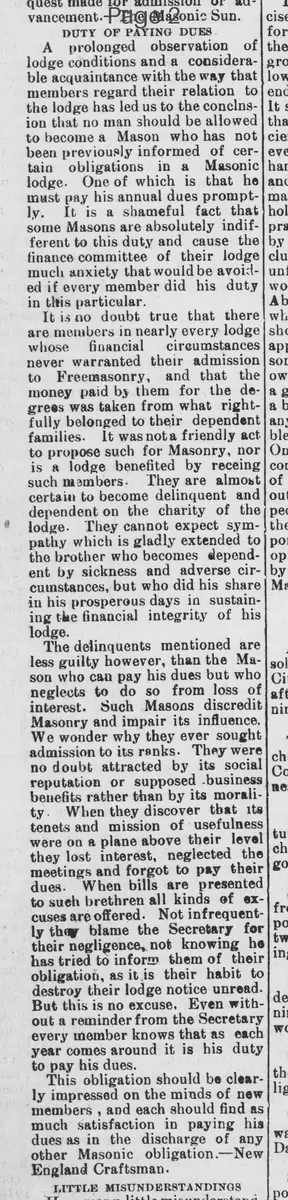
DUTY OF PAYING DUES
A prolonged observation of lodge conditions and a considerable acquaintance with the way that members regard their relation to the lodge has led us to the conclusion that no man should be allowed to become a Mason who has not been previously informed of certain obligations in a Masonic lodge. One of which is that he must pay his annual dues promptly. It is a shameful fact that some Masons are absolutely indifferent to this duty and cause the finance committee of their lodge much anxiety that would be avoided if every member did his duty in this particular.
It is no doubt true that there are members in nearly every lodge whose financial circumstances never warranted their admission to Freemasonry, and that the money paid by them for the degrees was taken from what rightfully belonged to their dependent families. It was not a friendly act to propose such for Masonry, nor is a lodge benefited by receiving such members. They are almost certain to become delinquent and dependent on the charity of the lodge. They cannot expect sympathy which is gladly extended to the brother who becomes dependent by sickness and adverse circumstances, but who did his share in his prosperous days in sustaining the financial integrity of his lodge.
The delinquents mentioned are less guilty however, than the Mason who can pay his dues but who neglects to do so from loss of interest. Such Masons discredit Masonry and impair its influence. We wonder why they ever sought admission to its ranks. They were no doubt attracted by its social reputation or supposed business benefits rather than by its morality. When they discover that its tenets and mission of usefulness were on a plane above their level they lost interest, neglected the meetings and forgot to pay their dues. When bills are presented to such brethren all kinds of excuses are offered. Not infrequently they blame the Secretary for their negligence, not knowing he has tried to inform them of their obligation, as it is their habit to destroy their lodge notice unread.
But this is no excuse. Even without a reminder from the Secretary every member knows that as each year comes around it is his duty to pay his dues. This obligation should be clearly impressed on the minds of new members, and each should find as much satisfaction in paying his dues as in the discharge of any other Masonic obligation.-New England Craftsman.
A prolonged observation of lodge conditions and a considerable acquaintance with the way that members regard their relation to the lodge has led us to the conclusion that no man should be allowed to become a Mason who has not been previously informed of certain obligations in a Masonic lodge. One of which is that he must pay his annual dues promptly. It is a shameful fact that some Masons are absolutely indifferent to this duty and cause the finance committee of their lodge much anxiety that would be avoided if every member did his duty in this particular.
It is no doubt true that there are members in nearly every lodge whose financial circumstances never warranted their admission to Freemasonry, and that the money paid by them for the degrees was taken from what rightfully belonged to their dependent families. It was not a friendly act to propose such for Masonry, nor is a lodge benefited by receiving such members. They are almost certain to become delinquent and dependent on the charity of the lodge. They cannot expect sympathy which is gladly extended to the brother who becomes dependent by sickness and adverse circumstances, but who did his share in his prosperous days in sustaining the financial integrity of his lodge.
The delinquents mentioned are less guilty however, than the Mason who can pay his dues but who neglects to do so from loss of interest. Such Masons discredit Masonry and impair its influence. We wonder why they ever sought admission to its ranks. They were no doubt attracted by its social reputation or supposed business benefits rather than by its morality. When they discover that its tenets and mission of usefulness were on a plane above their level they lost interest, neglected the meetings and forgot to pay their dues. When bills are presented to such brethren all kinds of excuses are offered. Not infrequently they blame the Secretary for their negligence, not knowing he has tried to inform them of their obligation, as it is their habit to destroy their lodge notice unread.
But this is no excuse. Even without a reminder from the Secretary every member knows that as each year comes around it is his duty to pay his dues. This obligation should be clearly impressed on the minds of new members, and each should find as much satisfaction in paying his dues as in the discharge of any other Masonic obligation.-New England Craftsman.
What sub-type of article is it?
Moral Or Religious
What keywords are associated?
Masonic Dues
Lodge Obligations
Member Delinquency
Freemasonry Morality
Annual Payments
What entities or persons were involved?
Masons
Masonic Lodge
Finance Committee
Secretary
Editorial Details
Primary Topic
Duty Of Paying Masonic Dues
Stance / Tone
Exhortative Emphasis On Responsibility
Key Figures
Masons
Masonic Lodge
Finance Committee
Secretary
Key Arguments
Prospective Masons Must Be Informed Of Obligation To Pay Annual Dues Promptly
Indifferent Members Cause Anxiety To Finance Committees
Admission Of Financially Unfit Members Harms Lodges And Families
Delinquent Members Who Can Pay But Neglect Do So From Loss Of Interest
Such Members Discredit Masonry And Impair Its Influence
Members Should Find Satisfaction In Paying Dues As A Masonic Obligation