Thank you for visiting SNEWPapers!
Sign up free
The Rhode Island American, And General Advertiser
Providence, Providence County, Rhode Island
What is this article about?
On January 16, 1812, President Madison sends Congress diplomatic correspondence between British Envoy Foster and Secretary Monroe, highlighting British hostility toward U.S. neutral rights amid trade disputes with France's decrees and Britain's Orders in Council.
Merged-components note: This is a single continuous article presenting the President's message to Congress including the diplomatic correspondence between Mr. Foster and Mr. Monroe, split across multiple columns on page 1 and continuing to page 2. Relabeled to domestic_news as it concerns US national policy and government communications regarding foreign relations.
Clippings
1 of 2
OCR Quality
Full Text
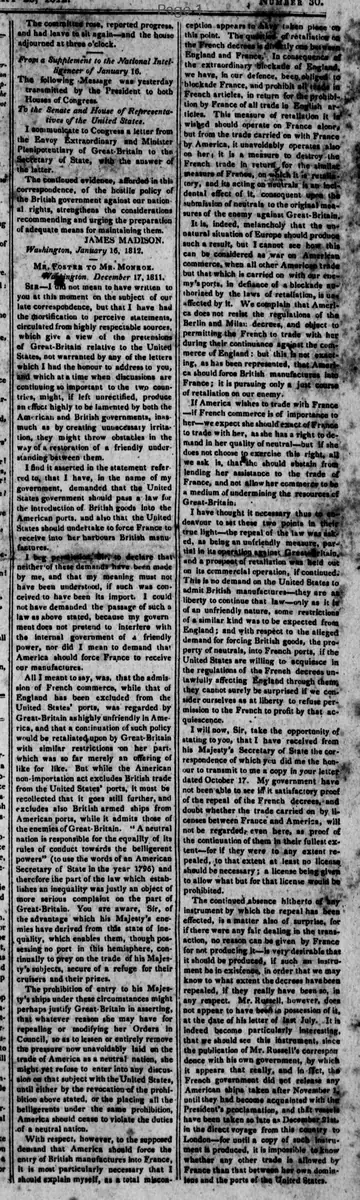
The following Message was yesterday transmitted by the President to both Houses of Congress
To the Senate and House of Representatives of the United States.
I communicate to Congress a letter from the Envoy Extraordinary and Minister Plenipotentiary of Great-Britain to the Secretary of State, with the answer of the latter.
The continued evidence, afforded in this correspondence, of the hostile policy of the British government against our national rights, strengthens the considerations recommending and urging the preparation of adequate means for maintaining them.
JAMES MADISON.
Washington, January 16, 1812.
MR. FOSTER To Mr. MONROE.
Washington, December 17, 1811.
SIR—I did not mean to have written to you at this moment on the subject of our late correspondence, but that I have had the mortification to perceive statements, circulated from highly respectable sources, which give a view of the pretensions of Great-Britain relative to the United States, not warranted by any of the letters which I had the honour to address to you, and which at a time when discussions are continuing so important to the two countries, might, if left unrectified, produce an effect highly to be lamented by both the American and British governments, inasmuch as by creating unnecessary irritation, they might throw obstacles in the way of a restoration of a friendly understanding between them.
I find it asserted in the statement referred to, that I have, in the name of my government, demanded that the United States government should pass a law for the introduction of British goods into the American ports, and also that the United States should undertake to force France to receive into her harbours British manufactures.
I beg permission Sir to declare that neither of these demands have been made by me, and that my meaning must not have been understood, if such was conceived to have been its import. I could not have demanded the passage of such a law as above stated, because my government does not pretend to interfere with the internal government of a friendly power, nor did I mean to demand that America should force France to receive our manufactures.
All I meant to say, was, that the admission of French commerce, while that of England has been excluded from the United States' ports, was regarded by Great-Britain as highly unfriendly in America, and that a continuation of such policy would be retaliated upon by Great-Britain with similar restrictions on her part, which was so far merely an offering of like for like. But while the American non-importation act excludes British trade from the United States' ports, it must be recollected that it goes still further, and excludes also British armed ships from American ports, while it admits those of the enemies of Great-Britain. "A neutral nation is responsible for the equality of its rules of conduct towards the belligerent powers" (to use the words of an American Secretary of State in the year 1796) and therefore the part of the law which establishes an inequality was justly an object of more serious complaint on the part of Great-Britain. You are aware, Sir, of the advantage which his Majesty's enemies have derived from this state of inequality, which enables them, though possessing no port in this hemisphere, continually to prey on the trade of his Majesty's subjects, secure of a refuge for their cruisers and their prizes.
The prohibition of entry to his Majesty's ships under these circumstances might perhaps justify Great-Britain in asserting, that whatever reason she may have for repealing or modifying her Orders in Council, so as to lessen or entirely remove the pressure now unavoidably laid on the trade of America as a neutral nation, she might yet refuse to enter into any discussion on that subject with the United States, until either by the revocation of the prohibition above stated, or the placing all the belligerents under the same prohibition, America should cease to violate the duties of a neutral nation.
With respect, however, to the supposed demand that America should force the entry of British manufactures into France, it is most particularly necessary that I should explain myself, as a total misconception appears to have taken place on this point. The question of retaliation on the French decrees is directly one between England and France. In consequence of the extraordinary blockade of England we have, in our defence, been obliged to blockade France, and prohibit all trade in French articles, in return for the prohibition by France of all trade in English articles. This measure of retaliation it is wished should operate on France alone but from the trade carried on with France by America, it unavoidably operates also on her; it is a measure to destroy the French trade in return for the similar measure of France, on which it is retaliatory, and its acting on neutrals is an incidental effect of it, consequent upon the submission of neutrals to the original measures of the enemy against Great-Britain. It is, indeed, melancholy that the unnatural situation of Europe should produce such a result, but I cannot see how this can be considered as war on American commerce, when all other American trade but that which is carried on with our enemy's ports, in defiance of a blockade authorized by the laws of retaliation, is unaffected by it. We complain that America does not resist the regulations of the Berlin and Milan decrees, and object to permitting the French to trade with her during their continuance against the commerce of England: but this is not exacting, as has been represented, that America should force British manufactures into France; it is pursuing only a just course of retaliation on our enemy.
If America wishes to trade with France—if French commerce is of importance to her—we expect she should exact of France to trade with her, as she has a right to demand in her quality of neutral—but if she does not choose to exercise this right, all we ask is, that she should abstain from lending her assistance to the trade of France, and not allow her commerce to be a medium of undermining the resources of Great-Britain.
I have thought it necessary thus to endeavour to set these two points in their true light—the repeal of the law was urged as being an unfriendly measure, partial in its operation against Great Britain, and a prospect of retaliation was held out on its commercial operation, if continued. This is no demand on the United States to admit British manufactures—they are at liberty to continue that law—only as it is of an unfriendly nature, some restrictions of a similar kind was to be expected from England; and with respect to the alleged demand for forcing British goods, the property of neutrals, into French ports, if the United States are willing to acquiesce in the regulations of the French decrees unlawfully affecting England through them they cannot surely be surprised if we consider ourselves as at liberty to refuse permission to the French to profit by that acquiescence.
I will now, Sir, take the opportunity of stating to you, that I have received from his Majesty's Secretary of State the correspondence of which you did me the honour to transmit to me a copy in your letter dated October 17. My government have not been able to see in it satisfactory proof of the repeal of the French decrees, and doubt whether the trade carried on by licenses between France and America, will not be regarded, even here, as proof of the continuation of them in their fullest extent—for if they were to any extent repealed, to that extent at least no license should be necessary; a license being given to allow what but for that license would be prohibited.
The continued absence hitherto of any instrument by which the repeal has been effected, is a matter also of surprise, for if there were any fair dealing in the transaction, no reason can be given by France for not producing it—is very desirable that it should be produced, if such an instrument be in existence, in order that we may know to what extent the decrees have been repealed, if they really have been so, in any respect. Mr. Russell, however, does not appear to have been in possession of it, at the date of his letter of last July. It is indeed become particularly interesting, that we should see this instrument, since the publication of Mr. Russell's correspondence with his own government, by which it appears that really, and in fact, the French government did not release any American ships taken after November 1 until they had become acquainted with the President's proclamation, and that vessels have been taken so late as December 21st, in the direct voyage from this country to London—for until a copy of such instrument is produced, it is impossible to know whether any other trade is allowed by France than that between her own dominions and the ports of the United States.
I have the honour to be with the highest consideration, Sir, your most obedient humble servant,
AUG. J. FOSTER.
To the Honourable James Monroe, Esq. &c.
MR. MONROE To MR. FOSTER.
Department of State,
January 14, 1812.
SIR: I have had the honour to receive your letter of December 17th, and I embrace the first moment that I could command to make the observations which it suggests.
It would have afforded great satisfaction to the President to have found in the communication some proof of a disposition in the British government to put an end to the differences subsisting between our countries. I am sorry to be obliged to state that it presents a new proof only of its determination to adhere to the policy in which they are imputable.
You complain that the import of your former letters has been misunderstood in two important circumstances; that you have been represented to have demanded of the United States, a law for the introduction of British goods into their ports, and that they should also undertake to force France to receive British manufactures into her harbours.
You state that on the first point it was your intention to remonstrate against the non-importation act, as partial in its operation, and unfriendly to Great-Britain. On which account its repeal was claimed, and to intimate that if it was persevered in, Great-Britain would be compelled to retaliate on the commerce of the United States, by similar restrictions on her part.
And on the second point, that you intended only to urge, that in consequence of the extraordinary blockade of England, your government had been obliged to blockade France, and to prohibit all trade in French articles, in return for the prohibition by France of all trade in English articles.
It is sufficient to remark on the first point, that on whatever ground the repeal of the non-importation act is required, the United States are justified in adhering to it, by the refusal of the British government to repeal its Orders in Council; and if a distinction is thus produced between Great Britain, and the other belligerent, it must be referred to the difference in the conduct of the two parties.
On the second point I have to observe, that the explanation given cannot be satisfactory, because it does not meet the case now existing. France did, it is true, declare a blockade of England: against the trade of the United States, and prohibited all trade in English articles on the high seas, but this blockade and prohibition no longer exists. It is true, also, that a part of those decrees did prohibit a trade in English articles, within her territorial jurisdiction--but this prohibition violates no national rights or neutral commerce of the United States. Still your blockade and prohibition are continued, in violation of the national and neutral rights of the United States, on a pretext of retaliation, which if even applicable, could only be applied to the former, and not to the latter interdictions-and it is required that France shall change her internal regulations against English trade, before England will change her external regulations against the trade of the United States.
But you still insist that the French decrees are unrevoked, and urge in proof of it a fact drawn from Mr. Russell's correspondence, that some American vessels have been taken since the 1st of November in their route to England.
It is a satisfactory answer to this remark, that it appears by the same correspondence, that every American vessel which had been taken in that trade, the seizure of which rested on the Berlin and Milan decrees only, were, as soon as that fact was ascertained, delivered up to their owners. Might there not be other ground also, on which seizures might be made? Great-Britain claims a right to seize for other causes, and all nations admit in the case of contraband of war. If by the law of nations, one belligerent has a right to seize neutral property in any case, the other belligerent has the same right. Nor ought I to overlook that the practice of counterfeiting American papers in England; which is well known to the continent, has, by impairing the faith due to American documents, done to the United States essential injury. Against this practice the minister of the United States at London, as will appear by reference to his letter to the Marquis Wellesley, of the 3d of May, 1810, made a formal representation in pursuance of instructions from his government, with an offer of every information possessed by him, which might contribute to detect and suppress it. It is painful to add, that this communication was entirely disregarded. That Great-Britain should complain of acts of France, to which, by her neglect, she was instrumental, and draw from them proof in support of her Orders in Council, ought certainly not to have been expected.
Your remarks also, that the practice of the French government to grant licenses to certain American vessels, engaged in the trade between the United States and France, is an additional proof that the French decrees still operate in their fullest extent. On what principle this inference is drawn from that fact it is impossible for me to conceive. It was not the object of the Berlin and Milan decrees to prohibit the trade between the United States and France. They were meant to prohibit the trade of the United States with Great-Britain, which violated our neutral rights, and to prohibit the trade of Great-Britain with the continent, with which the United States have nothing to do. If the object had been to prohibit the trade between the United States and France, Great-Britain could never have found in them any pretext for complaint.
And if the idea of retaliation, could in any respect have been applicable, it would have been by prohibiting our trade with herself. To prohibit it with France would not have been a retaliation, but a co-operation. If licensing by France the trade in certain instances, prove any thing, it proves nothing more than that the trade with France, in other instances is under restraint. It seems impossible to extract from it in any respect, that the Berlin and Milan decrees are in force, so far as they prohibit the trade between the United States and England.
I might here repeat that the French practice of granting licenses to trade between the United States and France, may have been intended in part, at least, as a security against the simulated papers--the forging of which was not suppressed in England.
It is not to be inferred from these remarks, that a trade by license, is one with which the United States are satisfied. They have the strongest objections to it, but these are founded on other principles, than those suggested in your note.
It is a cause of great surprise to the President, that your government has not seen in the correspondence of Mr. Russell, which I had the honour to communicate to you on the 17th of October last, and which has been lately transmitted to you by your government, sufficient proof of the repeal of the Berlin and Milan decrees, independent of the conclusive evidence of the act, which that correspondence afforded, it was not to be presumed from the intimation of the Marquis of Wellesley, that if it was to be transmitted to you, to be taken into consideration in the depending discussions that it was of a nature to have no weight in these discussions.
The demand which you now make of a view of the order given by the French government to its cruisers, in consequence of the repeal of the French Decrees, in a new proof of its indisposition to repeal the Orders in Council. The declaration of the French government was, as has been heretofore observed, a solemn and obligatory act, and as such entitled to the notice and respect of other governments. It was incumbent on Great-Britain, therefore, in fulfilment of her engagement, to have provided that her Orders in Council should not have effect, after the time fixed for the cessation of the French decrees. A pretension in Great-Britain to keep her orders in force until she received satisfaction of the practical compliance of France, is utterly incompatible with her pledge. A doubt, founded on any single act, however unauthorised, committed by a French privateer, might, on that principle, become a motive for delay and refusal. A suspicion that such acts would be committed, might have the same effect; and in like manner her compliance might be withheld as long as the war continued.-But let me here remark that if there was a question whether the French repeal did or did not take effect- at the date announced by France, and required by the United States, it cannot be alleged that the decrees have not ceased to operate since the 2d of February last, as heretofore observed. And as the actual cessation of the decrees to violate our neutral rights, was the only essential fact in the case, has long been known to your government, the Orders in Council from the date of that knowledge ought to have ceased, according to its own principles and pledges.
But the question whether and when the repeal of the Berlin and Milan Decrees took effect, in relation to the neutral commerce of the United States, is superceded by the novel and extraordinary claim of Great-Britain to a trade in British articles, with her enemy'; for supposing the repeal to have taken place, in the fullest extent claimed by the United States, it could, according to that claim, have no effect in removing the Orders in Council.
On a full view of the conduct of the British government in these transactions, it is impossible to see in it any thing short of a spirit of determined hostility to the rights and interests of the United States.--It issued the Orders in Council, on a principle of retaliation on France, at a time when it admitted the French Decrees to be ineffectual; it has sustained those orders in full force since, notwithstanding the pretext for them has been removed, and latterly it has added a new condition of their repeal to be performed by France, to which the United States in their neutral character have no claim, and could not demand, without departing from their neutrality, a condition, which, in respect to the commerce of other nations is repugnant to her own policy prohibited by her own laws and which can never be enforced on any nation without subversion of its sovereignty and independence.
I have the honour to be, &c.
JAMES MONROE
Augustus J. Foster, Esq. &c.
What sub-type of article is it?
What keywords are associated?
What entities or persons were involved?
Where did it happen?
Domestic News Details
Primary Location
Washington
Event Date
January 16, 1812
Key Persons
Outcome
ongoing diplomatic tensions between the united states, great britain, and france regarding trade restrictions, blockades, and neutral rights; no immediate resolution.
Event Details
President James Madison transmits to Congress a letter from British Envoy Augustus J. Foster to Secretary of State James Monroe dated December 17, 1811, and Monroe's response dated January 14, 1812. The correspondence addresses misunderstandings about British demands on U.S. trade policy, the non-importation act, French decrees, British Orders in Council, and U.S. neutral rights.