Thank you for visiting SNEWPapers!
Sign up free
Rutland Weekly Herald
Rutland, Rutland County, Vermont
What is this article about?
Union Sergeant Thomas McCauley, captured in Tennessee in August 1864, endures multiple daring escapes from Confederate prisons in Richmond and Andersonville, Georgia, using tunnels, swamps, and disguises to reach Union lines near Atlanta.
Clipping
OCR Quality
Full Text
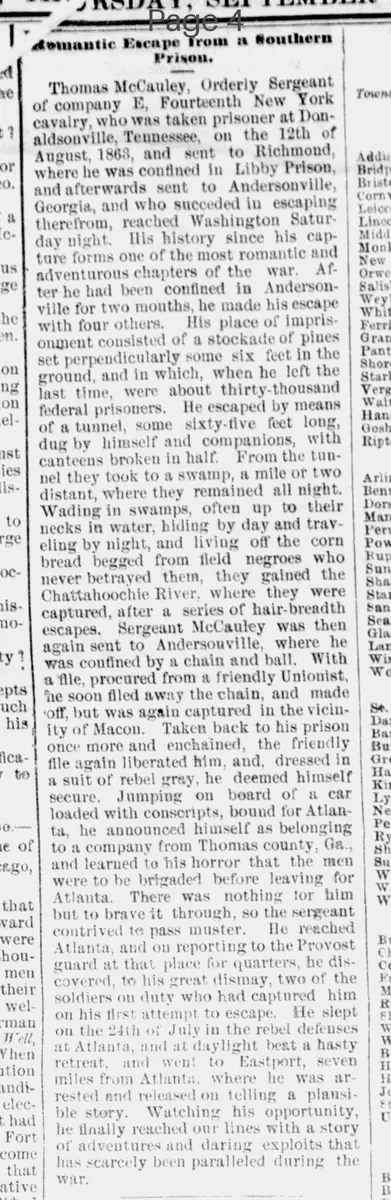
Thomas McCauley, Orderly Sergeant of company E, Fourteenth New York cavalry, who was taken prisoner at Donaldsonville, Tennessee, on the 12th of August, 1864, and sent to Richmond, where he was confined in Libby Prison, and afterwards sent to Andersonville, Georgia, and who succeeded in escaping therefrom, reached Washington Saturday night. His history since his capture forms one of the most romantic and adventurous chapters of the war. After he had been confined in Andersonville for two months, he made his escape with four others. His place of imprisonment consisted of a stockade of pines set perpendicularly some six feet in the ground, and in which, when he left the last time, were about thirty-thousand federal prisoners. He escaped by means of a tunnel, some sixty-five feet long, dug by himself and companions, with canteens broken in half. From the tunnel they took to a swamp, a mile or two distant, where they remained all night. Wading in swamps, often up to their necks in water, hiding by day and traveling by night, and living off the corn bread begged from field negroes who never betrayed them, they gained the Chattahoochee River, where they were captured, after a series of hair-breadth escapes. Sergeant McCauley was then again sent to Andersonville, where he was confined by a chain and ball. With a file, procured from a friendly Unionist, he soon filed away the chain, and made off, but was again captured in the vicinity of Macon. Taken back to his prison once more and enchained, the friendly file again liberated him, and, dressed in a suit of rebel gray, he deemed himself secure. Jumping on board of a car loaded with conscripts, bound for Atlanta, he announced himself as belonging to a company from Thomas county, Ga., and learned to his horror that the men were to be brigaded before leaving for Atlanta. There was nothing for him but to brave it through, so the sergeant contrived to pass muster. He reached Atlanta, and on reporting to the Provost guard at that place for quarters, he discovered, to his great dismay, two of the soldiers on duty who had captured him on his first attempt to escape. He slept on the 24th of July in the rebel defenses at Atlanta, and at daylight beat a hasty retreat, and went to Eastport, seven miles from Atlanta where he was arrested and released on telling a plausible story. Watching his opportunity, he finally reached our lines with a story of adventures and daring exploits that has scarcely been paralleled during the war.
What sub-type of article is it?
What themes does it cover?
What keywords are associated?
What entities or persons were involved?
Where did it happen?
Story Details
Key Persons
Location
Donaldsonville, Tennessee; Richmond, Virginia (Libby Prison); Andersonville, Georgia; Chattahoochee River; Macon, Georgia; Atlanta, Georgia; Eastport, Georgia
Event Date
August 12, 1864
Story Details
Captured in Tennessee, McCauley is imprisoned in Libby and Andersonville prisons. He escapes multiple times: first via tunnel and swamps but recaptured; second by filing chain but recaptured near Macon; third in rebel disguise, passing muster in Atlanta, evading captors, and reaching Union lines.