Thank you for visiting SNEWPapers!
Sign up free
Gazette Of The United States
New York, New York County, New York
What is this article about?
In April 1792, the French National Assembly discussed diplomatic dispatches with Austria amid rising tensions. Minister Dumouriez reported on negotiations, leading to accusations against Ambassador de Noailles. On April 20, the Assembly declared war on the King of Hungary and Bohemia, sanctioned by the King, framing it as defense of liberty.
Clipping
OCR Quality
Full Text
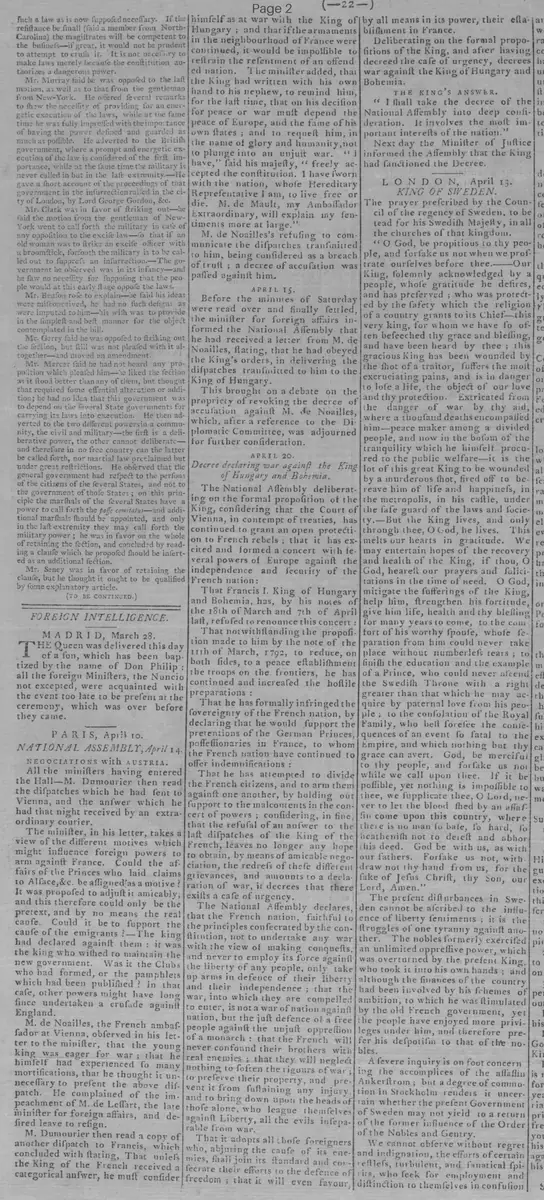
NATIONAL ASSEMBLY, April 14.
NEGOTIATIONS With AUSTRIA.
All the ministers having entered the Hall, M. Dumourier then read the dispatches which he had sent to Vienna, and the answer which he had that night received by an extraordinary courier.
The minister, in his letter, takes a view of the different motives which might influence foreign powers to arm against France. Could the affairs of the Princes who laid claims to Alsace, &c. be assigned as a motive? It was proposed to adjust it amicably, and this therefore could only be the pretext, and by no means the real cause. Could it be to support the cause of the emigrants?—The king had declared against them: it was the king who wished to maintain the new government. Was it the Clubs who had formed, or the pamphlets which had been published? In that case, other powers might have long since undertaken a crusade against England.
M. de Noailles, the French ambassador at Vienna, observed in his letter to the minister, that the young king was eager for war; that he himself had experienced so many mortifications, that he thought it unnecessary to present the above dispatch. He complained of the impeachment of M. de Leart, the late minister for foreign affairs, and desired leave to resign.
M. Dumourier then read a copy of another dispatch to Francis, which concluded with stating, That unless the King of the French received a categorical answer, he must consider himself as at war with the King of Hungary; and that if the armaments in the neighbourhood of France were continued, it would be impossible to restrain the resentment of an offended nation. The minister added, that the King had written with his own hand to his nephew, to remind him, for the last time, that on his decision for peace or war must depend the peace of Europe, and the fame of his own states; and to request him, in the name of glory and humanity, not to plunge into an unjust war. "I have," said his majesty, "freely accepted the constitution. I have sworn with the nation, whose Hereditary Representative I am, to live free or die. M. de Mauld, my Ambassador Extraordinary, will explain my sentiments more at large."
M. de Noailles's refusing to communicate the dispatches transmitted to him, being considered as a breach of trust; a decree of accusation was passed against him.
APRIL 15.
Before the minutes of Saturday were read over and finally settled, the minister for foreign affairs informed the National Assembly that he had received a letter from M. de Noailles, stating, that he had obeyed the King's orders, in delivering the dispatches transmitted to him to the King of Hungary.
This brought on a debate on the propriety of revoking the decree of accusation against M. de Noailles, which, after a reference to the Diplomatic Committee, was adjourned for further consideration.
APRIL 20.
Decree declaring war against the King of Hungary and Bohemia.
The National Assembly, deliberating on the formal proposition of the King, considering that the Court of Vienna, in contempt of treaties, has continued to grant an open protection to French rebels; that it has excited and formed a concert with several powers of Europe against the independence and security of the French nation:
That Francis I. King of Hungary and Bohemia, has, by his notes of the 18th of March and 7th of April last, refused to renounce this concert:
That notwithstanding the proposition made to him by the note of the 11th of March, 1792, to reduce, on both sides, to a peace establishment the troops on the frontiers, he has continued and increased the hostile preparations:
That he has formally infringed the sovereignty of the French nation, by declaring that he would support the pretensions of the German Princes, possessors in France, to whom the French nation have continued to offer indemnifications:
That he has attempted to divide the French citizens, and to arm them against one another, by holding out support to the malcontents in the concert of powers; considering, in fine, that the refusal of an answer to the last dispatches of the King of the French, leaves no longer any hope to obtain, by means of amicable negotiation, the redress of these different grievances, and amounts to a declaration of war, it decrees that there exists a case of urgency.
The National Assembly declares, that the French nation, faithful to the principles consecrated by the constitution, not to undertake any war with the view of making conquests, and never to employ its force against the liberty of any people, only take up arms in defence of their liberty and their independence; that the war, into which they are compelled to enter, is not a war of nation against nation, but the just defence of a free people against the unjust oppression of a monarch: that the French will never confound their brothers with real enemies; that they will neglect nothing to soften the rigours of war; to preserve their property, and prevent it from sustaining any injury, and to bring down upon the heads of those alone, who league themselves against Liberty, all the evils inseparable from war.
That it adopts all those foreigners who, abjuring the cause of its enemies, shall join its standard and consecrate their efforts to the defence of freedom: that it will even favour, by all means in its power, their establishment in France.
Deliberating on the formal propositions of the King, and after having decreed the case of urgency, decrees war against the King of Hungary and Bohemia.
THE KING'S ANSWER.
"I shall take the decree of the National Assembly into deep consideration. It involves the most important interests of the nation."
Next day the Minister of Justice informed the Assembly that the King had sanctioned the Decree.
What sub-type of article is it?
What keywords are associated?
What entities or persons were involved?
Where did it happen?
Foreign News Details
Primary Location
Paris
Event Date
April 10 20, 1792
Key Persons
Outcome
declaration of war against the king of hungary and bohemia; decree of accusation against m. de noailles; king sanctions the war decree.
Event Details
The National Assembly discussed dispatches from Minister Dumouriez to Vienna regarding motives for foreign powers arming against France, including Alsace claims, emigrants, and clubs. Ambassador de Noailles reported the young king's eagerness for war and sought to resign. A dispatch warned of war if no categorical answer; the King personally urged peace. Accusation decreed against de Noailles for breach of trust. On April 15, debate on revoking accusation adjourned. On April 20, Assembly declared war due to Vienna's protection of rebels, refusal to renounce concert with powers, increased preparations, support for German princes, and lack of response, framing it as defensive war for liberty; adopted foreigners joining the cause; King sanctioned the decree.