Thank you for visiting SNEWPapers!
Sign up free
Editorial
March 14, 1833
Lynchburg Virginian
Lynchburg, Virginia
What is this article about?
Lynchburg, Va. editorial on March 14, 1833, argues against secession as a remedy for federal actions, promoting union preservation via constitutional means or rebellion. Critiques figures like Randolph and Tyler amid nullification crisis; notes local anti-secession resolutions and election candidates.
Clipping
OCR Quality
80%
Good
Full Text
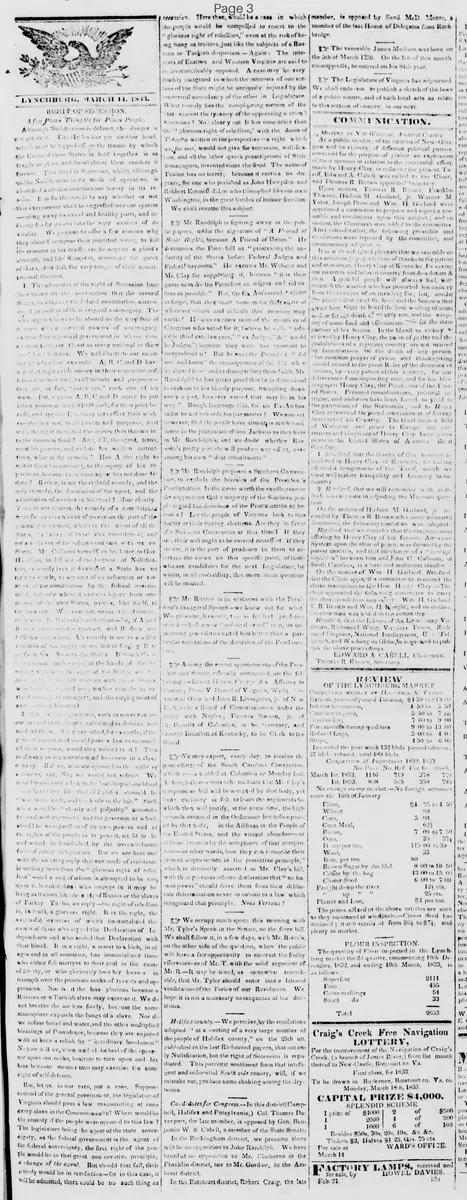
LYNCHBURG, MARCH 14, 1833.
RIGHT OF SECESSION.
A few Plain Thoughts for Plain People.
Although Nullification is defunct, the danger is not yet over. It still has yet another head which must be chopped off, or the tenure by which the Union of these States is held together is as fragile as glass, and the slightest blow sunders it forever. That threat is Secession, which, although unlike Nullification in its mode of operation, is infected with that mischievous heresy in its results. It is for the people to say whether or not this excrescence shall be engrafted into our system, eating away its sound and healthy parts, and finally prostrating the very sources of its vitality. We propose to offer a few reasons why they should interpose their potential voice, to kill the monster in his cradle, ere he acquire a giant's strength, and like Samson, unrooting the gates of Gaza, pull down the very temple of their constitutional liberties.
1. The advocates of the right of Secession base their theory on the assumption that the several States, in adopting the Federal constitution, surrendered no portion of their original sovereignty. The idea appears to us to be absurd on the very face of it. Such a [theory assumes no ] surrender of several powers of sovereignty exercised by a general government in whose constitution there exists as many national ones as there are States. We will illustrate our meaning by example. A, B, C and D have a right to the money in their respective coffers - it is their own, to all intents and purposes - they are, in full, sovereigns. Each one owns. Into a common stock, A, B, C and D agree to put some each, for their joint benefit, and appoint C agent to effect their wishes - do they not, to all intents and purposes, part with the right each had to the money thus thrown into the common fund? And, if C, the agent, transcends his powers, and acts contrary to his written instructions, what is the remedy? Has A the right to secede from his contract, to the injury of his co-partners? Because their joint agent has not done his duty? Rather, is not the rightful remedy, and the only remedy, the dismission of the agent, and the substitution of another in his stead? Most clearly. So, in our system, the remedy of a complaining State against oppression of power on the part of the general government, which is the agent of all the States, one of those which constitute it, and not an alien or sovereign contracting with us States. Mr. Calhoun himself, in his letter to Gov. Hamilton, in defence of the Doctrine of Nullification, expressly lays it down that a State has no right to secede, on ground of an infraction or violation of the constitution by the federal government, but only where it sustains injury from one or more of the other States, parties, like itself, to the compact. However, [he] opposes the doctrine. Even Virginia's restriction - for if A and B enter into contract, and B does not fulfill his, A's remedy is not in a wilful violation of his engagements, but in forcing B to perform his. So with the States. If she complains of the tenure of the States, she will form compact with other States who have [similar complaints], ardently her remedy is in the dismissal of the agent, and the employment of another in his stead.
2. Moreover, such nonsense as is entered on occur, are put to the people calculated to deceive and mislead them. They are asked, for example, if the general government should pass a law to manumit all their negroes, would they submit to it? This is always an argumentum ad hominem in a slave country. But we, who are opposed to the right of secession, say, No; we would not submit. We would resist such a law to the last drop of our blood - the battle cry, like that of Palafox, should be 'war to the knife, and the knife to the hilt.' Such a law would be 'clearly and palpably' unconstitutional and oppressive, and the government which should be so regardless of its own powers and of the rights of the people as to pass it, ought to be, and would be demolished, by the overwhelming force of public indignation. But we are here met with the sneering reply that our mode of resistance is nothing more than the 'glorious right of rebellion' - and a sort of odium is attempted to be cast upon it because those who engage in it may be hung as traitors, like the serfs of Russia or the slaves of Turkey. To this we reply - the right of rebellion is, in truth, a glorious right. It is the right, the successful exercise of which immortalized the names of those who signed the Declaration of Independence and who sealed that Declaration with their blood. It is a right, a resort to which, in all ages and in all countries, has immortalized those who either fell martyrs to their zeal in the cause of liberty, or who gloriously bore her banner in triumph over the prostrate necks of tyrants and oppressors. Nor is it the less glorious because a Russian or a Turkish slave may exercise it. We do not breathe the air less freely, because the same atmosphere expands the lungs of a slave. Nor do we refuse bread and water, and the other multiplied blessings of Providence, because they are enjoyed with as keen a relish by 'hereditary bondsmen.' Neither will we, when we feel the heel of the oppressor upon our necks, hesitate to turn upon and lay him low, because meaner men may exercise the same right of self-defence.
But, let us, in our turn, put a case. Suppose instead of the general government, the legislature of Virginia should pass a law manumitting at once every slave in the Commonwealth? Where would be the remedy if the people were opposed to this law? The legislature being the agent of the state sovereignty, as the federal government is the agent of the federal sovereignty, the first right of the people would be in that great conservative principle, a change of the agent. But should that fail, their remedy would lie in revolution - for in this case, it will be admitted, there could be no such thing as secession. Here then, would be a case in which the people would be compelled to resort to the 'glorious right of rebellion,' even at the risk of being hung as traitors, just like the subjects of a Russian or Turkish despotism. Again: The interests of Eastern and Western Virginia are said to be irreconcilably opposed. A case may be very readily imagined in which the interests of one section of the State might be seriously injured by the numerical ascendancy of the other in Legislature. What remedy has the complaining section of the State against the tyranny of the oppressing section? Secession? No: clearly not. It has none other than the 'glorious right of rebellion,' with the doom of treason written in the perspective - a right which we, for one, would not give for secession, nullification, and all the other quack prescriptions of State demagogues, invented since the flood. The name of Traitor has no terror, because it carries no disgrace, for one who perished as John Hampden and Robert Emmett did, or who triumphed like our own Washington, in the great battles of human freedom.
We shall resume this subject.
Mr. Randolph is figuring away in the public papers, under the signature of 'A Friend of State Rights, because A Friend of Union.' He denounces the Force bill as 'prostrating the authority of the States before Federal Judges and Federal bayonets.' He excuses Mr. Webster and Mr. Clay for supporting it, because 'it is their game to make the President as odious and ridiculous as possible.' But, the Ex-Ambassador 'seems to forget, that they must come in for their share of whatever odium and ridicule this measure may excite!' He also excuses most of the members of Congress who voted for it, (whom he calls 'tolerable third rate lawyers,' 'ex-Judges' & 'would be Judges') because they were too ignorant to comprehend it! But he pays the President 'did see and know' the consequences of the bill when he signed it - 'and in disregarding them (adds Mr. Randolph) he has given proof that he is determined to rush on to his bloody purpose, trampling down every object, however sacred that may lie in his way.' Rough language thus, for an Ex-Ambassador to use towards his paymaster! We suspect, however, that the people have almost as much confidence in the patriotism of Gen. Jackson as they have in Mr. Randolph's, and we doubt whether Roanoke's pretty periods will produce any effect, save among his own 'dear constituents.'
Mr. Randolph proposes a Southern Convention, to explode the heresies of the President's Proclamation. Is the game worth the candle, even on the supposition that a majority of the Southern people regard the doctrines of the Proclamation as heretical? Let the people of Virginia look to this matter at their Spring elections. Are they in favor of a Southern Convention at this time? If they are, their will ought to be carried into effect. If they are not, it is the part of prudence in them to ascertain the views, on this specific point, of those who are candidates for the next Legislature, by whom, in all probability, this momentous question will be mooted.
Mr. Ritchie is in ecstasies with the President's inaugural Speech - we knew not for what. We presume, however, that as he has predetermined to find an 'able and patriotic' in it, its unmeaning generalities suit him better than a particular reiteration of the doctrines of the Proclamation.
Among the recent appointments of the President and Senate officially announced, are the following: - Levett Harris, Charge d'Affaires to Russia. Price V. Daniel of Virginia, William Iman of Ohio and John R. Livingston, jr. of New York, to be a Board of Commissioners under the treaty with Naples; Thomas Swann, jr. of the District of Columbia, to be secretary, and George Breathitt, of Kentucky, to be Clerk to the Board.
We may expect, every day, to receive the proceedings of the South Carolina Convention which re-assembled at Columbia on Monday last. Although there seems to be no doubt that Mr. Clay's compromise bill will be accepted by that body, yet curiosity is felt to learn the arguments by which they will justify, at the same time, the high grounds assumed in the Ordinance heretofore passed by that body, in the Address to the People of the United States, and the virtual abandonment of those grounds by the acceptance of that compromise - in other words, how they can reconcile their present acquiescence in the protective principle, which is distinctly asserted in Mr. Clay's bill, with their previous solemn declaration that 'no human power' should drive them from their deliberate determination never to submit to a law which recognized that principle. Vnus Veedrum!
We occupy much space this morning with Mr. Tyler's Speech in the Senate, on the force bill. We shall follow it, in a few days, with Mr. Rives's on the other side of the question, when the public will have a fair opportunity to contrast the frothy effervescence of Mr. T. with the solid argument of Mr. R. - It may be noted, as somewhat remarkable, that Mr. Tyler should enter into a labored vindication of the Tories of our Revolution. We hope it is not a necessary consequence of his doctrines.
Halifax county. - We perceive, by the resolutions adopted 'at a meeting of a very large number of the people of Halifax county,' on the 25th ult., published in the last Richmond papers, that not only Nullification, but the right of Secession is repudiated. This patriotic sentiment from that intelligent and influential South side county, will, if we mistake not, produce some shaking among the dry-bones.
Candidates for Congress. - In this district (Campbell, Halifax and Pittsylvania,) Col. Thomas Davenport, the late member, is opposed by Gen. Benjamin W. S. Cabell, a member of the State Senate. In the Buckingham district, we presume there will be no opposition to John Randolph. We have heard of no opposition to Mr. Claiborne in the Franklin district, nor to Mr. Gordon, in the Amherst district. In the Botetourt district, Robert Craig, the late member, is opposed by Saml. McD. Moore, a member of the last House of Delegates. Com. Rockbridge.
RIGHT OF SECESSION.
A few Plain Thoughts for Plain People.
Although Nullification is defunct, the danger is not yet over. It still has yet another head which must be chopped off, or the tenure by which the Union of these States is held together is as fragile as glass, and the slightest blow sunders it forever. That threat is Secession, which, although unlike Nullification in its mode of operation, is infected with that mischievous heresy in its results. It is for the people to say whether or not this excrescence shall be engrafted into our system, eating away its sound and healthy parts, and finally prostrating the very sources of its vitality. We propose to offer a few reasons why they should interpose their potential voice, to kill the monster in his cradle, ere he acquire a giant's strength, and like Samson, unrooting the gates of Gaza, pull down the very temple of their constitutional liberties.
1. The advocates of the right of Secession base their theory on the assumption that the several States, in adopting the Federal constitution, surrendered no portion of their original sovereignty. The idea appears to us to be absurd on the very face of it. Such a [theory assumes no ] surrender of several powers of sovereignty exercised by a general government in whose constitution there exists as many national ones as there are States. We will illustrate our meaning by example. A, B, C and D have a right to the money in their respective coffers - it is their own, to all intents and purposes - they are, in full, sovereigns. Each one owns. Into a common stock, A, B, C and D agree to put some each, for their joint benefit, and appoint C agent to effect their wishes - do they not, to all intents and purposes, part with the right each had to the money thus thrown into the common fund? And, if C, the agent, transcends his powers, and acts contrary to his written instructions, what is the remedy? Has A the right to secede from his contract, to the injury of his co-partners? Because their joint agent has not done his duty? Rather, is not the rightful remedy, and the only remedy, the dismission of the agent, and the substitution of another in his stead? Most clearly. So, in our system, the remedy of a complaining State against oppression of power on the part of the general government, which is the agent of all the States, one of those which constitute it, and not an alien or sovereign contracting with us States. Mr. Calhoun himself, in his letter to Gov. Hamilton, in defence of the Doctrine of Nullification, expressly lays it down that a State has no right to secede, on ground of an infraction or violation of the constitution by the federal government, but only where it sustains injury from one or more of the other States, parties, like itself, to the compact. However, [he] opposes the doctrine. Even Virginia's restriction - for if A and B enter into contract, and B does not fulfill his, A's remedy is not in a wilful violation of his engagements, but in forcing B to perform his. So with the States. If she complains of the tenure of the States, she will form compact with other States who have [similar complaints], ardently her remedy is in the dismissal of the agent, and the employment of another in his stead.
2. Moreover, such nonsense as is entered on occur, are put to the people calculated to deceive and mislead them. They are asked, for example, if the general government should pass a law to manumit all their negroes, would they submit to it? This is always an argumentum ad hominem in a slave country. But we, who are opposed to the right of secession, say, No; we would not submit. We would resist such a law to the last drop of our blood - the battle cry, like that of Palafox, should be 'war to the knife, and the knife to the hilt.' Such a law would be 'clearly and palpably' unconstitutional and oppressive, and the government which should be so regardless of its own powers and of the rights of the people as to pass it, ought to be, and would be demolished, by the overwhelming force of public indignation. But we are here met with the sneering reply that our mode of resistance is nothing more than the 'glorious right of rebellion' - and a sort of odium is attempted to be cast upon it because those who engage in it may be hung as traitors, like the serfs of Russia or the slaves of Turkey. To this we reply - the right of rebellion is, in truth, a glorious right. It is the right, the successful exercise of which immortalized the names of those who signed the Declaration of Independence and who sealed that Declaration with their blood. It is a right, a resort to which, in all ages and in all countries, has immortalized those who either fell martyrs to their zeal in the cause of liberty, or who gloriously bore her banner in triumph over the prostrate necks of tyrants and oppressors. Nor is it the less glorious because a Russian or a Turkish slave may exercise it. We do not breathe the air less freely, because the same atmosphere expands the lungs of a slave. Nor do we refuse bread and water, and the other multiplied blessings of Providence, because they are enjoyed with as keen a relish by 'hereditary bondsmen.' Neither will we, when we feel the heel of the oppressor upon our necks, hesitate to turn upon and lay him low, because meaner men may exercise the same right of self-defence.
But, let us, in our turn, put a case. Suppose instead of the general government, the legislature of Virginia should pass a law manumitting at once every slave in the Commonwealth? Where would be the remedy if the people were opposed to this law? The legislature being the agent of the state sovereignty, as the federal government is the agent of the federal sovereignty, the first right of the people would be in that great conservative principle, a change of the agent. But should that fail, their remedy would lie in revolution - for in this case, it will be admitted, there could be no such thing as secession. Here then, would be a case in which the people would be compelled to resort to the 'glorious right of rebellion,' even at the risk of being hung as traitors, just like the subjects of a Russian or Turkish despotism. Again: The interests of Eastern and Western Virginia are said to be irreconcilably opposed. A case may be very readily imagined in which the interests of one section of the State might be seriously injured by the numerical ascendancy of the other in Legislature. What remedy has the complaining section of the State against the tyranny of the oppressing section? Secession? No: clearly not. It has none other than the 'glorious right of rebellion,' with the doom of treason written in the perspective - a right which we, for one, would not give for secession, nullification, and all the other quack prescriptions of State demagogues, invented since the flood. The name of Traitor has no terror, because it carries no disgrace, for one who perished as John Hampden and Robert Emmett did, or who triumphed like our own Washington, in the great battles of human freedom.
We shall resume this subject.
Mr. Randolph is figuring away in the public papers, under the signature of 'A Friend of State Rights, because A Friend of Union.' He denounces the Force bill as 'prostrating the authority of the States before Federal Judges and Federal bayonets.' He excuses Mr. Webster and Mr. Clay for supporting it, because 'it is their game to make the President as odious and ridiculous as possible.' But, the Ex-Ambassador 'seems to forget, that they must come in for their share of whatever odium and ridicule this measure may excite!' He also excuses most of the members of Congress who voted for it, (whom he calls 'tolerable third rate lawyers,' 'ex-Judges' & 'would be Judges') because they were too ignorant to comprehend it! But he pays the President 'did see and know' the consequences of the bill when he signed it - 'and in disregarding them (adds Mr. Randolph) he has given proof that he is determined to rush on to his bloody purpose, trampling down every object, however sacred that may lie in his way.' Rough language thus, for an Ex-Ambassador to use towards his paymaster! We suspect, however, that the people have almost as much confidence in the patriotism of Gen. Jackson as they have in Mr. Randolph's, and we doubt whether Roanoke's pretty periods will produce any effect, save among his own 'dear constituents.'
Mr. Randolph proposes a Southern Convention, to explode the heresies of the President's Proclamation. Is the game worth the candle, even on the supposition that a majority of the Southern people regard the doctrines of the Proclamation as heretical? Let the people of Virginia look to this matter at their Spring elections. Are they in favor of a Southern Convention at this time? If they are, their will ought to be carried into effect. If they are not, it is the part of prudence in them to ascertain the views, on this specific point, of those who are candidates for the next Legislature, by whom, in all probability, this momentous question will be mooted.
Mr. Ritchie is in ecstasies with the President's inaugural Speech - we knew not for what. We presume, however, that as he has predetermined to find an 'able and patriotic' in it, its unmeaning generalities suit him better than a particular reiteration of the doctrines of the Proclamation.
Among the recent appointments of the President and Senate officially announced, are the following: - Levett Harris, Charge d'Affaires to Russia. Price V. Daniel of Virginia, William Iman of Ohio and John R. Livingston, jr. of New York, to be a Board of Commissioners under the treaty with Naples; Thomas Swann, jr. of the District of Columbia, to be secretary, and George Breathitt, of Kentucky, to be Clerk to the Board.
We may expect, every day, to receive the proceedings of the South Carolina Convention which re-assembled at Columbia on Monday last. Although there seems to be no doubt that Mr. Clay's compromise bill will be accepted by that body, yet curiosity is felt to learn the arguments by which they will justify, at the same time, the high grounds assumed in the Ordinance heretofore passed by that body, in the Address to the People of the United States, and the virtual abandonment of those grounds by the acceptance of that compromise - in other words, how they can reconcile their present acquiescence in the protective principle, which is distinctly asserted in Mr. Clay's bill, with their previous solemn declaration that 'no human power' should drive them from their deliberate determination never to submit to a law which recognized that principle. Vnus Veedrum!
We occupy much space this morning with Mr. Tyler's Speech in the Senate, on the force bill. We shall follow it, in a few days, with Mr. Rives's on the other side of the question, when the public will have a fair opportunity to contrast the frothy effervescence of Mr. T. with the solid argument of Mr. R. - It may be noted, as somewhat remarkable, that Mr. Tyler should enter into a labored vindication of the Tories of our Revolution. We hope it is not a necessary consequence of his doctrines.
Halifax county. - We perceive, by the resolutions adopted 'at a meeting of a very large number of the people of Halifax county,' on the 25th ult., published in the last Richmond papers, that not only Nullification, but the right of Secession is repudiated. This patriotic sentiment from that intelligent and influential South side county, will, if we mistake not, produce some shaking among the dry-bones.
Candidates for Congress. - In this district (Campbell, Halifax and Pittsylvania,) Col. Thomas Davenport, the late member, is opposed by Gen. Benjamin W. S. Cabell, a member of the State Senate. In the Buckingham district, we presume there will be no opposition to John Randolph. We have heard of no opposition to Mr. Claiborne in the Franklin district, nor to Mr. Gordon, in the Amherst district. In the Botetourt district, Robert Craig, the late member, is opposed by Saml. McD. Moore, a member of the last House of Delegates. Com. Rockbridge.
What sub-type of article is it?
Constitutional
Partisan Politics
Economic Policy
What keywords are associated?
Secession
Nullification
Union
Force Bill
Southern Convention
Tariff Compromise
Constitutional Sovereignty
Rebellion
State Rights
What entities or persons were involved?
John C. Calhoun
Andrew Jackson
John Randolph
Thomas Ritchie
John Tyler
William Rives
Henry Clay
South Carolina Convention
Editorial Details
Primary Topic
Opposition To The Right Of Secession
Stance / Tone
Strongly Pro Union, Anti Secession And Nullification
Key Figures
John C. Calhoun
Andrew Jackson
John Randolph
Thomas Ritchie
John Tyler
William Rives
Henry Clay
South Carolina Convention
Key Arguments
States Surrendered Portions Of Sovereignty Upon Adopting The Federal Constitution
Remedy For Federal Overreach Is Dismissal Of The Agent (Government) Or Rebellion, Not Secession
Calhoun Opposed Secession Even While Defending Nullification
Resistance To Unconstitutional Laws Like Forced Manumission Would Be Through Armed Rebellion
Secession Would Undermine The Union Like A Virus
Critique Of Randolph's Attacks On The Force Bill And Call For Southern Convention
Support For Testing Views On Southern Convention In Virginia Elections
Acceptance Of Clay's Compromise By South Carolina Contradicts Prior Declarations
Contrast Between Tyler's And Rives's Speeches On The Force Bill
Halifax County Resolutions Repudiate Nullification And Secession