Thank you for visiting SNEWPapers!
Sign up free
Story
September 23, 1956
Atlanta Daily World
Atlanta, Fulton County, Georgia
What is this article about?
Dr. Lamont Henry, past president of the Georgia Heart Association, reports gains in the 'Stop Rheumatic Fever' program and calls for continued educational efforts to prevent the disease via streptococcal infection treatment in Georgia.
Clipping
OCR Quality
98%
Excellent
Full Text
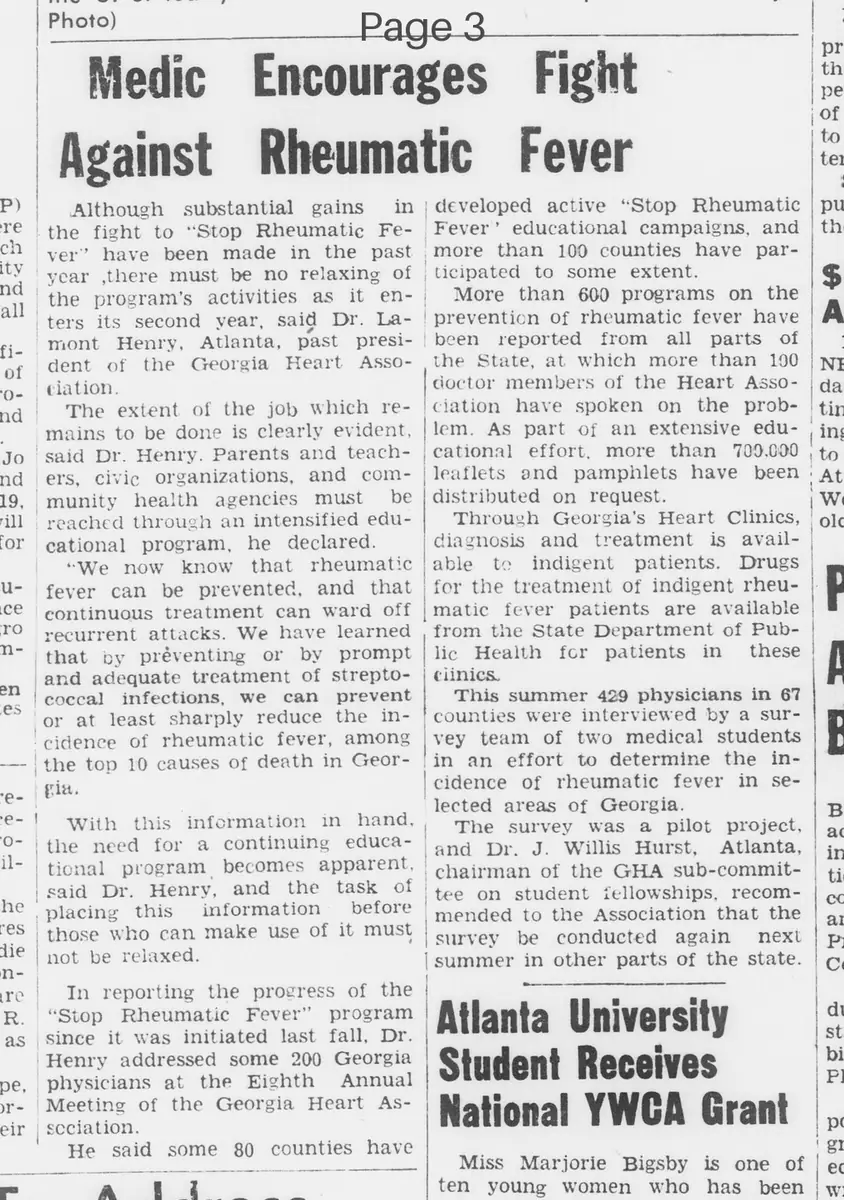
Medic Encourages Fight Against Rheumatic Fever
Although substantial gains in the fight to "Stop Rheumatic Fever" have been made in the past year, there must be no relaxing of the program's activities as it enters its second year, said Dr. Lamont Henry, Atlanta, past president of the Georgia Heart Association.
The extent of the job which remains to be done is clearly evident, said Dr. Henry. Parents and teachers, civic organizations, and community health agencies must be reached through an intensified educational program, he declared.
"We now know that rheumatic fever can be prevented, and that continuous treatment can ward off recurrent attacks. We have learned that by preventing or by prompt and adequate treatment of streptococcal infections, we can prevent or at least sharply reduce the incidence of rheumatic fever, among the top 10 causes of death in Georgia."
With this information in hand, the need for a continuing educational program becomes apparent, said Dr. Henry, and the task of placing this information before those who can make use of it must not be relaxed.
In reporting the progress of the "Stop Rheumatic Fever" program since it was initiated last fall, Dr. Henry addressed some 200 Georgia physicians at the Eighth Annual Meeting of the Georgia Heart Association.
He said some 80 counties have developed active "Stop Rheumatic Fever" educational campaigns, and more than 100 counties have participated to some extent.
More than 600 programs on the prevention of rheumatic fever have been reported from all parts of the State, at which more than 100 doctor members of the Heart Association have spoken on the problem. As part of an extensive educational effort, more than 700,000 leaflets and pamphlets have been distributed on request.
Through Georgia's Heart Clinics, diagnosis and treatment is available to indigent patients. Drugs for the treatment of indigent rheumatic fever patients are available from the State Department of Public Health for patients in these clinics.
This summer 429 physicians in 67 counties were interviewed by a survey team of two medical students in an effort to determine the incidence of rheumatic fever in selected areas of Georgia.
The survey was a pilot project, and Dr. J. Willis Hurst, Atlanta, chairman of the GHA sub-committee on student fellowships, recommended to the Association that the survey be conducted again next summer in other parts of the state.
Although substantial gains in the fight to "Stop Rheumatic Fever" have been made in the past year, there must be no relaxing of the program's activities as it enters its second year, said Dr. Lamont Henry, Atlanta, past president of the Georgia Heart Association.
The extent of the job which remains to be done is clearly evident, said Dr. Henry. Parents and teachers, civic organizations, and community health agencies must be reached through an intensified educational program, he declared.
"We now know that rheumatic fever can be prevented, and that continuous treatment can ward off recurrent attacks. We have learned that by preventing or by prompt and adequate treatment of streptococcal infections, we can prevent or at least sharply reduce the incidence of rheumatic fever, among the top 10 causes of death in Georgia."
With this information in hand, the need for a continuing educational program becomes apparent, said Dr. Henry, and the task of placing this information before those who can make use of it must not be relaxed.
In reporting the progress of the "Stop Rheumatic Fever" program since it was initiated last fall, Dr. Henry addressed some 200 Georgia physicians at the Eighth Annual Meeting of the Georgia Heart Association.
He said some 80 counties have developed active "Stop Rheumatic Fever" educational campaigns, and more than 100 counties have participated to some extent.
More than 600 programs on the prevention of rheumatic fever have been reported from all parts of the State, at which more than 100 doctor members of the Heart Association have spoken on the problem. As part of an extensive educational effort, more than 700,000 leaflets and pamphlets have been distributed on request.
Through Georgia's Heart Clinics, diagnosis and treatment is available to indigent patients. Drugs for the treatment of indigent rheumatic fever patients are available from the State Department of Public Health for patients in these clinics.
This summer 429 physicians in 67 counties were interviewed by a survey team of two medical students in an effort to determine the incidence of rheumatic fever in selected areas of Georgia.
The survey was a pilot project, and Dr. J. Willis Hurst, Atlanta, chairman of the GHA sub-committee on student fellowships, recommended to the Association that the survey be conducted again next summer in other parts of the state.
What sub-type of article is it?
Historical Event
Medical Curiosity
What themes does it cover?
Recovery
Moral Virtue
What keywords are associated?
Rheumatic Fever
Prevention
Educational Campaign
Georgia Heart Association
Streptococcal Infections
What entities or persons were involved?
Dr. Lamont Henry
Dr. J. Willis Hurst
Where did it happen?
Georgia
Story Details
Key Persons
Dr. Lamont Henry
Dr. J. Willis Hurst
Location
Georgia
Story Details
Dr. Lamont Henry reports progress in the 'Stop Rheumatic Fever' program initiated last fall, urging intensified education to prevent rheumatic fever through treatment of streptococcal infections; highlights campaigns in counties, distribution of materials, clinic services, and a pilot survey.