Thank you for visiting SNEWPapers!
Sign up free
Letter to Editor
April 28, 1804
Virginia Argus
Richmond, Virginia
What is this article about?
L. McLean describes a 1804 medical case of R. Wood's arm injury from gunshot, leading to mortification and delayed shoulder amputation, quoting Bell's Surgery on timing. He defends his treatment using Peruvian bark and criticizes Dr. Morrison's practices in this and other cases, with endorsements from Drs. Logan and Rawlings on fever treatments in Albemarle, Virginia.
Clipping
OCR Quality
95%
Excellent
Full Text
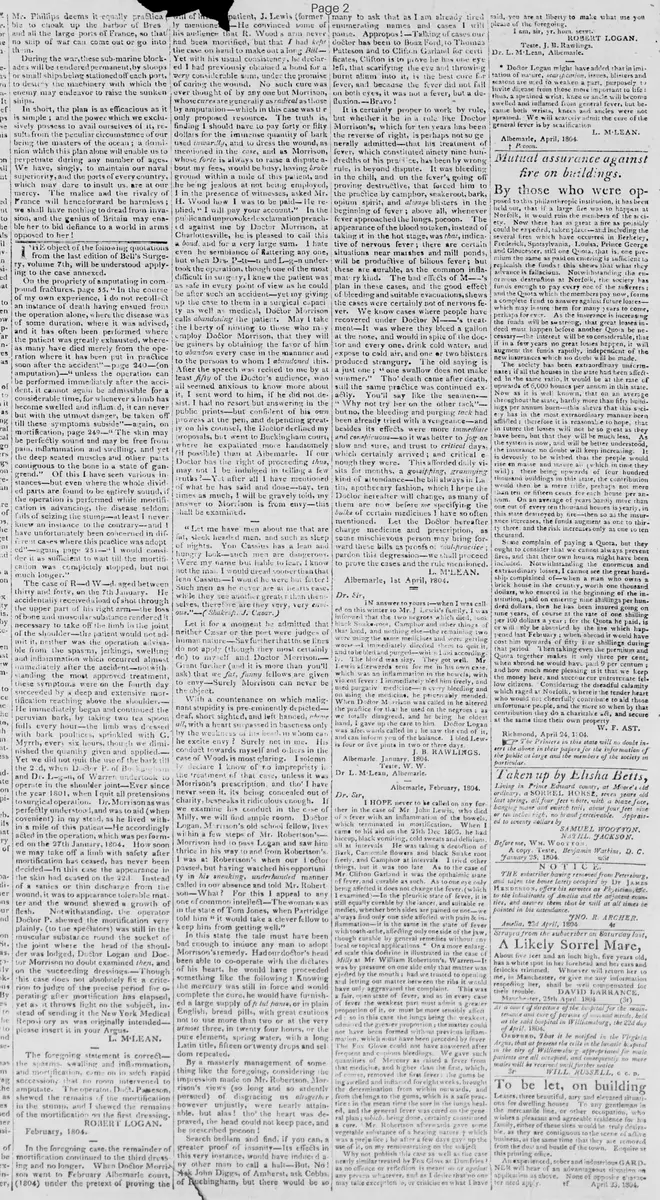
The object of the following quotations from the last edition of Bell's Surgery, volume 7th, will be understood applying to the case annexed.
On the propriety of amputating in compound fractures, page 55, "In the course of my own experience, I do not recollect an instance of death having ensued from the operation alone, where the disease was of some duration, where it was advised, and it has often been performed where the patient was greatly exhausted, whereas many have died merely from the operation where it has been put in practice soon after the accident"-page 240-(on amputation)-"unless the operation can be performed immediately after the accident, it cannot again be admissible for a considerable time, for whenever a limb has become swelled and inflamed, it can never but with the utmost danger, be taken off till these symptoms subside" -again, on mortification, page 249-" The skin may be perfectly sound and may be free from pain, inflammation and swelling, and yet the deep seated muscles and other parts contiguous to the bone in a state of gangrene." Of this I have seen various instances--but even where the whole divided parts are found to be entirely sound, if the operation is performed while mortification is advancing, the disease seldom fails of seizing the stump--at least I never knew an instance to the contrary--and I have unfortunately been concerned in different cases where this practice was adopted"-again, page 251--"I would consider it as sufficient to wait till the mortification was completely stopped, but not much longer."
The case of R--d W--d, aged between thirty and forty, on the 7th January. He accidentally received a load of shot through the upper part of his right arm--the loss of bone and muscular substance rendered it necessary to take off the limb in the joint of the shoulder--the patient would not admit it, neither was the operation advisable from the spasms, jerkings, swelling and inflammation which occurred almost immediately after the accident--notwithstanding the most approved treatment, these symptoms were on the fourth day succeeded by a deep and extensive mortification reaching above the shoulder.-- He immediately began and continued the Peruvian bark, by taking two tea spoon fulls every hour--the limb was dressed with bark poultices, sprinkled with G. Myrrh, every six hours, though we diminished the quantity given and applied.-- Yet we did not quit the use of the bark till the 2d, when Doctor P. of Buckingham and Dr. L--g--n, of Warren undertook to operate in the shoulder joint--Ever since the year 1801, when I quit all pretensions to surgical operation, Dr. Morrison as was perfectly understood, and was to aid (when convenient) in my stead, as he lived within a mile of this patient--He accordingly acted in the operation, which was performed on the 27th January, 1804. How soon we may take off a limb with safety after mortification has ceased, has never been decided. In this case the appearance in the skin had ceased on the 22d. Instead of a sanies or thin discharge from the wound, it was to appearance tolerable matter and the wound shewed a growth of flesh. Notwithstanding, the operator Doctor P. shewed the mortification very plainly, (to the spectators) was still in the muscular substance round the socket of the joint where the head of the shoulder was lodged, Doctor Logan and Doctor Morrison no doubt examined then, and on the succeeding dressings.--Though this case does not absolutely fix a criterion to judge of the precise period for operating after mortification has elapsed, yet as it throws light on the subject, instead of sending it to the New York Medical Repository as was originally intended-- please insert it in your Argus.
L. McLEAN.
The foregoing statement is correct-- the spasms, swelling and inflammation, and mortification, came on in such rapid succession; that no room intervened to amputate. The operator, Doct. P. showed the remains of the mortification in the stump, and I shewed the remains of the mortification on the first dressing:
ROBERT LOGAN.
February, 1804.
In the foregoing case, the remainder of mortification continued to the third dressing and no longer. When Doctor Morrison went to February Albemarle court, (1804) under the pretext of proving the patient, J. Lewis (formerly mentioned)--He convinced some of his audience that R. Wood's arm never had been mortified, but that I had kept the case on hand to make out a long Bill-- Yet with his usual consistency, he declared I had previously obtained a bond for a very considerable sum, under the promise of curing the wound. No such cure was ever thought of by any one but Morrison, whose cures are generally as radical as those by amputation--which in this case was the only proposed resource. The truth is, finding I should have to pay forty or fifty dollars for the immense quantity of bark used inwardly, and to dress the wound, as mentioned in the case, and as Morrison, whose forte is always to raise a dispute about my fees, would be busy, having broke ground within a mile of this patient, and he being jealous at not being employed, I in the presence of witnesses, asked Mr. H. Wood how I was to be paid-- He replied, "I will pay your account." In the public and unprovoked exclamation preached against me by Doctor Morrison, at Charlottesville, he is pleased to call this a bond, and for a very large sum. I hate even the semblance of flattering any one, but when Drs. P--t--n and L--g--n undertook the operation, though one of the most difficult in surgery, I knew the patient was as safe in every point of view as he could be after such an accident--yet my giving up the case to them in a surgical capacity as well as medical, Doctor Morrison calls abandoning the patient. May I take the liberty of hinting to those who may employ Doctor Morrison, that they will be gainers by obtaining the favor of him to abandon every case in the manner and to the persons to whom I abandoned this. After the speech was recited to me by at least fifty of the Doctor's audience, who all seemed anxious to know more about it, I sent word to him, if he did not desist, I had no resort but answering in the public prints--but confident of his own prowess at the pen, and depending greatly on his counsel, the Doctor declined my proposals, but went to Buckingham court, where he expatiated more handsomely (if possible) than at Albemarle. If our Doctor has the right of proceeding thus, may not I be indulged in telling a few truths?--Yet after all I have mentioned of what he has said and done--nay, ten times as much, I will be gravely told, my answer to Morrison is from envy--this shall be examined.
" Let me have men about me that are fat, sleek headed men, and such as sleep of nights. Yon Cassius has a lean and hungry look--such men are dangerous. Were my name but liable to fear, I know not the man. I would dread sooner than that lean Cassius--I would he were but fatter ! Such men as he never are at hearts ease, while they see another greater than themselves, therefore are they very, very envious."~-(Shakesp. J. Caesar.)
Let it for a moment be admitted that neither Caesar or the poet were judges of human nature--Say further that these lines do not apply (though they most certainly do) to myself and Doctor Morrison.--Grant further (and it is more than you'll ask) that we fat, funny fellows are given to envy--Surely Morrison can never be the object.
With a countenance on which malignant stupidity is pre-eminently depicted-- deaf, short sighted, and left handed, above all, with a heart surpassed in baseness only by the weakness of his head, in whom can he excite envy ? Surely not in me. His conduct towards myself and others in the case of Wood, is most glaring: I solemnly declare I know of no impropriety in the treatment of that case, unless it was Morrison's prescription, and tho' I have never seen it, its being concealed out of charity, bespeaks it ridiculous enough. If we examine his conduct in the case of Milly, we will find ample room. Doctor Logan, Morrison's old school fellow, lives within a few steps of Mr. Robertson's-- Morrison had to pass Logan and saw him thrice in his way to and from Robertson's. I was at Robertson's when our Doctor passed, but having watched his opportunity in his sneaking, underhanded manner called in our absence and told Mr. Robertson--What? For this I appeal to any one of common intellect--The woman was in the state of Tom Jones, when Partridge told him "it would take a clever fellow to keep him from getting well." In this state the tale must have been bad enough to induce any man to adopt Morrison's remedy. Had our doctor's head been able to co-operate with the dictates of his heart, he would have proceeded something like the following : Knowing the mercury was still in force and would complete the cure, he would have furnished a large supply of nux vomica, or in plain English, bread pills, with great cautions not to use more than two or at the very utmost three, in twenty four hours, or the pure element, spring water, with a long Latin title, fifteen or twenty drops and seldom repeated.
By a masterly management of some thing like the foregoing, considering the impression made on Mr. Robertson, Morrison's views (so long and so ardently pursued) of disgracing us altogether however unjustly, were nearly attainable, but alas! tho' the heart was depraved, the head could not keep pace, and he prescribed pocoon ! Search bedlam and find, if you can, a greater proof of insanity--Its effects in this very instance, would have induced any other man to call a halt--But, No! Ask John Diggs, of Amherst, ask Cobbs, of Buckingham, but there would be so many to ask that as I am already tired enumerating names and cases I will pause. Appropos!--Talking of cases our doctor has been to Boaz Ford, to Thomas Patteson and to Clifton Garland for certificates, Clifton is to prove he has one eye left, that scarifying the eye and throwing burnt alum into it, is the best cure for fever, and because the fever did not fall on both eyes, it was not a fever, but a defluxion.--Bravo!
It is certainly proper to work by rule, but whether it be in a rule like Doctor Morrison's, which for ten years has been the reverse of right, is perhaps not so generally admitted--that his treatment of fever, which constituted ninety nine hundredths of his practice, has been by wrong rule, is beyond dispute. It was bleeding in the chill, and on the fever's going off proving destructive, that forced him to the practice by camphor, snakeroot, bark, opium spirit, and always blisters in the beginning of fever; above all, whenever fever approached the lungs, pocoon. The appearance of the blood so taken, instead of taking it in the hot stage, was that, indicative of nervous fever; there are certain situations near marshes and mill ponds, will be productive of bilious fever: but these are curable, as the common inflammatory kind. The bad effects of M--.'s plan in these cases, and the good effect of bleeding and suitable evacuations, shews the cases were certainly not of nervous fever. We know cases where people have recovered under Doctor M--.'s treatment--It was where they bled a gallon at the nose, and would in spite of the doctor and every one, drink cold water, and expose to cold air, and one or two blisters produced strangury. The old saying is a just one; "one swallow does not make summer." Tho' death came after death, still the same practice was continued exactly. You'll say like the seamen-- " Why not try her on the other tack"--. but no, the bleeding and purging tack had been already tried with a vengeance--and besides its effects were more immediate and conspicuous--so it was better to jog on slow and sure, and trust to critical days, which certainly arrived; and critical enough they were. This afforded daily visits for months, a gossiping, grannying kind of attendance--the bill always in Latin, apothecary fashion, which I hope the Doctor hereafter will change, as many of them are now before me specifying the bulks of certain medicines I have so often mentioned. Let the Doctor hereafter charge medicine and prescription, as some mischievous person may bring forward these bills as proofs of mal-practice ; pardon this digression--we shall proceed to prove the cases and the rule mentioned.
L. McLEAN.
Albemarle, 1st April, 1804.
Dr. Sir,
IN answer to yours ;--when I was called on this winter to Mr. J Lewis's family. I was informed that the two negroes which died, took black Snake-root, Camphor and other things of that kind, and nothing else--the remaining two were using the same medicines and were getting worse--I immediately directed them to quit it, and to be bled and purged--which I did according to. The blood was sizy. They got well. Mr. Lewis afterwards sent for me in his own case, which was an inflammation in the bowels, with violent fever : I immediately bled him freely, and used purgative medicine--in every bleeding and on using the medicine, he perceivably mended. When Doctor Morrison was called in he altered the practice for that he used on the negroes : as we totally disagreed, and he being the oldest hand, I gave up the care to him Doctor Logan was afterwards called in ; he saw the end of it, and can inform you of the balance. I bled Lewis four or five pints in two or three days.
J. B. RAWLINGS.
Albemarle January, 1804.
Teste, W. W.
Dr L.M'Lean, Albemarle.
Albemarle, February, 1804.
Dr. Sir,
I HOPE never to be called on any further in the case of Mr John Lewis, who died of a fever with an inflammation of the bowels, which terminated in mortification. When I came to his aid on the 25th Dec 1803. he had hiccup, black vomiting, cold sweats and delirium. all at intervals He was taking a decoction of Bark, Camomile flowers and black Snake root freely, and Camphor at intervals I tried other things, but it was too late As to the case of Mr Clifton Garland it was the ophthalmic state of fever, and curable as such. As to one eye only being affected it does not change the fever, (which I examined--In the pleuritic state of fever, it is still equally curable by the lancet, and suitable remedies, whether both sides are pained or not--we always find only one side affected with pain & inflammation--it is the same in the state of fever with tooth-ache, affecting only one side of the jaw, though curable by general remedies without any local or topical applications * On a more enlarged scale this doctrine is illustrated in the case of Milly at Mr William Robertson's, Warren--It was by pressure on one side only that matter was ejected by the mouth : had we trusted to opening and letting out matter between the ribs it would have only aggravated the complaint. This was a fair, open state of fever, and as in every case of fever the weakest part must admit a greater proportion of it, or must be more sensibly affected so in this case the lungs being the weakest. admitted the greater proportion; the matter could not have been formed without previous inflammation, which must have been preceded by fever The Fox Glove could not have answered after frequent and copious bleedings. We gave such quantities of Mercury as raised a fever from that medicine, and higher than the first, which, of course, removed the first fever: the gums being swelled and inflamed for eight weeks, brought the determination from within outwards, and from the lungs to the gums, which is a safe practice : in the mean time the sore in the lungs healed. and the general fever was cured on the general plan: which, being done, certainly constituted a cure. Mr. Robertson afterwards gave some vegetable substance of a heating nature t which was a prejudice ; he after a few days gave up the use of it, on my remonstrating on the subject Why not publish the case as well as the case nearly similar treated by Fox Glove at Dumfries ? as no offence or reflection is meant to or against any person whatever, and as I desire that no one may take exception to, or criticise on what I have said. you are at liberty to make what use you please of the foregoing.
I am, sir, yr. hum. servt.
ROBERT LOGAN.
Teste. J. B. Rawlings.
Dr. L. M'Lean. Albemarle.
Doctor Logan might have added that imitation of nature, scarification, issues, blisters and setons are used to weaken a part, purposely to invite disease from those more important to life : thus. a sprained wrist, knee or ankle will become swelled and inflamed from general fever, but because both wrists. knees and ankles were not sprained. We will scarcely admit the cure of the general fever is by scarification
L. M'LEAN.
Albemarle, April, 1804
On the propriety of amputating in compound fractures, page 55, "In the course of my own experience, I do not recollect an instance of death having ensued from the operation alone, where the disease was of some duration, where it was advised, and it has often been performed where the patient was greatly exhausted, whereas many have died merely from the operation where it has been put in practice soon after the accident"-page 240-(on amputation)-"unless the operation can be performed immediately after the accident, it cannot again be admissible for a considerable time, for whenever a limb has become swelled and inflamed, it can never but with the utmost danger, be taken off till these symptoms subside" -again, on mortification, page 249-" The skin may be perfectly sound and may be free from pain, inflammation and swelling, and yet the deep seated muscles and other parts contiguous to the bone in a state of gangrene." Of this I have seen various instances--but even where the whole divided parts are found to be entirely sound, if the operation is performed while mortification is advancing, the disease seldom fails of seizing the stump--at least I never knew an instance to the contrary--and I have unfortunately been concerned in different cases where this practice was adopted"-again, page 251--"I would consider it as sufficient to wait till the mortification was completely stopped, but not much longer."
The case of R--d W--d, aged between thirty and forty, on the 7th January. He accidentally received a load of shot through the upper part of his right arm--the loss of bone and muscular substance rendered it necessary to take off the limb in the joint of the shoulder--the patient would not admit it, neither was the operation advisable from the spasms, jerkings, swelling and inflammation which occurred almost immediately after the accident--notwithstanding the most approved treatment, these symptoms were on the fourth day succeeded by a deep and extensive mortification reaching above the shoulder.-- He immediately began and continued the Peruvian bark, by taking two tea spoon fulls every hour--the limb was dressed with bark poultices, sprinkled with G. Myrrh, every six hours, though we diminished the quantity given and applied.-- Yet we did not quit the use of the bark till the 2d, when Doctor P. of Buckingham and Dr. L--g--n, of Warren undertook to operate in the shoulder joint--Ever since the year 1801, when I quit all pretensions to surgical operation, Dr. Morrison as was perfectly understood, and was to aid (when convenient) in my stead, as he lived within a mile of this patient--He accordingly acted in the operation, which was performed on the 27th January, 1804. How soon we may take off a limb with safety after mortification has ceased, has never been decided. In this case the appearance in the skin had ceased on the 22d. Instead of a sanies or thin discharge from the wound, it was to appearance tolerable matter and the wound shewed a growth of flesh. Notwithstanding, the operator Doctor P. shewed the mortification very plainly, (to the spectators) was still in the muscular substance round the socket of the joint where the head of the shoulder was lodged, Doctor Logan and Doctor Morrison no doubt examined then, and on the succeeding dressings.--Though this case does not absolutely fix a criterion to judge of the precise period for operating after mortification has elapsed, yet as it throws light on the subject, instead of sending it to the New York Medical Repository as was originally intended-- please insert it in your Argus.
L. McLEAN.
The foregoing statement is correct-- the spasms, swelling and inflammation, and mortification, came on in such rapid succession; that no room intervened to amputate. The operator, Doct. P. showed the remains of the mortification in the stump, and I shewed the remains of the mortification on the first dressing:
ROBERT LOGAN.
February, 1804.
In the foregoing case, the remainder of mortification continued to the third dressing and no longer. When Doctor Morrison went to February Albemarle court, (1804) under the pretext of proving the patient, J. Lewis (formerly mentioned)--He convinced some of his audience that R. Wood's arm never had been mortified, but that I had kept the case on hand to make out a long Bill-- Yet with his usual consistency, he declared I had previously obtained a bond for a very considerable sum, under the promise of curing the wound. No such cure was ever thought of by any one but Morrison, whose cures are generally as radical as those by amputation--which in this case was the only proposed resource. The truth is, finding I should have to pay forty or fifty dollars for the immense quantity of bark used inwardly, and to dress the wound, as mentioned in the case, and as Morrison, whose forte is always to raise a dispute about my fees, would be busy, having broke ground within a mile of this patient, and he being jealous at not being employed, I in the presence of witnesses, asked Mr. H. Wood how I was to be paid-- He replied, "I will pay your account." In the public and unprovoked exclamation preached against me by Doctor Morrison, at Charlottesville, he is pleased to call this a bond, and for a very large sum. I hate even the semblance of flattering any one, but when Drs. P--t--n and L--g--n undertook the operation, though one of the most difficult in surgery, I knew the patient was as safe in every point of view as he could be after such an accident--yet my giving up the case to them in a surgical capacity as well as medical, Doctor Morrison calls abandoning the patient. May I take the liberty of hinting to those who may employ Doctor Morrison, that they will be gainers by obtaining the favor of him to abandon every case in the manner and to the persons to whom I abandoned this. After the speech was recited to me by at least fifty of the Doctor's audience, who all seemed anxious to know more about it, I sent word to him, if he did not desist, I had no resort but answering in the public prints--but confident of his own prowess at the pen, and depending greatly on his counsel, the Doctor declined my proposals, but went to Buckingham court, where he expatiated more handsomely (if possible) than at Albemarle. If our Doctor has the right of proceeding thus, may not I be indulged in telling a few truths?--Yet after all I have mentioned of what he has said and done--nay, ten times as much, I will be gravely told, my answer to Morrison is from envy--this shall be examined.
" Let me have men about me that are fat, sleek headed men, and such as sleep of nights. Yon Cassius has a lean and hungry look--such men are dangerous. Were my name but liable to fear, I know not the man. I would dread sooner than that lean Cassius--I would he were but fatter ! Such men as he never are at hearts ease, while they see another greater than themselves, therefore are they very, very envious."~-(Shakesp. J. Caesar.)
Let it for a moment be admitted that neither Caesar or the poet were judges of human nature--Say further that these lines do not apply (though they most certainly do) to myself and Doctor Morrison.--Grant further (and it is more than you'll ask) that we fat, funny fellows are given to envy--Surely Morrison can never be the object.
With a countenance on which malignant stupidity is pre-eminently depicted-- deaf, short sighted, and left handed, above all, with a heart surpassed in baseness only by the weakness of his head, in whom can he excite envy ? Surely not in me. His conduct towards myself and others in the case of Wood, is most glaring: I solemnly declare I know of no impropriety in the treatment of that case, unless it was Morrison's prescription, and tho' I have never seen it, its being concealed out of charity, bespeaks it ridiculous enough. If we examine his conduct in the case of Milly, we will find ample room. Doctor Logan, Morrison's old school fellow, lives within a few steps of Mr. Robertson's-- Morrison had to pass Logan and saw him thrice in his way to and from Robertson's. I was at Robertson's when our Doctor passed, but having watched his opportunity in his sneaking, underhanded manner called in our absence and told Mr. Robertson--What? For this I appeal to any one of common intellect--The woman was in the state of Tom Jones, when Partridge told him "it would take a clever fellow to keep him from getting well." In this state the tale must have been bad enough to induce any man to adopt Morrison's remedy. Had our doctor's head been able to co-operate with the dictates of his heart, he would have proceeded something like the following : Knowing the mercury was still in force and would complete the cure, he would have furnished a large supply of nux vomica, or in plain English, bread pills, with great cautions not to use more than two or at the very utmost three, in twenty four hours, or the pure element, spring water, with a long Latin title, fifteen or twenty drops and seldom repeated.
By a masterly management of some thing like the foregoing, considering the impression made on Mr. Robertson, Morrison's views (so long and so ardently pursued) of disgracing us altogether however unjustly, were nearly attainable, but alas! tho' the heart was depraved, the head could not keep pace, and he prescribed pocoon ! Search bedlam and find, if you can, a greater proof of insanity--Its effects in this very instance, would have induced any other man to call a halt--But, No! Ask John Diggs, of Amherst, ask Cobbs, of Buckingham, but there would be so many to ask that as I am already tired enumerating names and cases I will pause. Appropos!--Talking of cases our doctor has been to Boaz Ford, to Thomas Patteson and to Clifton Garland for certificates, Clifton is to prove he has one eye left, that scarifying the eye and throwing burnt alum into it, is the best cure for fever, and because the fever did not fall on both eyes, it was not a fever, but a defluxion.--Bravo!
It is certainly proper to work by rule, but whether it be in a rule like Doctor Morrison's, which for ten years has been the reverse of right, is perhaps not so generally admitted--that his treatment of fever, which constituted ninety nine hundredths of his practice, has been by wrong rule, is beyond dispute. It was bleeding in the chill, and on the fever's going off proving destructive, that forced him to the practice by camphor, snakeroot, bark, opium spirit, and always blisters in the beginning of fever; above all, whenever fever approached the lungs, pocoon. The appearance of the blood so taken, instead of taking it in the hot stage, was that, indicative of nervous fever; there are certain situations near marshes and mill ponds, will be productive of bilious fever: but these are curable, as the common inflammatory kind. The bad effects of M--.'s plan in these cases, and the good effect of bleeding and suitable evacuations, shews the cases were certainly not of nervous fever. We know cases where people have recovered under Doctor M--.'s treatment--It was where they bled a gallon at the nose, and would in spite of the doctor and every one, drink cold water, and expose to cold air, and one or two blisters produced strangury. The old saying is a just one; "one swallow does not make summer." Tho' death came after death, still the same practice was continued exactly. You'll say like the seamen-- " Why not try her on the other tack"--. but no, the bleeding and purging tack had been already tried with a vengeance--and besides its effects were more immediate and conspicuous--so it was better to jog on slow and sure, and trust to critical days, which certainly arrived; and critical enough they were. This afforded daily visits for months, a gossiping, grannying kind of attendance--the bill always in Latin, apothecary fashion, which I hope the Doctor hereafter will change, as many of them are now before me specifying the bulks of certain medicines I have so often mentioned. Let the Doctor hereafter charge medicine and prescription, as some mischievous person may bring forward these bills as proofs of mal-practice ; pardon this digression--we shall proceed to prove the cases and the rule mentioned.
L. McLEAN.
Albemarle, 1st April, 1804.
Dr. Sir,
IN answer to yours ;--when I was called on this winter to Mr. J Lewis's family. I was informed that the two negroes which died, took black Snake-root, Camphor and other things of that kind, and nothing else--the remaining two were using the same medicines and were getting worse--I immediately directed them to quit it, and to be bled and purged--which I did according to. The blood was sizy. They got well. Mr. Lewis afterwards sent for me in his own case, which was an inflammation in the bowels, with violent fever : I immediately bled him freely, and used purgative medicine--in every bleeding and on using the medicine, he perceivably mended. When Doctor Morrison was called in he altered the practice for that he used on the negroes : as we totally disagreed, and he being the oldest hand, I gave up the care to him Doctor Logan was afterwards called in ; he saw the end of it, and can inform you of the balance. I bled Lewis four or five pints in two or three days.
J. B. RAWLINGS.
Albemarle January, 1804.
Teste, W. W.
Dr L.M'Lean, Albemarle.
Albemarle, February, 1804.
Dr. Sir,
I HOPE never to be called on any further in the case of Mr John Lewis, who died of a fever with an inflammation of the bowels, which terminated in mortification. When I came to his aid on the 25th Dec 1803. he had hiccup, black vomiting, cold sweats and delirium. all at intervals He was taking a decoction of Bark, Camomile flowers and black Snake root freely, and Camphor at intervals I tried other things, but it was too late As to the case of Mr Clifton Garland it was the ophthalmic state of fever, and curable as such. As to one eye only being affected it does not change the fever, (which I examined--In the pleuritic state of fever, it is still equally curable by the lancet, and suitable remedies, whether both sides are pained or not--we always find only one side affected with pain & inflammation--it is the same in the state of fever with tooth-ache, affecting only one side of the jaw, though curable by general remedies without any local or topical applications * On a more enlarged scale this doctrine is illustrated in the case of Milly at Mr William Robertson's, Warren--It was by pressure on one side only that matter was ejected by the mouth : had we trusted to opening and letting out matter between the ribs it would have only aggravated the complaint. This was a fair, open state of fever, and as in every case of fever the weakest part must admit a greater proportion of it, or must be more sensibly affected so in this case the lungs being the weakest. admitted the greater proportion; the matter could not have been formed without previous inflammation, which must have been preceded by fever The Fox Glove could not have answered after frequent and copious bleedings. We gave such quantities of Mercury as raised a fever from that medicine, and higher than the first, which, of course, removed the first fever: the gums being swelled and inflamed for eight weeks, brought the determination from within outwards, and from the lungs to the gums, which is a safe practice : in the mean time the sore in the lungs healed. and the general fever was cured on the general plan: which, being done, certainly constituted a cure. Mr. Robertson afterwards gave some vegetable substance of a heating nature t which was a prejudice ; he after a few days gave up the use of it, on my remonstrating on the subject Why not publish the case as well as the case nearly similar treated by Fox Glove at Dumfries ? as no offence or reflection is meant to or against any person whatever, and as I desire that no one may take exception to, or criticise on what I have said. you are at liberty to make what use you please of the foregoing.
I am, sir, yr. hum. servt.
ROBERT LOGAN.
Teste. J. B. Rawlings.
Dr. L. M'Lean. Albemarle.
Doctor Logan might have added that imitation of nature, scarification, issues, blisters and setons are used to weaken a part, purposely to invite disease from those more important to life : thus. a sprained wrist, knee or ankle will become swelled and inflamed from general fever, but because both wrists. knees and ankles were not sprained. We will scarcely admit the cure of the general fever is by scarification
L. M'LEAN.
Albemarle, April, 1804
What sub-type of article is it?
Informative
Investigative
Persuasive
What themes does it cover?
Health Medicine
What keywords are associated?
Amputation Timing
Mortification Treatment
Peruvian Bark
Fever Therapy
Dr Morrison Criticism
Medical Dispute
Bleeding Purgatives
What entities or persons were involved?
L. Mclean
Your Argus
Letter to Editor Details
Author
L. Mclean
Recipient
Your Argus
Main Argument
defends delayed amputation after mortification in r. wood's gunshot case using peruvian bark, quoting bell's surgery; criticizes dr. morrison's improper treatments and motives in this and other fever cases, supported by logan and rawlings.
Notable Details
Quotes From Bell's Surgery On Amputation Timing
Shakespeare Quote From Julius Caesar On Envy
Cases Of J. Lewis, Milly At Robertson's, Clifton Garland