Thank you for visiting SNEWPapers!
Sign up free
Editorial
May 16, 1820
The Rhode Island American, And General Advertiser
Providence, Providence County, Rhode Island
What is this article about?
The editorial endorses President Monroe's message to Congress recommending postponement of the Florida occupation bill due to Spain's recent revolution, praising a peaceful policy aligned with US interests, morals, and prosperity, while warning of war's detrimental effects on economy and virtue. (248 characters)
Clipping
OCR Quality
95%
Excellent
Full Text
THE AMERICAN.
PROVIDENCE
Tuesday, May 16,
1820.
SPANISH AFFAIRS.
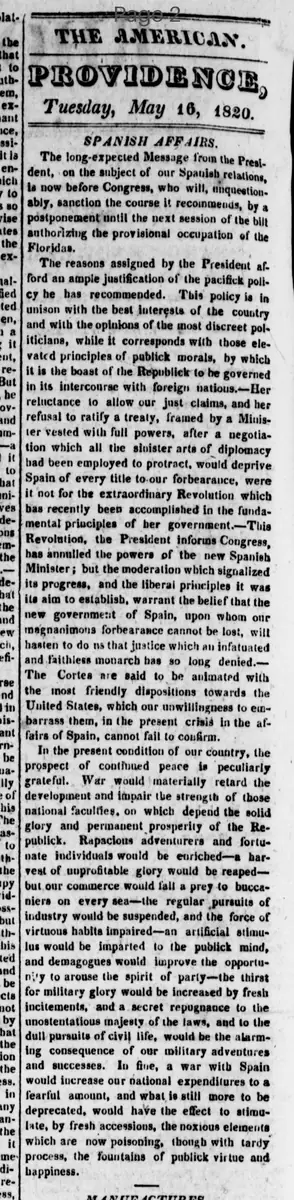
The long-expected Message from the President, on the subject of our Spanish relations, is now before Congress, who will, unquestionably, sanction the course it recommends, by a postponement until the next session of the bill authorizing the provisional occupation of the Floridas.
The reasons assigned by the President afford an ample justification of the pacifick policy he has recommended. This policy is in unison with the best interests of the country and with the opinions of the most discreet politicians, while it corresponds with those elevated principles of publick morals, by which it is the boast of the Republick to be governed in its intercourse with foreign nations.-Her reluctance to allow our just claims, and her refusal to ratify a treaty, framed by a Minister vested with full powers, after a negotiation which all the sinister arts of diplomacy had been employed to protract, would deprive Spain of every title to our forbearance, were it not for the extraordinary Revolution which has recently been accomplished in the fundamental principles of her government.-This Revolution, the President informs Congress, has annulled the powers of the new Spanish Minister; but the moderation which signalized its progress, and the liberal principles it was its aim to establish, warrant the belief that the new government of Spain, upon whom our magnanimous forbearance cannot be lost, will hasten to do us that justice which an infatuated and faithless monarch has so long denied.-
The Cortes are said to be animated with the most friendly dispositions towards the United States, which our unwillingness to embarrass them, in the present crisis in the affairs of Spain, cannot fail to confirm.
In the present condition of our country, the prospect of continued peace is peculiarly grateful. War would materially retard the development and impair the strength of those national faculties, on which depend the solid glory and permanent prosperity of the Republick. Rapacious adventurers and fortunate individuals would be enriched-a harvest of unprofitable glory would be reaped-but our commerce would fall a prey to buccaneers on every sea-the regular pursuits of industry would be suspended, and the force of virtuous habits impaired-an artificial stimulus would be imparted to the publick mind, and demagogues would improve the opportunity to arouse the spirit of party-the thirst for military glory would be increased by fresh incitements, and a secret repugnance to the unostentatious majesty of the laws, and to the dull pursuits of civil life, would be the alarming consequence of our military adventures and successes. In fine, a war with Spain would increase our national expenditures to a fearful amount, and what is still more to be deprecated, would have the effect to stimulate, by fresh accessions, the noxious elements which are now poisoning, though with tardy process, the fountains of publick virtue and happiness.
PROVIDENCE
Tuesday, May 16,
1820.
SPANISH AFFAIRS.
The long-expected Message from the President, on the subject of our Spanish relations, is now before Congress, who will, unquestionably, sanction the course it recommends, by a postponement until the next session of the bill authorizing the provisional occupation of the Floridas.
The reasons assigned by the President afford an ample justification of the pacifick policy he has recommended. This policy is in unison with the best interests of the country and with the opinions of the most discreet politicians, while it corresponds with those elevated principles of publick morals, by which it is the boast of the Republick to be governed in its intercourse with foreign nations.-Her reluctance to allow our just claims, and her refusal to ratify a treaty, framed by a Minister vested with full powers, after a negotiation which all the sinister arts of diplomacy had been employed to protract, would deprive Spain of every title to our forbearance, were it not for the extraordinary Revolution which has recently been accomplished in the fundamental principles of her government.-This Revolution, the President informs Congress, has annulled the powers of the new Spanish Minister; but the moderation which signalized its progress, and the liberal principles it was its aim to establish, warrant the belief that the new government of Spain, upon whom our magnanimous forbearance cannot be lost, will hasten to do us that justice which an infatuated and faithless monarch has so long denied.-
The Cortes are said to be animated with the most friendly dispositions towards the United States, which our unwillingness to embarrass them, in the present crisis in the affairs of Spain, cannot fail to confirm.
In the present condition of our country, the prospect of continued peace is peculiarly grateful. War would materially retard the development and impair the strength of those national faculties, on which depend the solid glory and permanent prosperity of the Republick. Rapacious adventurers and fortunate individuals would be enriched-a harvest of unprofitable glory would be reaped-but our commerce would fall a prey to buccaneers on every sea-the regular pursuits of industry would be suspended, and the force of virtuous habits impaired-an artificial stimulus would be imparted to the publick mind, and demagogues would improve the opportunity to arouse the spirit of party-the thirst for military glory would be increased by fresh incitements, and a secret repugnance to the unostentatious majesty of the laws, and to the dull pursuits of civil life, would be the alarming consequence of our military adventures and successes. In fine, a war with Spain would increase our national expenditures to a fearful amount, and what is still more to be deprecated, would have the effect to stimulate, by fresh accessions, the noxious elements which are now poisoning, though with tardy process, the fountains of publick virtue and happiness.
What sub-type of article is it?
Foreign Affairs
War Or Peace
What keywords are associated?
Spanish Affairs
Florida Occupation
Pacific Policy
Spanish Revolution
Us Spain Relations
National Prosperity
Public Virtue
What entities or persons were involved?
President
Congress
Spain
Cortes
Spanish Minister
Editorial Details
Primary Topic
Us Policy On Spanish Relations And Florida Occupation
Stance / Tone
Support For Pacific Policy And Forbearance Towards Spain
Key Figures
President
Congress
Spain
Cortes
Spanish Minister
Key Arguments
President's Message Recommends Postponing Florida Occupation Bill Until Next Session
Spanish Revolution Annuls Powers Of Previous Minister, Warranting Us Forbearance
New Spanish Government Likely To Grant Justice Denied By Previous Monarch
Cortes Friendly Towards Us, Confirmed By Us Unwillingness To Embarrass Spain
War With Spain Would Retard National Development, Harm Commerce, Suspend Industry, Increase Expenditures, And Stimulate Noxious Political Elements