Thank you for visiting SNEWPapers!
Sign up free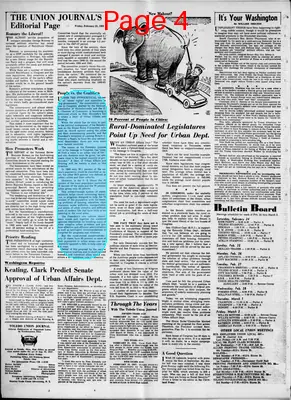
Editorial
February 23, 1962
Toledo Union Journal
Toledo, Lucas County, Ohio
What is this article about?
Editorial criticizes conservative coalition's opposition to President Kennedy's proposed Department of Urban Affairs and Housing, highlighting urban-rural population imbalance in Congress, racial bias in nominating Robert C. Weaver, and need for federal action on city problems like housing and slums.
Clipping
OCR Quality
98%
Excellent
Full Text
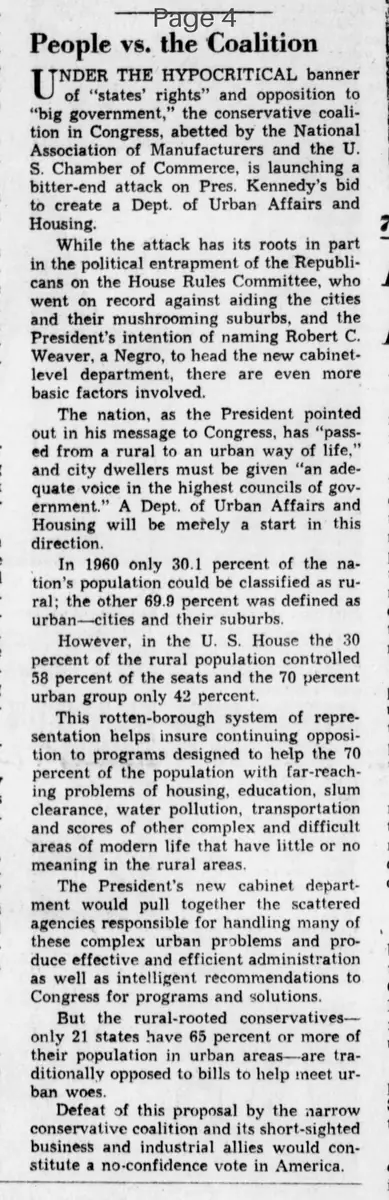
People vs. the Coalition
Under the hypocritical banner of "states' rights" and opposition to "big government," the conservative coalition in Congress, abetted by the National Association of Manufacturers and the U. S. Chamber of Commerce, is launching a bitter-end attack on Pres. Kennedy's bid to create a Dept. of Urban Affairs and Housing.
While the attack has its roots in part in the political entrapment of the Republicans on the House Rules Committee, who went on record against aiding the cities and their mushrooming suburbs, and the President's intention of naming Robert C. Weaver, a Negro, to head the new cabinet-level department, there are even more basic factors involved.
The nation, as the President pointed out in his message to Congress, has "passed from a rural to an urban way of life." and city dwellers must be given "an adequate voice in the highest councils of government." A Dept. of Urban Affairs and Housing will be merely a start in this direction.
In 1960 only 30.1 percent of the nation's population could be classified as rural; the other 69.9 percent was defined as urban—cities and their suburbs.
However, in the U. S. House the 30 percent of the rural population controlled 58 percent of the seats and the 70 percent urban group only 42 percent.
This rotten-borough system of representation helps insure continuing opposition to programs designed to help the 70 percent of the population with far-reaching problems of housing, education, slum clearance, water pollution, transportation and scores of other complex and difficult areas of modern life that have little or no meaning in the rural areas.
The President's new cabinet department would pull together the scattered agencies responsible for handling many of these complex urban problems and produce effective and efficient administration as well as intelligent recommendations to Congress for programs and solutions.
But the rural-rooted conservatives—only 21 states have 65 percent or more of their population in urban areas—are traditionally opposed to bills to help meet urban woes.
Defeat of this proposal by the narrow conservative coalition and its short-sighted business and industrial allies would constitute a no-confidence vote in America.
Under the hypocritical banner of "states' rights" and opposition to "big government," the conservative coalition in Congress, abetted by the National Association of Manufacturers and the U. S. Chamber of Commerce, is launching a bitter-end attack on Pres. Kennedy's bid to create a Dept. of Urban Affairs and Housing.
While the attack has its roots in part in the political entrapment of the Republicans on the House Rules Committee, who went on record against aiding the cities and their mushrooming suburbs, and the President's intention of naming Robert C. Weaver, a Negro, to head the new cabinet-level department, there are even more basic factors involved.
The nation, as the President pointed out in his message to Congress, has "passed from a rural to an urban way of life." and city dwellers must be given "an adequate voice in the highest councils of government." A Dept. of Urban Affairs and Housing will be merely a start in this direction.
In 1960 only 30.1 percent of the nation's population could be classified as rural; the other 69.9 percent was defined as urban—cities and their suburbs.
However, in the U. S. House the 30 percent of the rural population controlled 58 percent of the seats and the 70 percent urban group only 42 percent.
This rotten-borough system of representation helps insure continuing opposition to programs designed to help the 70 percent of the population with far-reaching problems of housing, education, slum clearance, water pollution, transportation and scores of other complex and difficult areas of modern life that have little or no meaning in the rural areas.
The President's new cabinet department would pull together the scattered agencies responsible for handling many of these complex urban problems and produce effective and efficient administration as well as intelligent recommendations to Congress for programs and solutions.
But the rural-rooted conservatives—only 21 states have 65 percent or more of their population in urban areas—are traditionally opposed to bills to help meet urban woes.
Defeat of this proposal by the narrow conservative coalition and its short-sighted business and industrial allies would constitute a no-confidence vote in America.
What sub-type of article is it?
Partisan Politics
Social Reform
Constitutional
What keywords are associated?
Urban Affairs
Housing Department
Conservative Coalition
Rural Urban Divide
Representation Imbalance
Kennedy Proposal
What entities or persons were involved?
Pres. Kennedy
Robert C. Weaver
Conservative Coalition
Republicans On The House Rules Committee
National Association Of Manufacturers
U. S. Chamber Of Commerce
Editorial Details
Primary Topic
Opposition To Department Of Urban Affairs And Housing
Stance / Tone
Strongly Supportive Of Kennedy's Proposal And Critical Of Conservative Coalition
Key Figures
Pres. Kennedy
Robert C. Weaver
Conservative Coalition
Republicans On The House Rules Committee
National Association Of Manufacturers
U. S. Chamber Of Commerce
Key Arguments
Conservative Coalition Opposes Urban Department Under Hypocritical Banner Of States' Rights
Urban Population Shift Requires Voice In Government
Rural Areas Overrepresented In House, Controlling 58% Of Seats Despite 30% Population
Urban Issues Like Housing, Education, Slums Need Coordinated Federal Response
Proposal Would Improve Administration Of Urban Problems
Defeat Would Be No Confidence In America