Thank you for visiting SNEWPapers!
Sign up free
Literary
May 19, 1861
New York Daily Tribune
New York, New York County, New York
What is this article about?
The text reviews Jules Simon's 'L'Ouvriere,' praising its practical focus on French working women's conditions and relevance to America, alongside mentions of philosophical editions and 'Les Excentricites de la Langue Française.' It highlights humanitarianism over mere theory.
Clipping
OCR Quality
95%
Excellent
Full Text
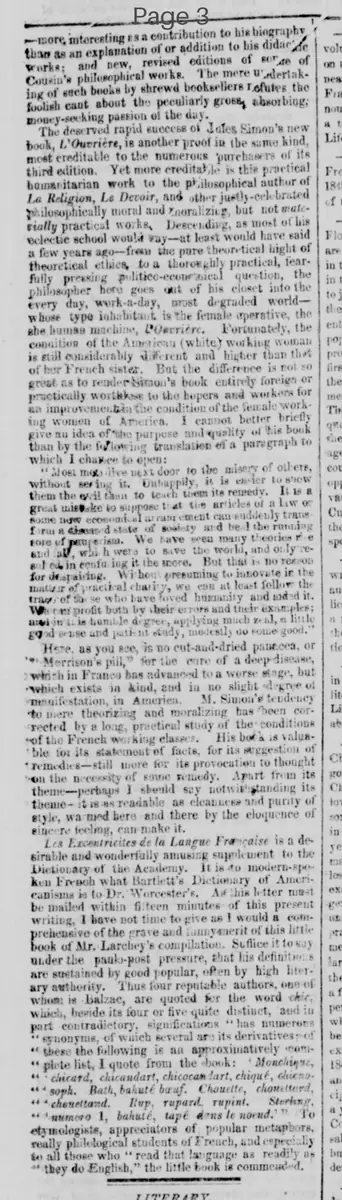
—more interesting as a contribution to his biography than as an explanation of or addition to his didactic works: and new, revised editions of some of Cousin's philosophical works. The mere undertaking of such books by shrewd booksellers refutes the foolish cant about the peculiarly gross, absorbing money-seeking passion of the day.
The deserved rapid success of Jules Simon's new book, L'Ouvriere, is another proof in the same kind, most creditable to the numerous purchasers of its third edition. Yet more creditable is this practical humanitarian work to the philosophical author of La Religion, Le Devoir, and other justly-celebrated philosophically moral and moralizing, but not materially practical works. Descending, as most of his eclectic school would say—at least would have said a few years ago—from the pure theoretical height of theoretical ethics, to a thoroughly practical, fearfully pressing politico-economical question, the philosopher here goes out of his closet into the every day, work-a-day, most degraded world—whose type inhabitant is the female operative, the she human machine, ouvriere. Fortunately, the condition of the American (white) working woman is still considerably different and higher than that of her French sister. But the difference is not so great as to render Simon's book entirely foreign or practically worthless to the hopers and workers for an improvement in the condition of the female working women of America. I cannot better briefly give an idea of the purpose and quality of his book than by the following translation of a paragraph to which I chance to open:
"Most men live next door to the misery of others, without seeing it. Unhappily, it is easier to show them the evil than to teach them its remedy. It is something new in sociological as well as in geometry, that a sudden transformation can take place; it is great wisdom to suppose that the articles of a law or from a civilized state of society can break the running torrent of pauperism. We have seen many theories result in confusing it the more. But that is no reason for despairing. Without presuming to innovate in the matter of practical charity, we can at least follow the track of those who have loved humanity and aided it. We can profit both by their errors and their examples; and in a humble degree, applying much zeal, a little good sense and patient study, modestly do some good."
Here, as you see, is no cut-and-dried panacea, or "Morrison's pill," for the cure of a deep disease, which in France has advanced to a worse stage, but which exists in kind, and in no slight degree of manifestation, in America. M. Simon's tendency to mere theorizing and moralizing has been corrected by a long, practical study of the conditions of the French working classes. His book is valuable for its statement of facts, for its suggestion of remedies—still more for its provocation to thought on the necessity of some remedy. Apart from its theme—perhaps I should say notwithstanding its theme—it is as readable as clearness and purity of style, warmed here and there by the eloquence of sincere feeling, can make it.
Les Excentricites de la Langue Française is a desirable and wonderfully amusing supplement to the Dictionary of the Academy. It is to modern-spoken French what Bartlett's Dictionary of Americanisms is to Dr. Worcester's. As this letter must be mailed within fifteen minutes of this present writing, I have not time to give as I would a comprehensive view of the grave and humorous merit of this little book of Mr. Larchey's compilation. Suffice it to say under the mail-post pressure, that his definitions are sustained by good popular, often by high literary authority. Thus four reputable authors, one of whom is Balzac, are quoted for the word chic, which, beside its four or five quite distinct, and in part contradictory, significations "has numerous synonyms, of which several are its derivatives—of these the following is an approximately complete list, I quote from the book: 'Monchicgre, chicard, chicardart, chicocandart, chignk, chienoph. Bath, bahuté bauf. Chouette, chouettard. Rup, rupard, rupin. Sterling, numeroteux, bahuté, tapé dans le mille.'" To etymologists, appreciators of popular metaphors, really philological students of French, and especially to all those who "read that language as readily as they do English," the little book is commended.
The deserved rapid success of Jules Simon's new book, L'Ouvriere, is another proof in the same kind, most creditable to the numerous purchasers of its third edition. Yet more creditable is this practical humanitarian work to the philosophical author of La Religion, Le Devoir, and other justly-celebrated philosophically moral and moralizing, but not materially practical works. Descending, as most of his eclectic school would say—at least would have said a few years ago—from the pure theoretical height of theoretical ethics, to a thoroughly practical, fearfully pressing politico-economical question, the philosopher here goes out of his closet into the every day, work-a-day, most degraded world—whose type inhabitant is the female operative, the she human machine, ouvriere. Fortunately, the condition of the American (white) working woman is still considerably different and higher than that of her French sister. But the difference is not so great as to render Simon's book entirely foreign or practically worthless to the hopers and workers for an improvement in the condition of the female working women of America. I cannot better briefly give an idea of the purpose and quality of his book than by the following translation of a paragraph to which I chance to open:
"Most men live next door to the misery of others, without seeing it. Unhappily, it is easier to show them the evil than to teach them its remedy. It is something new in sociological as well as in geometry, that a sudden transformation can take place; it is great wisdom to suppose that the articles of a law or from a civilized state of society can break the running torrent of pauperism. We have seen many theories result in confusing it the more. But that is no reason for despairing. Without presuming to innovate in the matter of practical charity, we can at least follow the track of those who have loved humanity and aided it. We can profit both by their errors and their examples; and in a humble degree, applying much zeal, a little good sense and patient study, modestly do some good."
Here, as you see, is no cut-and-dried panacea, or "Morrison's pill," for the cure of a deep disease, which in France has advanced to a worse stage, but which exists in kind, and in no slight degree of manifestation, in America. M. Simon's tendency to mere theorizing and moralizing has been corrected by a long, practical study of the conditions of the French working classes. His book is valuable for its statement of facts, for its suggestion of remedies—still more for its provocation to thought on the necessity of some remedy. Apart from its theme—perhaps I should say notwithstanding its theme—it is as readable as clearness and purity of style, warmed here and there by the eloquence of sincere feeling, can make it.
Les Excentricites de la Langue Française is a desirable and wonderfully amusing supplement to the Dictionary of the Academy. It is to modern-spoken French what Bartlett's Dictionary of Americanisms is to Dr. Worcester's. As this letter must be mailed within fifteen minutes of this present writing, I have not time to give as I would a comprehensive view of the grave and humorous merit of this little book of Mr. Larchey's compilation. Suffice it to say under the mail-post pressure, that his definitions are sustained by good popular, often by high literary authority. Thus four reputable authors, one of whom is Balzac, are quoted for the word chic, which, beside its four or five quite distinct, and in part contradictory, significations "has numerous synonyms, of which several are its derivatives—of these the following is an approximately complete list, I quote from the book: 'Monchicgre, chicard, chicardart, chicocandart, chignk, chienoph. Bath, bahuté bauf. Chouette, chouettard. Rup, rupard, rupin. Sterling, numeroteux, bahuté, tapé dans le mille.'" To etymologists, appreciators of popular metaphors, really philological students of French, and especially to all those who "read that language as readily as they do English," the little book is commended.
What sub-type of article is it?
Essay
What themes does it cover?
Moral Virtue
Social Manners
Political
What keywords are associated?
Book Review
Jules Simon
L Ouvriere
Working Women
French Philosophy
Social Reform
Labor Conditions
Literary Details
Subject
Review Of Jules Simon's L'ouvriere And Other Books
Key Lines
"Most Men Live Next Door To The Misery Of Others, Without Seeing It. Unhappily, It Is Easier To Show Them The Evil Than To Teach Them Its Remedy. It Is Something New In Sociological As Well As In Geometry, That A Sudden Transformation Can Take Place; It Is Great Wisdom To Suppose That The Articles Of A Law Or From A Civilized State Of Society Can Break The Running Torrent Of Pauperism. We Have Seen Many Theories Result In Confusing It The More. But That Is No Reason For Despairing. Without Presuming To Innovate In The Matter Of Practical Charity, We Can At Least Follow The Track Of Those Who Have Loved Humanity And Aided It. We Can Profit Both By Their Errors And Their Examples; And In A Humble Degree, Applying Much Zeal, A Little Good Sense And Patient Study, Modestly Do Some Good."