Thank you for visiting SNEWPapers!
Sign up free
The National Intelligencer And Washington Advertiser
Washington, District Of Columbia
What is this article about?
Official 1801 documents from the National Intelligencer detailing accounts of U.S. Indian trading factories in Georgia and Tellico, reporting increased capital and successful operations, alongside Secretary of War Dearborn's observations on the system's benefits for fair trade and strengthening U.S.-Indian relations.
Clipping
OCR Quality
Full Text
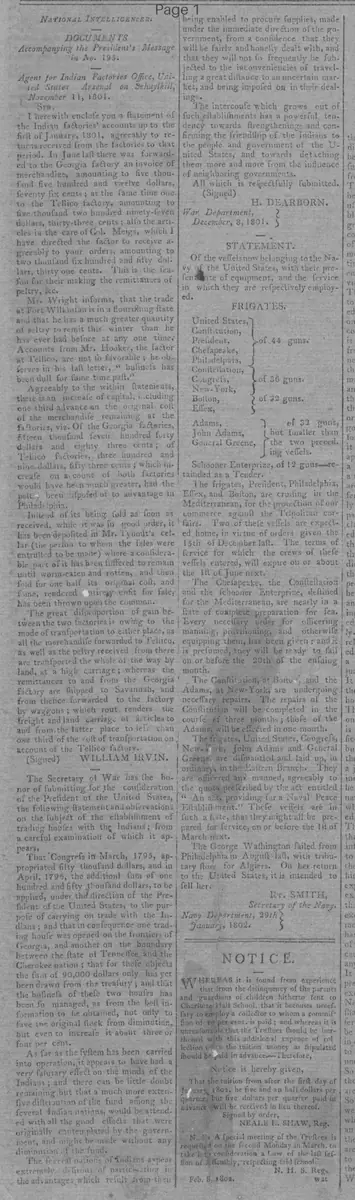
DOCUMENTS
Accompanying the President's Message
in No. 195.
Agent for Indian Factories Office, United
States Arsenal on Schuylkill,
November 11, 1801.
SIR,
I herewith enclose you a statement of
the Indian factories' accounts up to the
first of January, 1801, agreeably to re-
turns received from the factories to that
period. In June last there was forward-
ed to the Georgia factory an invoice of
merchandize, amounting to five thou-
sand five hundred and twelve dollars,
seventy six cents; at the same time one
to the Tellico factory, amounting to
five thousand two hundred ninety-seven
dollars, thirty-three cents; also the arti-
cles in the care of Col. Meigs, which I
have directed the factor to receive a-
greeably to your orders, amounting to
two thousand six hundred and fifty dol-
lars, thirty one cents. This is the rea-
son for their making the remittances of
peltry, &c.
Mr. Wright informs, that the trade
at Fort Wilkinson is in a flourishing state
and that he has a much greater quantity
of peltry to remit this winter than he
has ever had before at any one time.
Accounts from Mr. Hooker, the factor
at Tellico, are not so favorable; he ob-
serves in his last letter, "business has
been dull for some time past."
Agreeably to the within Statements,
there is an increase of capital, including
one third advance on the original cost
of the merchandize remaining at the
factories, viz. Of the Georgia factories,
fifteen thousand seven hundred forty
dollars and eighty three cents; of
Tellico factories, three hundred and
nine dollars, fifty three cents; which in-
crease on account of both factories
would have been much greater, had the
pelt. been disposed of to advantage in
Philadelphia.
Instead of its being sold as soon as
received, while it was in good order, it
has been deposited in Mr. Tybout's cel-
lar (the person to whom the sales were
entrusted to be made) where a considera-
ble part of it has been suffered to remain
until worm-eaten and rotten, and then
sold for one half its original cost, and
some, rendered entirely unfit for sale,
has been thrown upon the common.
The great disproportion of gain be-
tween the two factories is owing to the
mode of transportation to either place, as
all the merchandize forwarded to Tellico,
as well as the peltry received from there
are transported the whole of the way by
land, at a high carriage; whereas the
remittances to and from the Georgia
factory are shipped to Savannah, and
from thence forwarded to the factory
by waggons; which rout renders the
freight and land carriage of articles to
and from. the latter place to less than
one third of the cost of transportation on
account of the Tellico factory.
(Signed)
WILLIAM IRVIN.
The Secretary of War has the ho-
nor of submitting for the consideration
of the President of the United States,
the following statement and observations
on the subject of the establishment of
trading houses with the Indians; from
a careful examination of which it ap-
pears,
That Congress in March, 1795, ap-
propriated fifty thousand dollars, and in
April, 1796, the additional sum of one
hundred and fifty thousand dollars, to be
applied, under the direction of the Pre-
sident of the United States, to the pur-
pose of carrying on trade with the In-
dians; and that in consequence one trad-
ing house was opened on the frontiers of
Georgia, and another on the boundary
between the state of Tennessee and the
Cherokee nation; that for these objects
the sum of 90,000 dollars only has yet
been drawn from the treasury; and that
the business of these two houses has
been so managed, as from the best in-
formation to be obtained, not only to
save the original stock from diminution,
but even to increase it about three or
four per cent.
As far as the system has been carried
into operation, it appears to have had a
very salutary effect on the minds of the
Indians; and there can be little doubt
remaining but that a much more exten-
sive distribution of the fund among the
several Indian nations, would be attend-
ed with all the good effects that were
originally contemplated by the govern-
ment, and might be made without any
diminution of the fund.
The several nations of Indians appear
extremely desirous of participating in
the advantages which result from this
being enabled to procure supplies, made
under the immediate direction of the go-
vernment, from a confidence that they
will be fairly and honestly dealt with, and
that they will not so frequently be sub-
jected to the inconveniencies of travel-
ling a great distance to an uncertain mar-
ket, and being imposed on in their deal-
ings.
The intercourse which grows out of
such establishments has a powerful ten-
dency towards strengthening and con-
firming the friendship of the Indians to
the people and government of the U-
nited States, and towards detaching
them more and more from the influence
of neighboring governments.
All which is respectfully submitted.
(Signed)
H. DEARBORN.
War Department,
December, 8, 1801.
What sub-type of article is it?
What themes does it cover?
What keywords are associated?
What entities or persons were involved?
Where did it happen?
Story Details
Key Persons
Location
Georgia Factory, Tellico Factory, Fort Wilkinson, Schuylkill, Philadelphia, Savannah
Event Date
November 11, 1801; December 8, 1801; Accounts Up To January 1, 1801; Appropriations March 1795 And April 1796
Story Details
William Irvin reports on Indian factories' accounts showing capital increase despite transportation issues and poor peltry sales; H. Dearborn submits observations on the trading houses system established by Congress in 1795-1796, noting its success in fair trade, capital preservation with gains, salutary effects on Indians, and benefits for U.S. relations.