Thank you for visiting SNEWPapers!
Sign up free
The Recorder
Richmond, Virginia
What is this article about?
In 1802 Richmond, Virginia, a quarrel between executive council member George Hay and Recorder editor James Callender led to Hay securing a magistrate's order binding Callender and partner Pace to prevent future libelous publications. Callender refused security and was jailed without trial, igniting debate on press freedom violations.
Merged-components note: Continuation across pages of the detailed article reporting on the invasion of the liberty of the press in the Callender case.
Clippings
1 of 2
OCR Quality
Full Text
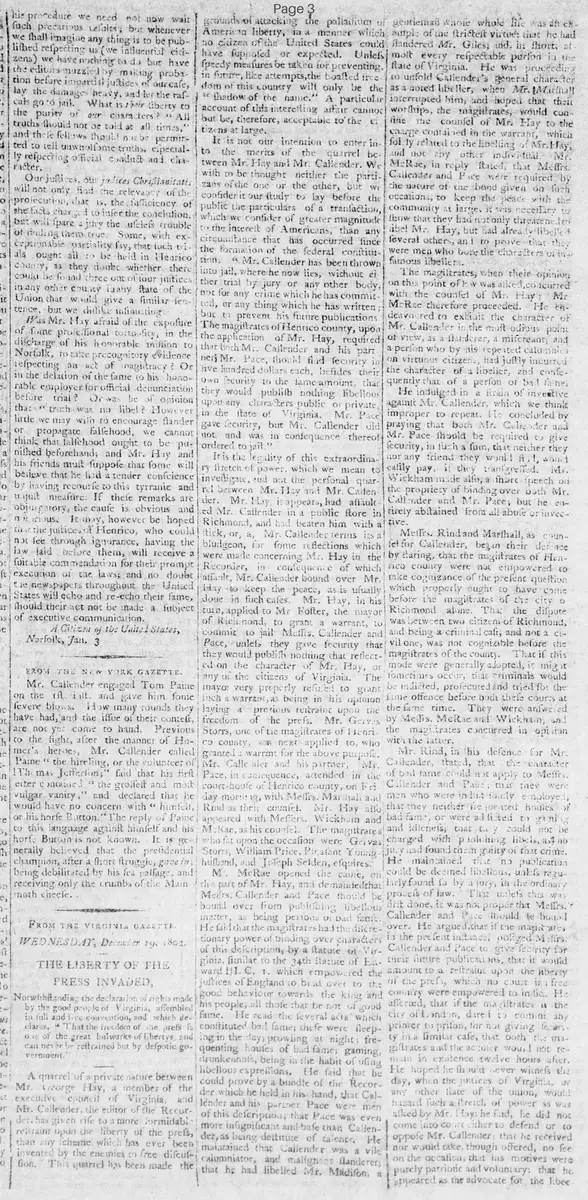
WEDNESDAY. December 29, 1802.
THE LIBERTY OF THE PRESS INVADED,
Notwithstanding the declaration of rights made by the good people of Virginia, assembled in full and free convention, and which declares, "That the freedom of the press is one of the great bulwarks of liberty, and can never be restrained but by despotic government."
A quarrel of a private nature between Mr. George Hay, a member of the executive council of Virginia, and Mr. Callender, the editor of the Recorder, has given rise to a more formidable restraint upon the liberty of the press, than any scheme which has ever been invented by the enemies to free discussion. This quarrel has been made the grounds of attacking the palladium of American liberty, in a manner which no citizen of the United States could have supposed or expected. Unless speedy measures be taken for preventing, in future, like attempts, the boasted freedom of this country will only be the "shadow of the name." A particular account of this interesting affair cannot but be, therefore, acceptable to the citizens at large.
It is not our intention to enter into the merits of the quarrel between Mr. Hay and Mr. Callender. We wish to be thought neither the partisans of the one or the other, but we consider it our duty to lay before the public the particulars of a transaction, which we consider of greater magnitude to the interest of Americans, than any circumstance that has occurred since the formation of the federal constitution. Mr. Callender has been thrown into jail, where he now lies, without either trial by jury or any other body, not for any crime which he has committed, or any thing which he has written; but to prevent his future publications. The magistrates of Henrico county, upon the application of Mr. Hay, required that both Mr. Callender and his partner Mr. Pace, should find security in five hundred dollars each, besides their own security to the same amount, that they would publish nothing libellous upon any characters public or private, in the state of Virginia. Mr. Pace gave security, but Mr. Callender did not and was in consequence thereof ordered to jail.
It is the legality of this extraordinary stretch of power, which we mean to investigate, and not the personal quarrel between Mr. Hay and Mr. Callender. Mr. Hay, it appears, had assaulted Mr. Callender in a public store in Richmond, and had beaten him with a stick, or, as Mr. Callender terms it, a bludgeon, for some reflections which were made concerning Mr. Hay in the Recorder, in consequence of which assault, Mr. Callender bound over Mr. Hay to keep the peace, as is usually done in such cases. Mr. Hay, in his turn, applied to Mr. Foster, the mayor of Richmond, to grant a warrant, to commit to jail Messrs. Callender and Pace, unless they gave security that they would publish nothing that reflected on the character of Mr. Hay, or any of the citizens of Virginia. The mayor very properly refused to grant such a warrant, as being in his opinion laying a previous restraint upon the freedom of the press. Mr. George W. Storrs, one of the magistrates of Henrico county, was next applied to, who granted a warrant for the above purpose. Mr. Callender and his partner, Mr. Pace, in consequence, attended in the court-house of Henrico county, on Friday morning, with Messrs. Marshall and Rind as their counsel. Mr. Hay also appeared with Messrs. Wickham and McRae, as his counsel. The magistrates who sat upon the occasion were Gervas Storrs, William Price, Pleasant Younghusband, and Joseph Selden, esquires.
Mr. McRae opened the cause, on the part of Mr. Hay, and demanded that Messrs. Callender and Pace should be bound over from publishing libellous matter, as being persons of bad fame. He said that the magistrates had the discretionary power of binding over characters of this description, by a Statute of Virginia, similar to the 34th statute of Edward III. C. 1. which empowered the justices of England to bind over to the good behaviour towards the king and his people, all those that be not of good fame. He read the several acts which constituted bad fame; these were sleeping in the day; prowling at night; frequenting houses of bad fame; gaming, drunkenness, being in the habit of using libellous expressions. He said that he could prove by a bundle of the Recorder which he held in his hand, that Callender and his Partner Pace were men of this description; that Pace was even more insignificant and base than Callender, as being destitute of talents. He maintained that Callender was a vile calumniator, and malignant slanderer; that he had libelled Mr. Madison, a gentleman whose whole life was an example of the strictest virtue: that he had slandered Mr. Giles; and, in short, almost every respectable person in the state of Virginia. He was proceeding to unfold Callender's general character as a noted libeller, when Mr. Marshall interrupted him, and hoped that their worships, the magistrates, would confine the counsel of Mr. Hay to the charge contained in the warrant, which solely related to the libelling of Mr. Hay, and not any other individual. Mr. McRae, in reply stated, that Messrs. Callender and Pace were required by the nature of the bond given on such occasions, to keep the peace with the community at large. It was necessary to show that they had not only threatened to libel Mr. Hay, but had already libelled several others, and to prove that they were men who bore the characters of infamous libellers.
The magistrates, when their opinion on this point of law was asked, concurred with the counsel of Mr. Hay; Mr. McRae therefore proceeded. He endeavoured to exhibit the character of Mr. Callender in the most odious point of view, as a slanderer, a miscreant, and a person who by his repeated calumnies on virtuous citizens, had justly incurred the character of a libeller, and consequently that of a person of bad fame. He indulged in a strain of invective against Mr. Callender, which we think improper to repeat. He concluded by praying that both Mr. Callender and Mr. Pace should be required to give security, in such a sum, that neither they nor any friend they would hit upon it easily pay, if they transgressed. Mr. Wickham made also, a short speech on the propriety of binding over both Mr. Callender and Mr. Pace; but he entirely abstained from all abuse or invective.
Messrs. Rind and Marshall, as counsel for Callender, began their defence by stating, that the magistrates of Henrico county were not empowered to take cognizance of the present question which properly ought to have come before the magistrates of the city of Richmond alone. That the dispute was between two citizens of Richmond, and being a criminal case, and not a civil one, was not cognizable before the magistrates of the county. That if this mode were generally adopted, it might sometimes occur, that criminals would be indicted, prosecuted and tried for the same offence before both these courts at the same time. They were answered by Messrs. McRae and Wickham, and the magistrates concurred in opinion with the latter.
Mr. Rind, in his defence for Mr. Callender, stated, that the character of bad fame could not apply to Messrs. Callender and Pace; they were men who were industriously employed, that they neither frequented houses of bad fame, or were addicted to gaming and idleness; that they could not be charged with publishing libels, as no jury had found them guilty of that crime. He maintained that no publication could be deemed libellous, unless regularly found so by a jury, in the ordinary process of law. That unless this was done, it was not proper that Messrs. Callender and Pace should be bound over. He argued, that if the magistrates in the present instance, obliged Messrs. Callender and Pace to give security for their future publications, that it would amount to a restraint upon the liberty of the press, which no court in a free country were empowered to inflict. He asserted, that if the magistrates of the city of London, dared to commit any printer to prison, for not giving security, in a similar case, that both the magistrates and the accuser would not remain in existence twelve hours after. He hoped he should ever witness the day, when the justices of Virginia, or any other state of the union, would hazard such a stretch of power as was asked by Mr. Hay: he said, he did not come into court either to defend or to oppose Mr. Callender; that he received nor would take, though offered, no fee on the occasion; that his motives were purely patriotic and voluntary: that he appeared as the advocate for the liberty
told the press, that if the magistrates agreed to the proposal of Mr. Hay in the present case, the freedom of the press might justly be said to be extinguished in this country. He said, that if Mr. Hay thought Mr. Callender published falsehoods reflecting on his conduct, that it was his duty to prosecute Callender and Pace for defamation, and that a jury would determine the extent of the offence. This was the only and the proper course in his opinion, which Mr. Hay ought to pursue. But if the magistrates bound Callender and Pace over, they would become the judges of the nature of the publication in question. They would in fact, he assumed, be assuming an authority, which was never vested in any magistrate in a free country.
He therefore entreated, that their worships would properly consider the magnitude of the present question, which was one of the most important that ever occurred in the union, and by binding Messrs. Callender and Pace to keep the peace, lay a restraint upon the liberty of the press, which would be reprobated from one end of the continent to the other.
Such was the general tendency of the able speech which Mr. Rind made on this occasion, and for which he merits the thanks of all citizens who have a concern for the preservation of the palladium of true liberty.
Mr. Marshall proceeded nearly on the same grounds with Mr. Rind. He stated to the magistrates, that his motives for appearing in court were precisely the same with those which actuated Mr. Rind; a desire to preserve the liberty of the press from any unjust attacks which might be attempted to be laid upon it. In support of the illegality of binding over printers to keep the peace, he read in court the sentiments of Judge Blackstone, on the liberty of the press, book iv. chap. 11. sec. 6. This learned author expressly declares, "that the liberty of the press consists in laying no previous restraints upon publications, and not in freedom from censure for criminal matter when published. Every freeman has an undoubted right to lay what sentiments he pleases before the public: to forbid this, is to destroy the freedom of the press: but if he publishes what is improper, mischievous, or illegal, he must take the consequence of his own temerity." Mr. Marshall therefore argued, that the act of binding over Messrs. Callender and Pace was unquestionably a previous restraint laid upon the press. That those two men had not yet been proved guilty of libelling any person, nor was any prosecution at present intended to be commenced against them on that supposition; but that Mr. Hay merely on suspicion that they were to publish libels on his character, demanded of their worships to bind them over to keep the peace. Mr. Marshall said, that it was the most extraordinary application which he ever had heard of; and if the magistrates should comply with the demand, it would be an act equally extraordinary. But he hoped that this would not be the case, nor that it would be said, that in the state of Virginia, the freedom of the press had received a check which it never experienced in any country that boasted of liberty.
Mr. Wickham in reply, contended that the binding over of Callender and Pace would be no restraint laid on the liberty of the press. That they were at full liberty to publish what they pleased notwithstanding, and that their recognizance could not be forfeited unless they published libellous matter, which would remain to be determined by a jury.
Mr. Rind, in answer to this argument, proved clearly that it would act as a previous restraint upon the liberty of the press; for if Callender and Pace gave security, and afterwards published what might be deemed libellous, that they would be sued simply upon the recognizance, which would unquestionably be forfeited, however trivial the nature of the libel might be.
Notwithstanding this reasoning on the part of the counsel of Callender and Pace, which we believe appeared satisfactory to the greater majority of those who were present, both the editors were required to give two securities, in the sum of five hundred dollars each: besides their own bonds to the same amount. Mr. Pace gave security, but Mr. Callender having failed to give security, was sent to jail, where he now is, without any other detainer. Mr. Selden was the only magistrate of the four who voted against the decision. He said he thought it improper that such a restraint should be laid on the press.
The citizens of other states will no doubt be anxious to know the political principles of the several magistrates and the counsel on both sides. Mr. Foster, the mayor of Richmond, is considered to be a federalist. The four magistrates who presided in court are known to belong to the party called anti-federal or democratic. Mr. Marshall, counsel for Messrs. Callender and Pace, and Mr. Wickham, counsel for Mr. Hay, are federalists. Mr. Rind and Mr. M'Rae, the other counsel, are of the other party.
This decision furnishes, however, the most decisive proof of the real principles of the present ruling party, and of those men who are perpetually bawling about liberty and republicanism.
The commitment of printers to jail on suspicion that they might publish libels, is an act which never until now was heard of in the United States. Such a circumstance never occurred in Great Britain, or indeed in any country where the people enjoyed the liberty of the press. Mr. Rind properly observed, that if such an attempt should be made in London, that both the magistrate and the person in the business would lose their lives in twelve hours after. We truly believe this would happen; but no justice would have the audacity to make the attempt. We can state on the authority of a person who once had the opportunity of being present in the court of session of Edinburgh, which is the court that generally decides all matters of any importance in Scotland, when an application was made to the lords of session to issue a warrant against the printers of a periodical pamphlet, in order to oblige him to give security that nothing libellous would appear in the succeeding numbers. But those learned lords who composed that court, were unanimously of opinion that no such previous restraint could be laid upon the press. If any libels were published either against government or against individuals, they said ample redress could afterwards be procured; but the binding of individuals over to keep the peace was an act that ought only to take place when personal danger or destruction of property were apprehended.
If we consider the words of Sir William Blackstone, it will appear that this was evidently the opinion of that learned lawyer. Any justice of the peace (book iv: chap. 18, sec. 1.) may, ex officio, bind all those to keep the peace, who in his presence make any affray; or threaten to kill or beat another; or go about with unusual weapons, to the terror of the people; and all such as he knows to be common barrators; and such as are brought before him by the constable for a breach of the peace in his presence; and all such persons as, having been before bound to the peace, have broken it, and forfeited their recognizances. Also, wherever any private man hath just cause to fear, that another will burn his house, or do him a corporal injury, by killing, imprisoning, or beating him; or that he will procure others so to do, he may demand surety of the peace against such person; and every justice of the peace is bound to grant it, if he who demands it will make oath, that he is actually under fear of death or bodily harm, and will shew that he has just cause to be so, by reason of the other's menaces, attempts, or having lain in wait for him; and will also further swear, that he does not require such surety out of malice or for mere vexation.
If the decision in the case of Callender and Pace, should prevail, the construction of libels would be entirely left to magistrates. They will have the power of judging of the extent of the supposed libellous matter, and not a jury. The inconvenience that will hence arise to society cannot be better described than by quoting a paragraph from Junius on this subject:
"If any honest man shall still be inclined to leave the construction of libels to the court. I would entreat him to consider what a dreadful complication of hardships he imposes upon his fellow subjects. In the first place the prosecution commences by information of an officer of the crown, not by the regular constitutional mode of indictment before a grand jury: as the fact is usually admitted, or in general can easily be proved, the office of the petty jury is nugatory. The court then judges of the nature and extent of the offence, and determines, ad arbitrium, the quantum of the punishment. from the lowest fine to a heavy one, to repeated whipping, to pillory, and unlimited imprisonment. --Cutting of ears and noses might still be inflicted by a resolute judge."
The case in question is even more dangerous than that which Junius supposes. For according to the opinions of the justices of Henrico county, a single individual magistrate is vested with the power of obliging any person whom he may suspect about to write libellous matter, to give recognizance to an enormous amount, which recognizance will be forfeited, if the person bound over should afterwards publish the most trivial libel.
The jury ought to be the persons entitled to judge of the extent of a libel: but according to the principles now laid down, this is left to the pleasure of any magistrate: for whatever the nature of the libel may be, the whole sum mentioned in the bond of security becomes forfeited.
We shall suppose, for instance, that a person has given a recognizance for five thousand dollars; this person afterwards accuses some obscure individual in the state, of some insignificant act that he never committed, and which perhaps does not injure his reputation not a cent, yet he is compelled to pay the five thousand dollars equally as if he had libelled in the most scandalous manner, the whole community. There is neither justice or reason in this doctrine.--Such a principle in law was never started before: that all libels, of every description, from the most trifling which can be conceived, to the most heinous and aggravating that can be committed, should receive the same punishment. For this will be precisely the case, if the despotic doctrine laid down by Mr. Hay, his counsel, and the three justices of Henrico county, be sustained." The suspected libeller is not punished for what he has done, but for his future crimes. Therefore, however he may conduct himself, whether immoderately or with discretion, his punishment is the same. It is astonishing, how any men versed in law, could have advanced, or listened to such absurdities.
It is pretended, that many such instances have occurred in England; but that they have been too trifling to be noticed. No attempt has ever been made in Great Britain upon the liberty of the press, but which has resounded from one end of the kingdom to the other, and if such an extraordinary instance as the present had happened, the whole world would have heard of it. It would not have been confined to Great Britain alone. Statements, and restatements of it, would have been published in every country and in every language in Europe, where the freedom of the press is suffered.
What noise did the trial of Woodfall make? What commotions did the persecution of Wilkes stir up! Yet these were cases insignificant and paltry when compared to the present. No doubt but many acts equally tyrannical have been committed, and are still committed with regard to the press in other countries, where liberty is not allowed to breathe. Such a decision, or order, would be thought nothing of at the present day in France; it would only accord with the general policy which seems to prevail in that country. But this decision, in a free country, such as America, ought to excite, not only surprise, but the utmost poignant indignation in the breast of every man who knows what freedom is; who understands the importance of the preservation of the press to his personal liberty, and who is not so debased as to court the interest of party or faction.
If the present restraint upon the liberty of the press be suffered to pass unnoticed, men in office may perpetrate what actions they please with impunity. No strictures can be made either on their conduct, or on the measures of government. No individual will be suffered to examine into the conduct of magistrates or persons holding offices under government. The lips of honest scrutiny will be sealed up. Peculation, disorder, and immorality may triumph, without the eye of censure daring to behold and expose crimes. The citizens of the United States will be hurled instantaneously from a state of virtuous freedom, into the abandoned condition of servility. Such, unquestionably, will be the melancholy consequences of such doctrines!
The restraint which the sedition act laid upon the press was trifling in comparison of the present; nor did it affect the press so adversely as was imagined; but it was found to be improper, and consequently was repealed.
The apprehension of personal dangers, and the defamation of character, are circumstances very different. It is highly necessary that preventive justice should take place in the former, but not in the latter. No redress, but what is pecuniary, can be procured by a personal assault. If a man has an eye knocked out of his head, no court or jury can replace it; but character may be repaired. Upon the conviction of the slanderer, the reputation of the slandered stands in the world as fair, and sometimes higher than ever. It is, therefore, evident, why the policy which justifies that men of bad fame should be bound to keep the peace, is not intended to operate as a restraint upon words or publications.--- Bodily injury, or the destruction of property, are not easily repaired, but character suffers no loss, when the slander is proved false and malicious.
If the mode of binding over persons to keep the peace and refrain from making strictures upon characters be found to be law, in what a situation will Paine, Cheetham, and Duane be placed? The author of Common Sense may return back to France; the Clintonian editor may ship himself for Manchester; and the organ of the public will, may take his passage to Calcutta. These defamers of morals will even be at more liberty in the countries which they have forsaken than in America, if the present doctrine should prevail. We are convinced that no circumstance which has happened since the revolution will attract the public notice more than the commitment of Callender to jail. With the greatest anxiety we wait the issue of this important affair, on which the liberty of the press depends. Not only the citizens of Europe are interested in it, but thousands of Europeans who may be at this moment preparing to make America their future home. The intelligence of the event, if inauspicious to the cause of liberty will be conveyed across the Atlantic with more eagerness, and will strike the embarking alien with more terror, than the sedition and alien laws ever did.
It would seem, that the present ruling party are afraid that certain secret matters will break forth, which may bring into disgrace several characters who are now in high repute, or they would never have resorted to such an expedient, which they themselves, not two years ago, reviled and execrated. The clamors of the democratic party during the administration of president Adams, are certainly not forgotten. Yet in that administration no stretch of power was exerted by any magistrate, or justice of the peace which could be compared to this. Those who were accused of writing libels, before they received sentence or punishment, were regularly tried, and found guilty by juries. No proposition was ever made to bind either printers, authors, or booksellers, from publishing what they pleased. This extraordinary attack upon the freedom of the press was reserved to the present day.
What sub-type of article is it?
What themes does it cover?
What keywords are associated?
What entities or persons were involved?
Where did it happen?
Story Details
Key Persons
Location
Richmond, Virginia; Henrico County
Event Date
December 1802
Story Details
A personal quarrel escalates when George Hay assaults Recorder editor Callender over published reflections, leading Hay to seek a prior restraint on Callender and Pace's publications via magistrates. Despite defenses citing Blackstone and arguing against press censorship, the magistrates bind them over; Callender refuses security and is jailed without trial, threatening American press freedom.