Thank you for visiting SNEWPapers!
Sign up free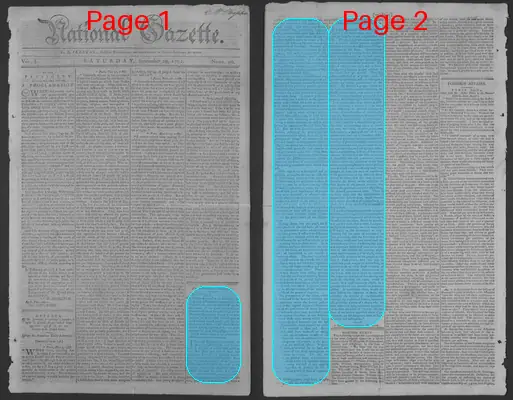
National Gazette
Philadelphia, Philadelphia County, Pennsylvania
What is this article about?
Letter to National Gazette editor transmitting extract from Virginia pamphlet urging state constitutional amendments to bolster republicanism, critique aristocratic federal influences, and reform taxation through state governments rather than executive departments.
Merged-components note: Continuation of the letter to Mr. Freneau from page 1 to page 2; original label of second component was editorial, corrected to letter_to_editor as it fits the content of a reader submission.
Clippings
1 of 2
OCR Quality
Full Text
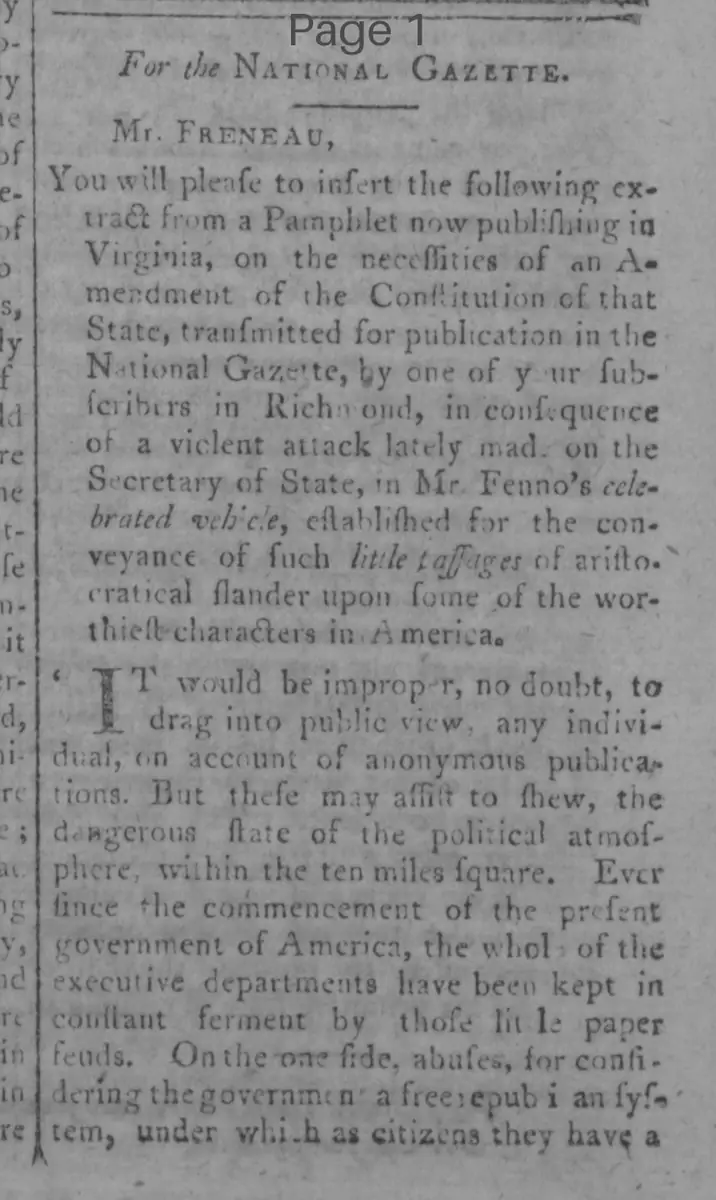
Mr. Freneau,
You will please to insert the following extract from a Pamphlet now publishing in Virginia, on the necessities of an Amendment of the Constitution of that State, transmitted for publication in the National Gazette, by one of your subscribers in Richmond, in consequence of a violent attack lately made on the Secretary of State, in Mr. Fenno's celebrated vehicle, established for the conveyance of such little baggage of aristocratical slander upon some of the worthiest characters in America.
It would be improper, no doubt, to drag into public view any individual, on account of anonymous publications. But these may serve to show, the dangerous state of the political atmosphere, within the ten miles square. Ever since the commencement of the present government of America, the whole of the executive departments have been kept in constant ferment by those little paper feuds. On the one side, abuses, for considering the government a mere republican system, under which as citizens they have a right, and as servants they are bound, to condemn whatever in their opinions, may appear wrong. The other, commended and extolled, for considering it only as one step towards that abject state of courtly deceit, which should render all its dependents base, in order to create a kind of secret, safe and snug freemasonry among the brethren of the court. Whether any of these publications are indebted to the hand, as well as to the conduct of these officers, for their existence, would perhaps be improper to premise. It is sufficient to observe, that any one less interested, or less capable than themselves, could scarcely have written so feelingly as some of their authors have certainly done.
As to the enmity or friendship of any of these officers to the present general government of America, it is not so much the business of this particular part of the present undertaking to enquire, as it appears to have been the object of some of those publications to show. It is to be presumed, that every one is a friend to the government under which he holds an elevated post, until something more, than mere objections to the administration of it, is made appear. Indeed, when we see a man in that situation, acting thus, it only serves to prove that something must be really wrong in public measures, as well as that he has an uncommon share of virtue himself. But when we see others, in a similar situation, perverting the principles of the government under which they act, by imposing on it, things unconstitutional and bad, and thereby exciting general disgust, we cannot but conclude, that they themselves will prove the real enemies to that government in the end. This then, is the only proper distinction to be drawn, between the different executive departments, on the score of enmity and friendship to the government under which they act.
With respect to aristocratical and republican principles, we have no difficulty in determining where to look for them. Whether any of the publications above alluded to, may be reckoned among either of those speculations on paper, for which one of those great departments of government is so renowned: or whether either of the officers of those departments, is an enemy or a friend to the present government of America, as before observed, is not so much the business of this digression to enquire, as what will be the probable issue of a loose indefinite display of liberty, in the governments of the different states.
Having shown the tree which has already produced the real fruits of enmity to the government under whose influence they have grown, it will not be difficult to trace the route through which the principles of monarchy and aristocracy are to aid in bringing its destruction about. By an indifferent and loose attention to our interests in the states, we acquire naturally the habit of inattention to our interests in American affairs. The same carelessness and indifference to our interests which will produce a weak and indifferent legislature in a state, will beget a trifling and incompetent representation there. From this cause may already have arisen, perhaps, the shameful practice of referring so much of the business of the general legislature, to the different departments of the executive branch, into whose dangerous vortex may be whirled in time, all the important interests of the people of America.
The governments of the states, which were formed in the hour of necessity and inexperience, when the human passions rose in their highest region of resentment, against the government of Great Britain, and have never since been corrected, may be considered therefore, as the stubborn tools of those evils, among which stands this main source of knowledge (on the high and speculative's fertile ground) to which we had recourse is often had. Every member, who from weakness or wrong principles, can be induced to taste of this forbidden fruit, may be considered as another dangerous old woman, in the great council of our political affairs. Whether he be weak, or whether he be base, will be a matter of but little consequence to us, after he is enticed. The little state devil, or political Satan of aristocracy, is always ready and ingenious enough to make the best of any opening that may offer, to produce the fall of man from his primitive state of republican innocence—Funding Systems, excise laws, exclusive privileges, &c. &c. for instance.
Perfection, knows but too well, on which side to look, for the frailties of human nature.
It is to a good and substantial system of policy in the states only, then, we can resort for security in our congressional affairs. The general government, excellent as it is in itself cannot produce complete happiness without the assistance of the governments of the states. Governments formed on right principles in the different states, would certainly be the most natural means of introducing proper principles into the government of the continent. The habit of acting in the right way at home, will always produce a proper conduct in men when they go abroad. Thus the states, accustomed to a proper mode of governing themselves, will naturally give a proper tone to the government of the whole. By showing a proper regard for the rights of representation ourselves, we should convince those, who were to govern there, that they would not go unnoticed in sporting with the people's rights at large.
In a country like this, where a difference of climate, a variety of soils, and a great difference in natural advantages, produce all the diversities of interests that can exist, no general system of taxation can possibly be equal and just. One an importing state; another a manufacturing one; the third an exporting one; a fourth too new, too local, or perhaps too poor to be either; a part peopled of slaves; another part made up of tradesmen, fishermen, and mariners; some interspersed with a variety of glorious navigable waters; and others environed with impenetrable mountains, wildernesses, and inhospitable tribes; such a complication, in short, of situations, climates, interests and the like, as renders it impossible that any general tax, which tends to throw the collection on the same article throughout, should be either politic, natural or just; and could only have been thought of from the want of confidence in the governments of the different states.
Indeed we know, that the want of confidence in the states, in the collection of their quotas of the general revenue, was among the principal causes for establishing the general government itself. There is no doubt then, that the establishment of proper state systems now, would immediately throw the reflux of revenue back, to those channels, in which it is so natural it should flow.
It is a mortifying thing, to both the representative and the represented, no doubt, that the important charge, with which the one is intrusted by the other, should be transferred and bartered off to a third, for a partnership in his knowledge, on little more than half-stocks to the community at large. Nothing but the want of confidence in some other body, than the Secretary of the Treasury, could ever have introduced the humiliating practice of referring the great and important business of taxation to one, who to save himself the trouble, might make another transfer, if he chose, of this transferable property in the people, to any little stock jobber, who was able to wield this great weapon of destruction, to deprive them of their small remnant of interest in themselves. Governments in the states, with whom could be intrusted the important business of determining the mode of collecting the taxes, would of course, be a most important object, on a general view of our interests in American affairs. A confidence there, would not only destroy the influence of those, who calculate the downfall of republicanism, through the medium of finance, but would also quiet the alarms of others, who aid their wishes, by being too much accustomed to view the cause of liberty, through some of our present imperfect plans of government, on the dangerous side of licentiousness and destruction.
† Instance the celebrated Mr. Duer.
What sub-type of article is it?
What themes does it cover?
What keywords are associated?
What entities or persons were involved?
Letter to Editor Details
Recipient
Mr. Freneau
Main Argument
state constitutions need amendment to foster republican principles, counter aristocratic federal executive influences, and enable states to handle taxation equitably, preventing the erosion of liberty through centralized power and financial manipulations.
Notable Details