Thank you for visiting SNEWPapers!
Sign up free
Editorial
October 18, 1890
The Helena Independent
Helena, Lewis And Clark County, Montana
What is this article about?
Editorial criticizes Republican-dominated tariff bill drafting for favoring Eastern manufacturers with higher duties while placing hides on free list, harming Western cattle interests by increasing competition from South America. Blames Senator Dawes and Montana's congressman.
Clipping
OCR Quality
98%
Excellent
Full Text
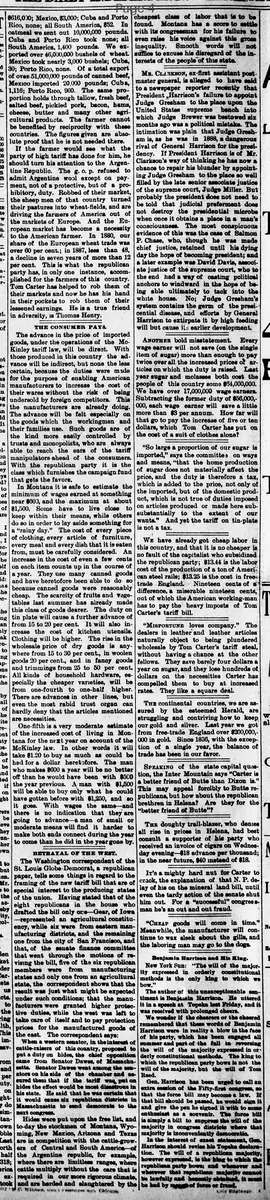
BETRAYAL OF THE WEST.
The Washington correspondent of the St. Louis Globe-Democrat, a republican paper, tells some things in regard to the framing of the new tariff bill that are of special interest to the producing states of the union. Having stated that of the eight republicans in the house who drafted the bill only one--Gear, of Iowa--represented an agricultural constituency, while six were from eastern manufacturing districts, and the remaining one from the city of San Francisco, and that, of the senate finance committee that went through the motions of revising the bill, five of the six republican members were from manufacturing states and only one from an agricultural state, the correspondent shows that the result was just what might be expected under such conditions; that the manufacturers were granted higher protective duties, while the west was left to take care of itself and to pay protection prices for the manufactured goods of the east. The correspondent says:
When a western senator, in the interest of cattle-raisers of this country, proposed to put a duty on hides, the chief opposition came from Senator Dawes, of Massachusetts. Senator Dawes went among the senators on his side of the chamber and assured them that if the tariff was put on hides the effect would be most disastrous in his state. He said that he was certain that it would cause six republican districts in Massachusetts to send democrats to the next congress.
Hides were put upon the free list, and to-day the stockmen of Montana, Wyoming, New Mexico, Arizona and Texas are in competition with the cattle-growers of Central and South America--of the Argentine republic, for example, where there are limitless ranges, where cattle multiply without the care that is required in our more rigorous climate, and are herded and slaughtered by the cheapest class of labor that is to be found. Montana has a score to settle with its congressman for his failure to even raise his voice against this gross inequality. Smooth words will not suffice to excuse his disregard of the interests of the people of this state.
The Washington correspondent of the St. Louis Globe-Democrat, a republican paper, tells some things in regard to the framing of the new tariff bill that are of special interest to the producing states of the union. Having stated that of the eight republicans in the house who drafted the bill only one--Gear, of Iowa--represented an agricultural constituency, while six were from eastern manufacturing districts, and the remaining one from the city of San Francisco, and that, of the senate finance committee that went through the motions of revising the bill, five of the six republican members were from manufacturing states and only one from an agricultural state, the correspondent shows that the result was just what might be expected under such conditions; that the manufacturers were granted higher protective duties, while the west was left to take care of itself and to pay protection prices for the manufactured goods of the east. The correspondent says:
When a western senator, in the interest of cattle-raisers of this country, proposed to put a duty on hides, the chief opposition came from Senator Dawes, of Massachusetts. Senator Dawes went among the senators on his side of the chamber and assured them that if the tariff was put on hides the effect would be most disastrous in his state. He said that he was certain that it would cause six republican districts in Massachusetts to send democrats to the next congress.
Hides were put upon the free list, and to-day the stockmen of Montana, Wyoming, New Mexico, Arizona and Texas are in competition with the cattle-growers of Central and South America--of the Argentine republic, for example, where there are limitless ranges, where cattle multiply without the care that is required in our more rigorous climate, and are herded and slaughtered by the cheapest class of labor that is to be found. Montana has a score to settle with its congressman for his failure to even raise his voice against this gross inequality. Smooth words will not suffice to excuse his disregard of the interests of the people of this state.
What sub-type of article is it?
Economic Policy
Agriculture
What keywords are associated?
Tariff Bill
Protectionism
Hides Duty
Western Betrayal
Cattle Raisers
Senator Dawes
Manufacturing Interests
What entities or persons were involved?
Senator Dawes
Gear Of Iowa
Republican House Committee
Senate Finance Committee
St. Louis Globe Democrat Correspondent
Montana Congressman
Editorial Details
Primary Topic
Criticism Of Republican Tariff Bill Favoring Eastern Manufacturers Over Western Producers
Stance / Tone
Strongly Critical Of Republican Policy Betraying Western Interests
Key Figures
Senator Dawes
Gear Of Iowa
Republican House Committee
Senate Finance Committee
St. Louis Globe Democrat Correspondent
Montana Congressman
Key Arguments
Drafting Committee Dominated By Representatives From Manufacturing Districts
Senate Finance Committee Mostly From Manufacturing States
Higher Protective Duties Granted To Manufacturers
Western States Left To Pay Protection Prices
Duty On Hides Opposed By Senator Dawes To Protect Massachusetts Districts
Hides Placed On Free List Harming Western Cattle Raisers
Western Stockmen Compete With Cheaper South American Producers
Montana Congressman Failed To Oppose The Inequality