Thank you for visiting SNEWPapers!
Sign up free
Story
September 10, 1915
The Dolores Star
Dolores, Montezuma County, Colorado
What is this article about?
National forest service foresters use acetylene signal lanterns to send Morse code messages visible up to 19 miles with binoculars. The lantern produces gas from carbide and water, allowing controlled flame flashes for dots and dashes.
Clipping
OCR Quality
95%
Excellent
Full Text
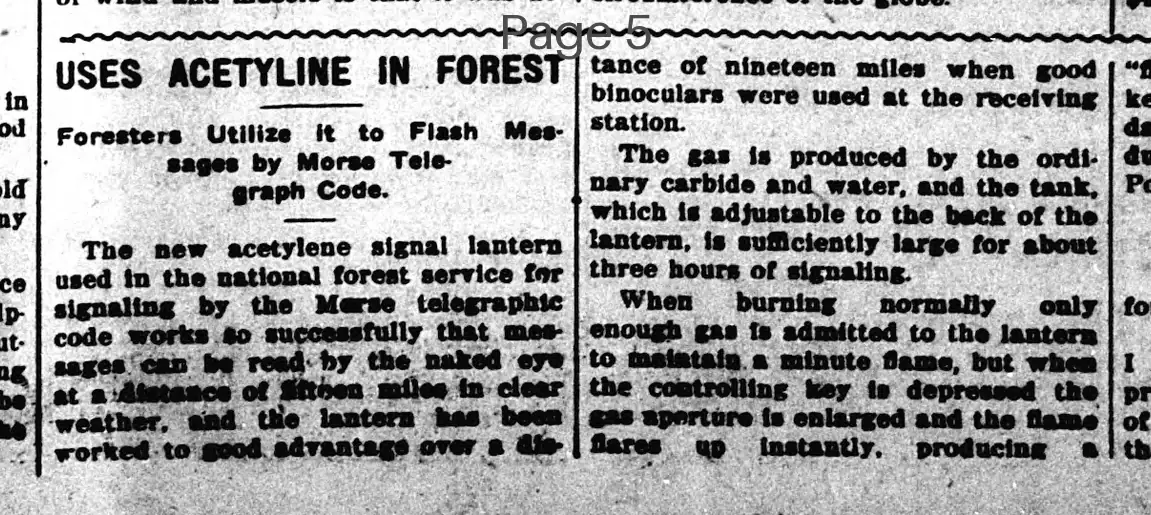
USES ACETYLENE IN FOREST
Foresters Utilize it to Flash Messages by Morse Telegraph Code.
The new acetylene signal lantern used in the national forest service for signaling by the Morse telegraphic code works so successfully that messages can be read by the naked eye at a distance of nineteen miles when good binoculars were used at the receiving station.
The gas is produced by the ordinary carbide and water, and the tank which is adjustable to the back of the lantern, is sufficiently large for about three hours of signaling.
When burning normally only enough gas is admitted to the lantern to maintain a minute flame, but when the controlling key is depressed the gas aperture is enlarged and the flame flares up instantly, producing a dash, which continues so long as the key is kept depressed. The dots and dashes of the Morse code are thus produced by manipulation of the key.
Foresters Utilize it to Flash Messages by Morse Telegraph Code.
The new acetylene signal lantern used in the national forest service for signaling by the Morse telegraphic code works so successfully that messages can be read by the naked eye at a distance of nineteen miles when good binoculars were used at the receiving station.
The gas is produced by the ordinary carbide and water, and the tank which is adjustable to the back of the lantern, is sufficiently large for about three hours of signaling.
When burning normally only enough gas is admitted to the lantern to maintain a minute flame, but when the controlling key is depressed the gas aperture is enlarged and the flame flares up instantly, producing a dash, which continues so long as the key is kept depressed. The dots and dashes of the Morse code are thus produced by manipulation of the key.
What sub-type of article is it?
Curiosity
Extraordinary Event
What themes does it cover?
Exploration
Triumph
What keywords are associated?
Acetylene Lantern
Morse Code Signaling
National Forest Service
Forest Communication
Long Distance Messaging
Where did it happen?
National Forests
Story Details
Location
National Forests
Story Details
Foresters in the national forest service use a new acetylene signal lantern to transmit Morse code messages visible up to nineteen miles with binoculars. The lantern generates gas from carbide and water, with a controllable flame for dots and dashes via a key.