Thank you for visiting SNEWPapers!
Sign up free
Literary
November 21, 1789
Gazette Of The United States
New York, New York County, New York
What is this article about?
In Letter XII from Amsterdam dated October 17, 1780, John Adams explains the dire financial state of the American colonies at the start of the Revolutionary War, the issuance of depreciating paper money as bills of credit, absence of steady import/export duties, and reliance on annual legislative grants from taxes on polls and estates, which have increased yearly to meet war demands.
Clipping
OCR Quality
98%
Excellent
Full Text
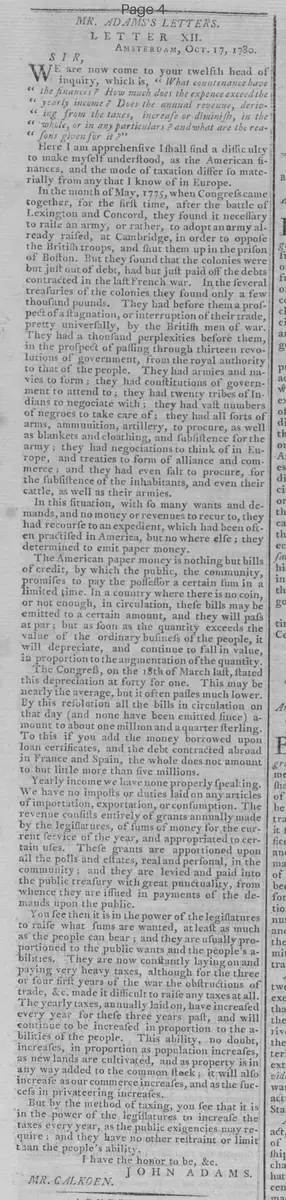
MR. ADAMS'S LETTERS.
LETTER XII.
Amsterdam, Oct. 17, 1780.
SIR,
WE are now come to your twelfth head of "the finances? How much does the expense exceed the yearly income? Does the annual revenue, deriving from the taxes, increase or diminish, in the whole, or in any particulars? and what are the reasons given for it?"
Here I am apprehensive I shall find a difficulty to make myself understood, as the American finances, and the mode of taxation differ so materially from any that I know of in Europe.
In the month of May, 1775, when Congress came together, for the first time, after the battle of Lexington and Concord, they found it necessary to raise an army, or rather, to adopt an army already raised, at Cambridge, in order to oppose the British troops, and shut them up in the prison of Boston. But they found that the colonies were but just out of debt, had but just paid off the debts contracted in the last French war. In the several treasuries of the colonies they found only a few thousand pounds. They had before them a prospect of a stagnation, or interruption of their trade, pretty universally, by the British men of war.
They had a thousand perplexities before them, in the prospect of passing through thirteen revolutions of government, from the royal authority to that of the people. They had armies and navies to form; they had constitutions of government to attend to; they had twenty tribes of Indians to negotiate with; they had vast numbers of negroes to take care of; they had all sorts of arms, ammunition, artillery, to procure, as well as blankets and clothing, and subsistence for the army; they had negotiations to think of in Europe, and treaties to form of alliance and commerce; and they had even salt to procure, for the subsistence of the inhabitants, and even their cattle, as well as their armies.
In this situation, with so many wants and demands, and no money or revenues to recur to, they had recourse to an expedient, which had been often practised in America, but no where else; they determined to emit paper money.
The American paper money is nothing but bills of credit, by which the public, the community, promises to pay the possessor a certain sum in a limited time. In a country where there is no coin, or not enough, in circulation, these bills may be emitted to a certain amount, and they will pass at par; but as soon as the quantity exceeds the value of the ordinary business of the people, it will depreciate, and continue to fall in value, in proportion to the augmentation of the quantity.
The Congress, on the 18th of March last, stated this depreciation at forty for one. This may be nearly the average, but it often falls much lower.
By this resolution all the bills in circulation on that day (and none have been emitted since) amount to about one million and a quarter sterling.
To this if you add the money borrowed upon loan certificates, and the debt contracted abroad in France and Spain, the whole does not amount to but little more than five millions.
Yearly income we have none properly speaking. We have no imposts or duties laid on any articles of importation, exportation, or consumption. The revenue consists entirely of grants annually made by the legislatures, of sums of money for the current service of the year, and appropriated to certain uses. These grants are apportioned upon all the polls and estates, real and personal, in the community; and they are levied and paid into the public treasury with great punctuality, from whence they are issued in payments of the demands upon the public.
You see then it is in the power of the legislatures to raise what sums are wanted, at least as much as the people can bear; and they are usually proportioned to the public wants and the people's abilities. They are now constantly laying on and paying very heavy taxes, although for the three or four first years of the war the obstructions of trade, &c. made it difficult to raise any taxes at all.
The yearly taxes, annually laid on, have increased every year for these three years past, and will continue to be increased in proportion to the abilities of the people. This ability, no doubt, increases, in proportion as population increases, as new lands are cultivated, and as property is in any way added to the common stock; it will also increase as our commerce increases, and as the successes in privateering increase.
But by the method of taxing, you see that it is in the power of the legislatures to increase the taxes every year, as the public exigencies may require; and they have no other restraint or limit than the people's ability.
I have the honor to be, &c.
JOHN ADAMS.
MR. GALKOEN.
LETTER XII.
Amsterdam, Oct. 17, 1780.
SIR,
WE are now come to your twelfth head of "the finances? How much does the expense exceed the yearly income? Does the annual revenue, deriving from the taxes, increase or diminish, in the whole, or in any particulars? and what are the reasons given for it?"
Here I am apprehensive I shall find a difficulty to make myself understood, as the American finances, and the mode of taxation differ so materially from any that I know of in Europe.
In the month of May, 1775, when Congress came together, for the first time, after the battle of Lexington and Concord, they found it necessary to raise an army, or rather, to adopt an army already raised, at Cambridge, in order to oppose the British troops, and shut them up in the prison of Boston. But they found that the colonies were but just out of debt, had but just paid off the debts contracted in the last French war. In the several treasuries of the colonies they found only a few thousand pounds. They had before them a prospect of a stagnation, or interruption of their trade, pretty universally, by the British men of war.
They had a thousand perplexities before them, in the prospect of passing through thirteen revolutions of government, from the royal authority to that of the people. They had armies and navies to form; they had constitutions of government to attend to; they had twenty tribes of Indians to negotiate with; they had vast numbers of negroes to take care of; they had all sorts of arms, ammunition, artillery, to procure, as well as blankets and clothing, and subsistence for the army; they had negotiations to think of in Europe, and treaties to form of alliance and commerce; and they had even salt to procure, for the subsistence of the inhabitants, and even their cattle, as well as their armies.
In this situation, with so many wants and demands, and no money or revenues to recur to, they had recourse to an expedient, which had been often practised in America, but no where else; they determined to emit paper money.
The American paper money is nothing but bills of credit, by which the public, the community, promises to pay the possessor a certain sum in a limited time. In a country where there is no coin, or not enough, in circulation, these bills may be emitted to a certain amount, and they will pass at par; but as soon as the quantity exceeds the value of the ordinary business of the people, it will depreciate, and continue to fall in value, in proportion to the augmentation of the quantity.
The Congress, on the 18th of March last, stated this depreciation at forty for one. This may be nearly the average, but it often falls much lower.
By this resolution all the bills in circulation on that day (and none have been emitted since) amount to about one million and a quarter sterling.
To this if you add the money borrowed upon loan certificates, and the debt contracted abroad in France and Spain, the whole does not amount to but little more than five millions.
Yearly income we have none properly speaking. We have no imposts or duties laid on any articles of importation, exportation, or consumption. The revenue consists entirely of grants annually made by the legislatures, of sums of money for the current service of the year, and appropriated to certain uses. These grants are apportioned upon all the polls and estates, real and personal, in the community; and they are levied and paid into the public treasury with great punctuality, from whence they are issued in payments of the demands upon the public.
You see then it is in the power of the legislatures to raise what sums are wanted, at least as much as the people can bear; and they are usually proportioned to the public wants and the people's abilities. They are now constantly laying on and paying very heavy taxes, although for the three or four first years of the war the obstructions of trade, &c. made it difficult to raise any taxes at all.
The yearly taxes, annually laid on, have increased every year for these three years past, and will continue to be increased in proportion to the abilities of the people. This ability, no doubt, increases, in proportion as population increases, as new lands are cultivated, and as property is in any way added to the common stock; it will also increase as our commerce increases, and as the successes in privateering increase.
But by the method of taxing, you see that it is in the power of the legislatures to increase the taxes every year, as the public exigencies may require; and they have no other restraint or limit than the people's ability.
I have the honor to be, &c.
JOHN ADAMS.
MR. GALKOEN.
What sub-type of article is it?
Epistolary
Essay
What themes does it cover?
Political
Commerce Trade
Taxation Oppression
What keywords are associated?
American Finances
Paper Money
Bills Of Credit
Taxation
Revolutionary War
Congress
Legislatures
Depreciation
What entities or persons were involved?
John Adams.
Literary Details
Title
Letter Xii.
Author
John Adams.
Subject
On The State Of American Finances And Taxation During The Revolutionary War
Key Lines
We Are Now Come To Your Twelfth Head Of "The Finances? How Much Does The Expense Exceed The Yearly Income? Does The Annual Revenue, Deriving From The Taxes, Increase Or Diminish, In The Whole, Or In Any Particulars? And What Are The Reasons Given For It?"
They Determined To Emit Paper Money.
The American Paper Money Is Nothing But Bills Of Credit, By Which The Public, The Community, Promises To Pay The Possessor A Certain Sum In A Limited Time.
Yearly Income We Have None Properly Speaking. We Have No Imposts Or Duties Laid On Any Articles Of Importation, Exportation, Or Consumption.
The Yearly Taxes, Annually Laid On, Have Increased Every Year For These Three Years Past, And Will Continue To Be Increased In Proportion To The Abilities Of The People.