Thank you for visiting SNEWPapers!
Sign up free
The Hillsborough Recorder
Hillsboro, Orange County, North Carolina
What is this article about?
In the Virginia House of Delegates on the 29th ultimo, Mr. Garland offered resolutions supporting the 1836 Treasury Order for gold and silver payments, which were laid on the table after debate. Mr. Botts then submitted counter-resolutions censuring Andrew Jackson, also laid on the table.
Clipping
OCR Quality
Full Text
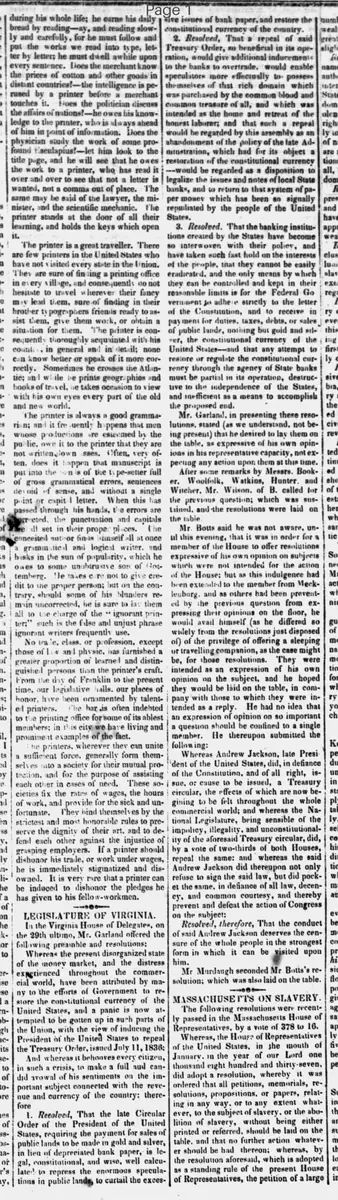
In the Virginia House of Delegates, on the 29th ultimo, Mr. Garland offered the following preamble and resolutions:
Whereas the present disorganized state of the money market, and the distress experienced throughout the commercial world, have been attributed by many to the efforts of Government to restore the constitutional currency of the United States, and a panic is now attempted to be gotten up in such parts of the Union, with the view of inducing the President of the United States to repeal the Treasury Order, issued July 11, 1836:
And whereas it behooves every citizen, in such a crisis, to make a full and candid avowal of his sentiments on the important subject connected with the revenue and currency of the country: therefore
1. Resolved, That the late Circular Order of the President of the United States, requiring the payment for sales of public lands to be made in gold and silver, in lieu of depreciated bank paper, is legal, constitutional, and wise, well calculated to repress the enormous speculations in public lands, to curtail the excessive issues of bank paper, and restore the constitutional currency of the country.
2. Resolved, That a repeal of said Treasury Order, so beneficial in its operation, would give additional inducements to the banks to overtrade, would enable speculators more effectually to possess themselves of that rich domain which was purchased by the common blood and common treasure of all, and which was intended as the home and retreat of the honest laborer; and that such a repeal would be regarded by this assembly as an abandonment of the policy of the late Administration, which had for its object a restoration of the constitutional currency—would be regarded as a disposition to legalize the issues and notes of local State banks, and to return to that system of paper money which has been so signally repudiated by the people of the United States.
3. Resolved, That the banking institutions created by the States have become so interwoven with their policy, and have taken such fast hold on the interests of the people, that they cannot be easily eradicated, and the only means by which they can be controlled and kept in their reasonable limits is for the Federal Government to adhere strictly to the letter of the Constitution, and to receive in payment for duties, taxes, debts, or sales of public lands, nothing but gold and silver, the constitutional currency of the United States—and that any attempt to restore or regulate the constitutional currency through the agency of State banks must be partial in its operation, destructive to the independence of the States, and inefficient as a means to accomplish the proposed end.
Mr. Garland, in presenting these resolutions, stated (as we understand, not being present) that he desired to lay them on the table, as expressive of his own opinions in his representative capacity, not expecting any action upon them at this time.
After some remarks by Messrs. Booker, Woolfolk, Watkins, Hunter, and Witcher, Mr. Wilson, of B., called for the previous question; which was sustained, and the resolutions were laid on the table.
Mr. Botts said he was not aware, until this evening, that it was in order for a member of the House to offer resolutions expressive of his own opinion on subjects which were not intended for the action of the House: but as this indulgence had been extended to the member from Mecklenburg, and as others had been prevented by the previous question from expressing their opinions on the floor, he would avail himself (as he differed so wholly from the resolutions just disposed of) of the privilege of offering a sleeping or travelling companion, as the case might be, for those resolutions. They were intended as an expression of his own opinion on the subject, and he hoped they would be laid on the table, in company with those to which they were intended as a reply. He had no idea that an expression of opinion on so important a question should be confined to a single member. He thereupon submitted the following:
Whereas Andrew Jackson, late President of the United States, did, in defiance of the Constitution, and of all right, issue, or cause to be issued, a Treasury circular, the effects of which are now beginning to be felt throughout the whole commercial world; and whereas the National legislature, being sensible of the impolicy, illegality, and unconstitutionality of the aforesaid Treasury circular, did, by a vote of two-thirds of both Houses, repeal the same: and whereas the said Andrew Jackson did thereupon not only refuse to sign the said law, but did pocket the same, in defiance of all law, decency, and common courtesy, and thereby prevent and defeat the action of Congress on the subject:
Resolved, therefore, That the conduct of said Andrew Jackson deserves the censure of the whole people in the strongest form in which it can be visited upon him.
Mr. Murdaugh seconded Mr. Botts's resolution; which was also laid on the table.
What sub-type of article is it?
What keywords are associated?
What entities or persons were involved?
Where did it happen?
Domestic News Details
Primary Location
Virginia
Event Date
29th Ultimo
Key Persons
Outcome
both sets of resolutions were laid on the table without further action.
Event Details
Mr. Garland offered resolutions supporting the Treasury Order of July 11, 1836, requiring gold and silver for public land sales, praising it as constitutional and aimed at curbing speculation and restoring currency. After debate, they were laid on the table. Mr. Botts then offered counter-resolutions censuring Andrew Jackson for issuing the order unconstitutionally and pocket-vetoing its repeal, which were seconded by Mr. Murdaugh and also laid on the table.